
Notice Change in 6–8 Weeks: Clinician Backed Burnout Therapy for UK
Discover how a structured three-stage therapeutic approach using CBT and mindfulness can effectively manage burnout and lead to recovery within eight weeks.

Clinically reviewed by
Dr Martina Paglia
Founder & CEO of Mind a Porter
HCPC-registered Clinical Psychologist
Special interests include anxiety, depression, trauma, OCD, burnout, workplace stress, relationship difficulties and high-performance mental wellbeing.
Last reviewed: 7 November 2026
All health information on Mind a Porter is clinically reviewed by our clinical lead. These resources are educational and do not replace professional advice.
Yes, therapy helps with burnout, and the evidence points most clearly towards cognitive behavioural therapy (CBT) and mindfulness-based approaches. These work best inside a staged pathway: stabilise the basics, do the active therapeutic work, then focus on preventing relapse. If you want to start straight away, a matching service such as Mind a Porter can connect you to a therapist for a low-cost discovery call.
TL;DR:
- Effective burnout therapy typically requires a staged approach: stabilizing sleep and basic needs before engaging in active therapy or workplace changes.
- CBT and mindfulness-based interventions show the strongest evidence, with moderate-to-large effects observed within six to eight weeks of consistent practice.
- Personalization and engagement are crucial for digital CBT programs, which work best as supplementary tools rather than standalone solutions for moderate to severe burnout.
- Recovery timelines vary widely, from one to three months for mild burnout to several months or years for severe cases with underlying trauma or organizational issues.
- Matching with a therapist who understands occupational stress and tailoring the modality to your specific burnout drivers improves therapy effectiveness and sustainability.
Table of Contents
- Which therapies are used for burnout and how they differ
- What the research says: evidence summary and effectiveness
- A staged treatment pathway: stabilise, then treat, then prevent relapse
- What to expect in therapy and how to prepare
- How to choose a therapist for burnout
- Common mistakes and realistic recovery: a clinical perspective
- How Mind a Porter can help you start therapy for burnout
- Sources
- FAQ
Which therapies are used for burnout and how they differ
Burnout is not a single condition with one fix, so the therapy that works for one person can miss the mark for another. The right choice depends on what is actually driving the exhaustion: an unmanageable workload, perfectionism, unresolved trauma, or a mismatch between your values and your job. Clinicians typically build a formulation first, a working theory of what is maintaining the burnout, before choosing a modality.
Cognitive behavioural therapy (CBT) is the most researched option. It identifies the thought patterns and behaviours that keep exhaustion going, such as all-or-nothing thinking about workload or an inability to say no, and replaces them with more workable alternatives. Sessions usually combine structured formulation with homework, gradually rebuilding activity levels through behavioural activation. Psychology Tools' clinical overview notes that CBT programmes for burnout typically take several weeks before people notice meaningful shifts.

Mindfulness-Based Stress Reduction (MBSR) and Mindfulness-Based Cognitive Therapy (MBCT) train attention and reduce the automatic stress reactivity that keeps the body stuck in fight-or-flight. Rather than challenging thoughts directly, these programmes teach you to notice a stress response early and respond deliberately instead of reactively.
Acceptance and Commitment Therapy (ACT), a "third-wave" CBT approach, focuses less on changing thoughts and more on changing your relationship to them. It suits people whose burnout is tangled up with a loss of meaning or direction at work, since ACT explicitly works on values and psychological flexibility rather than symptom suppression alone.
Compassion-Focused Therapy (CFT) targets the harsh self-criticism that often accompanies burnout, particularly in high-achieving or caregiving professions. It is worth prioritising when shame or self-blame is fuelling the exhaustion rather than external workload alone.
EMDR (Eye Movement Desensitisation and Reprocessing) and psychodynamic therapy come into play when burnout is entangled with earlier trauma or long-standing relational patterns, for instance when a person's inability to set boundaries traces back to childhood dynamics rather than current circumstances.
Delivery format matters too:
- Individual therapy suits complex or trauma-linked presentations where privacy and pacing matter.
- Group therapy can reduce isolation and normalise the experience, particularly for occupational burnout shared across a team.
- Digital and app-based CBT modules offer convenience for mild to moderate cases, though outcomes depend heavily on whether the person actually engages with the material.
What the research says: evidence summary and effectiveness
CBT and mindfulness-based interventions carry the strongest weight of evidence for burnout, with multiple systematic reviews confirming reductions in emotional exhaustion and improved stress management, typically within six to eight weeks of consistent practice.
What the numbers show: A 2025 systematic review and meta-analysis of third-wave CBT for healthcare professionals recorded a standardised mean difference (SMD) of −0.686 for emotional exhaustion and −0.529 for depersonalisation. Both figures represent moderate-to-large effects, meaning the improvement is unlikely to be down to chance or placebo alone.
That same body of research is more cautious about personal accomplishment, the third classic burnout dimension alongside exhaustion and depersonalisation. Third-wave CBT moves exhaustion and cynicism, but restoring a sense of accomplishment appears more closely tied to organisational change than to individual therapy alone, which is an uncomfortable but important limit on what therapy can do on its own.
An umbrella review of psychotherapeutic burnout interventions reinforces the pattern: CBT, MBSR, ACT, and rational-emotive approaches each show repeated benefit across separate studies. The same review flags a real evidence gap, though: much of this research focuses on doctors, nurses, and teachers, so how well it generalises to other occupations or to burnout outside a formal job (parental burnout, for example) is less established.
Digital delivery adds a further wrinkle. A mixed-methods trial of an AI-selected mobile CBT intervention for nurse burnout found small-to-moderate effects over four to six weeks, but only when tailoring and engagement held up. In practice, this means:
- Digital CBT can work as a bridge or adjunct, not usually as a standalone fix for moderate to severe burnout.
- Effect sizes shrink quickly when people stop engaging with the app or programme.
- Personalisation (matching content to the person's specific stressors) outperforms generic, one-size-fits-all modules.
The consistent thread across this research is that individual therapy changes how a person thinks, feels, and copes, but durable recovery usually also requires something at the organisational level to change too.
A staged treatment pathway: stabilise, then treat, then prevent relapse
Recovery from burnout rarely works as a straight line from "exhausted" to "fine." Clinicians generally recommend three overlapping stages, and skipping the first one is the most common reason therapy stalls.
- Stabilise. Before deep psychological work can land, the basics need shoring up: sleep, nutrition, and any safety concerns come first. This stage often includes short-term behavioural changes, temporarily reducing non-essential commitments, and leaning on immediate practical support from family, friends, or a GP.
- Active therapy. Once the person can concentrate and engage, the focus shifts to skills that restore functioning: cognitive restructuring in CBT, values work in ACT, or self-compassion practices in CFT. If trauma or long-standing patterns surface during this stage, deeper exploratory work (psychodynamic therapy or EMDR) may follow.
- Prevent relapse. This is where workplace factors have to be addressed directly, boundary setting, workload renegotiation, and, where necessary, formal involvement of occupational health or HR. Therapy alone rarely holds if the working conditions that caused the burnout remain unchanged.
Timelines vary enormously by severity. Mild burnout, caught early and paired with reduced stressors, can improve within one to three months. Moderate burnout typically takes three to twelve months of sustained work. Severe burnout, particularly where depression or long-term sick leave is involved, can take considerably longer, sometimes years, and clinicians stress that this variation is normal rather than a sign that therapy has failed.
Pro Tip: If you notice therapy isn't "working" in the first two or three sessions, check whether stabilisation has actually happened first. Skills-based CBT struggles to stick when someone is still running on four hours of sleep a night.
What to expect in therapy and how to prepare
A first session usually opens with an assessment: current symptoms, sleep and appetite, workload, relationships, and any history of anxiety, depression, or earlier stressful events. From there, the therapist builds a formulation, essentially a shared explanation of why burnout developed and what is keeping it going, which then shapes the treatment plan.
Most therapy runs weekly to begin with, often with homework between sessions (a thought record in CBT, or a brief mindfulness practice). Clinicians frequently track progress using standardised measures of exhaustion, cynicism, and functioning, so you should expect some form of structured check-in rather than a purely conversational approach.
There is a meaningful difference between short-term, skills-based work and longer exploratory therapy:
- Skills-based CBT or ACT programmes tend to run for a defined number of sessions with a specific goal, restoring sleep, reducing avoidance, or rebuilding a daily structure.
- Exploratory therapy (psychodynamic work, or EMDR for trauma-linked patterns) has a longer, less fixed timeline because it works through underlying material rather than symptoms alone.
Escalate immediately if you experience suicidal thoughts, an inability to function day to day, or thoughts of self-harm. In the UK, Samaritans (116 123, free, 24 hours) and your GP are the first points of contact for a crisis, and any therapist worth choosing will have a clear protocol for this.
How to choose a therapist for burnout
The right therapist match matters more for burnout than for many other presentations, because the wrong fit (a therapist unfamiliar with occupational stress, for instance) can waste weeks. A few questions are worth asking before you commit to a first full session:
- Have you worked with burnout specifically, or mainly with generalised anxiety and depression?
- Which modality do you use most, and why would it suit my situation?
- Do you track progress with any structured measures, or is it purely conversational?
- What are your fees, and do you work with my insurer if I have one?
- Do you offer remote sessions, and how flexible is scheduling around a demanding job?
Match the approach to your presentation rather than picking at random. Short-term CBT suits straightforward stabilisation and workload-driven exhaustion. ACT or CFT fit better when meaning, values, or harsh self-criticism are central. EMDR is worth raising specifically if you notice your burnout patterns trace back to earlier trauma rather than current stress alone.
Practicalities count too: waiting times, cost, language and cultural fit, and cancellation policies all affect whether therapy is sustainable over months rather than weeks. This is precisely where a matching platform earns its keep, reducing the weeks of searching that often precede the first useful session.
Pro Tip: Ask any prospective therapist what "good progress" would look like by session six. A vague answer is a warning sign; a specific one tells you they have a plan.
Common mistakes and realistic recovery: a clinical perspective
Rest alone rarely resolves burnout. People take a holiday, feel briefly better, and return to the same conditions, then wonder why the exhaustion comes straight back. Medication, where prescribed, can help mood or sleep, but it is not a substitute for the skills and workplace changes that address the underlying pattern.
The staged approach exists precisely because skipping ahead fails so often. I have seen the same sequence repeatedly in clinical practice: someone tries to start deep exploratory work on old wounds before their sleep and workload are stabilised, and the therapy stalls, not because the approach was wrong, but because the timing was.
Progress is rarely linear. Expect good weeks and setback weeks, and treat a setback as data, not failure.
How Mind a Porter can help you start therapy for burnout
Finding the right therapist usually takes longer than the therapy itself needs to. A matching service can connect you to qualified therapists across multiple languages, filtered by specialism, cultural fit, and availability, so you are not stuck waiting weeks for a first appointment.
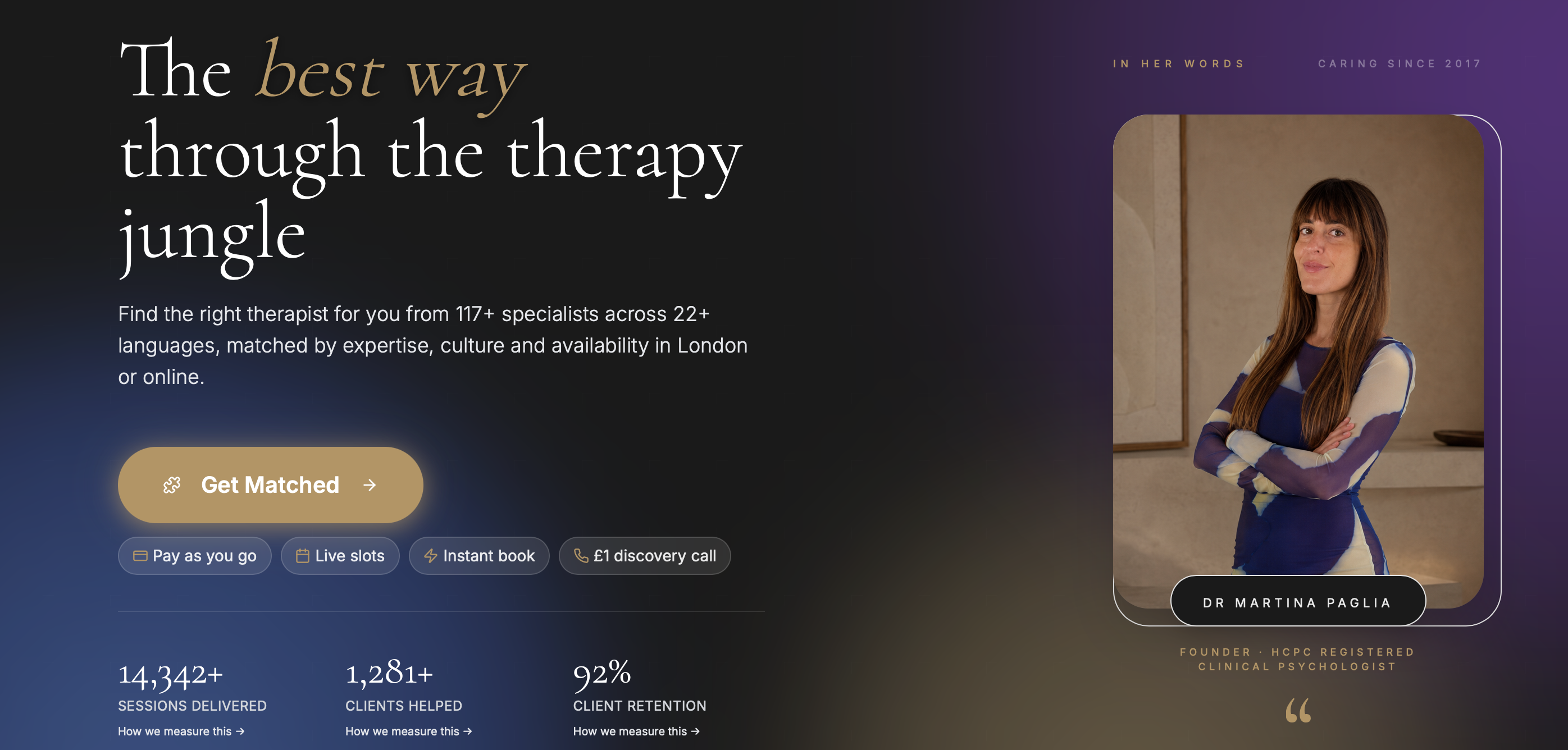
Where burnout treatment often stalls is the gap between deciding to get help and actually finding someone suitable. Mind a Porter's discovery call costs £1 and gives you a short, low-pressure conversation to establish what you actually need, whether that is CBT for stabilisation, ACT for values work, or EMDR if past events are part of the picture. Sessions are available both online and in person, and the platform covers individual therapy, couples counselling, and a range of modalities including CBT and EMDR. Book a discovery call and describe your symptoms and work situation honestly; that single conversation usually determines which of the approaches covered in this article fits you best.
FAQ
What type of therapy is best for burnout?
CBT and mindfulness-based approaches (MBSR, MBCT) have the strongest evidence base for reducing emotional exhaustion. The best individual choice still depends on your specific triggers, so ACT, CFT, or EMDR may suit better if meaning, self-criticism, or past trauma are driving the burnout.
What is the 42% rule for burnout?
This is not a recognised clinical framework, and definitions of it vary widely online with no consistent source. Rather than relying on an unverified rule, focus on the staged pathway covered above: stabilise, treat, then prevent relapse.
What are the seven signs of burnout?
Commonly cited signs include persistent exhaustion, cynicism or detachment from work, reduced sense of accomplishment, sleep disruption, irritability, difficulty concentrating, and physical symptoms such as headaches or gut problems. Not everyone experiences all seven, and the mix varies by person.
What is the quickest way to recover from burnout?
There is no shortcut that bypasses stabilisation first, sleep, reduced immediate demands, and safety, before active therapy can take hold. Mild burnout can improve within one to three months once stressors are reduced, but moderate and severe presentations generally need sustained CBT or mindfulness-based therapy over several months.
How quickly does therapy for burnout typically work?
Many people notice meaningful improvement within six to eight weeks of consistent CBT or mindfulness-based work. Full recovery timelines depend on severity, ranging from one to three months for mild cases to considerably longer for severe or long-standing burnout.
Next Step
Reading is a start. Talking is the next step.
Tell us what you are looking for and we will match you with a qualified therapist who fits. Online across the UK, or in person in London.
Professional Support
Find the Right Therapy
Explore specialist treatment options related to this article.
Keep Reading
Related Articles

Reasonable Adjustments at Work for Mental Health
A plain guide to reasonable adjustments for mental health at work in the UK, covering what the law requires, which changes actually help, and how to ask without disclosing a diagnosis.

Access to Work: Funding Mental Health Support at Work
Access to Work is a government grant that can fund practical support, coaching and adjustments for mental health conditions. Here's what it covers, who qualifies, what the assessment involves, and how to combine it with therapy.

Redundancy and Your Mental Health: Getting Through It
Redundancy is rarely just about the job. Here's how to get through the consultation period, the money worry and the unsettling first weeks without work.