
Start Therapy This Week: W‑CBT for Work Stress in the UK
Discover how work-focused CBT can help you manage career-related stress and effectively navigate the UK healthcare system to access timely professional support.

Clinically reviewed by
Dr Martina Paglia
Founder & CEO of Mind a Porter
HCPC-registered Clinical and Performance Psychologist · BSc, MSc, MA (Dist.), CP Licensure, MBA
Special interests include anxiety, depression, trauma, OCD, burnout, workplace stress, relationship difficulties and high-performance mental wellbeing.
Last reviewed: 25 September 2026
Therapy can genuinely reduce work-related stress, and work-focused CBT (W‑CBT) tends to work best when the goal is getting back to functioning normally at your job. Start with whichever route is fastest for you: your GP, your employer's EAP, an IAPT service, or a £1 discovery call through Mind a Porter. NICE and HSE data both back early action over waiting it out.
TL;DR:
- Work-focused CBT has been shown to facilitate return to work about four weeks earlier than standard CBT, especially when integrated directly into the workplace.
- Persistent work-related stress signs include ongoing anxiety, concentration issues, physical symptoms like fatigue, and behavioral changes such as withdrawal or absenteeism over several weeks.
- Immediate professional support is necessary if thoughts of self-harm or severe functional impairment occur; otherwise, mild to moderate symptoms can often be managed through self-help or GP referral.
- Choosing a therapist involves verifying accreditation, experience in work stress, and whether they use work-focused CBT, with same-day, multiple-language options available through platforms like Mind a Porter.
- While therapy addresses individual symptoms, reducing workplace stress also requires organizational changes, such as workload adjustments and better managerial support.
Table of Contents
- What are the signs of work-related stress?
- How does therapy for work stress actually work?
- Which therapy option fits your situation?
- What can you do today to reduce work stress?
- When should you see a professional about work stress?
- How do you choose a therapist and what happens first?
- A clinician's take on realistic recovery from work stress
- Ready to start therapy for work stress?
- Sources
- FAQ
What are the signs of work-related stress?
Work stress rarely announces itself with one dramatic symptom. It builds across four areas, and recognising the pattern matters more than fixating on any single sign.
- Emotional: persistent anxiety, tearfulness, irritability with colleagues or family, a flat or numb mood on workdays
- Cognitive: trouble concentrating, forgetting routine tasks, replaying work problems at 3am, difficulty making decisions that used to feel easy
- Physical: ongoing tiredness, tension headaches, muscle pain, disrupted sleep, stomach problems with no other clear cause
- Behavioural: presenteeism (being at your desk but not really working), rising absenteeism, procrastination, drinking more, or withdrawing from people you'd normally talk to
A single bad week rarely needs professional input. What does is when these signs persist for several weeks, start affecting your relationships or your work performance, or when you notice yourself dreading a normal working day rather than just a difficult project.
The scale of this is not trivial. In 2024/25, the Health and Safety Executive estimated 964,000 workers reported work-related stress, depression or anxiety, with workload pressures and poor managerial support cited as common causes. If your experience matches that pattern, you are far from alone in it, and the numbers suggest workplaces themselves carry a large share of the responsibility, not just individual resilience.
How does therapy for work stress actually work?
Different therapies target different parts of the problem, and understanding the mechanism helps you pick the right one rather than the first one you find.
CBT works by identifying the thought patterns and behaviours that keep stress running on a loop (catastrophising about a missed deadline, avoiding a difficult conversation) and replacing them with more workable responses. ACT (Acceptance and Commitment Therapy) takes a different route: rather than fighting stressful thoughts, it helps you act on your values despite them. Mindfulness-based approaches train attention and reduce the physiological stress response through regular practice.
Work-focused CBT (W‑CBT) is the version built specifically for occupational stress. It adds structured elements to standard CBT:
- Graded return-to-work planning, building activity back up in stages rather than all at once
- Workplace problem-solving, tackling the specific triggers at your job rather than stress in the abstract
- Goal-setting tied to work performance, not just symptom reduction
- Behavioural experiments that test avoided situations, like re-entering a meeting you've been dreading
A systematic review of W‑CBT found it more effective than standard CBT at facilitating return to work, largely because it integrates workplace contact directly into the treatment plan rather than treating the job as background noise. Separate trial data backs this up: one randomised trial of a work-focused CBT intervention found patients returned to lasting work around four weeks earlier than those receiving standard care.
Pro Tip: Ask any therapist upfront whether they use a work-focused model. Standard CBT and W‑CBT sound similar but structure the sessions very differently, and it's a fair question to ask before you commit to six weeks of appointments.
Expect weekly sessions initially, homework between sessions (often a stress diary or a graded task list), and a course of somewhere between six and twelve sessions for most work-stress presentations, though this varies by severity and format.

Which therapy option fits your situation?
There is no single best therapy for work stress. The right choice depends on what you're dealing with, how much time you have, and who is paying.
- Work-focused CBT — best if your goal is returning to or staying in a specific role; strongest evidence for return-to-work outcomes
- Standard CBT — suits generalised anxiety or low mood connected to work, without a specific RTW goal
- ACT — useful if you're stuck fighting your thoughts about work rather than acting on what matters to you
- Mindfulness-based stress reduction — group or individual format, NICE-recognised for reducing job stress and symptoms
- Guided online CBT or self-help programmes — lower cost, flexible timing, often available through the NHS or employer schemes
- Counselling or psychotherapy — better suited to broader life stress that work has aggravated rather than caused
- EMDR — reserved for cases where a specific traumatic workplace incident (harassment, an accident, a serious dispute) sits behind the stress
Delivery format matters as much as the therapy type. Face-to-face sessions suit people who want structure and find video calls draining; online sessions remove travel time and widen your choice of therapist, particularly useful if you need someone who works in a specific language or specialism. Group formats, common for mindfulness-based programmes, cost less per person but offer less individual tailoring.
A review of online ACT-based interventions found modest but real reductions in stress and burnout, with partially guided programmes (a therapist checking in periodically) showing better adherence than fully self-directed ones.
Employers typically fund or commission:
- Employee Assistance Programmes (EAP), usually a handful of free sessions
- Occupational health referrals for W‑CBT or standard CBT
- Group mindfulness or stress-management training, as NICE recommends employers offer
Routes usually paid privately or accessed via the NHS include IAPT talking therapies, longer-term counselling, EMDR, and specialist assessments.
What can you do today to reduce work stress?
Therapy takes time to arrange. These steps work in the meantime, and some readers find they're enough on their own.
- Set an email boundary — pick a hard stop time and a "stop-work ritual" (closing the laptop, a short walk) that signals the working day has ended
- Negotiate workload explicitly — write down what's on your plate and ask your manager which three things matter most this week, rather than trying to do everything
- Use micro-recovery — a five-minute walk, three slow breaths before a difficult call, or stepping outside at lunch genuinely lowers physiological stress in the short term
- Protect sleep — a consistent wake time does more for next-day resilience than an extra hour in bed at the weekend
- Move and cut stimulants — regular activity and reducing caffeine or alcohol both improve baseline stress tolerance over a few weeks
Pro Tip: Before a conversation with your manager about workload, write down two or three specific, reasonable adjustments (not "less stress" but "no meetings before 10am" or "one deadline moved by a week"). Vague requests get vague responses.
If these steps bring real relief within a few weeks, self-help may be enough. If symptoms persist despite genuinely trying them, or you notice functional impairment creeping into your personal life, that's the signal to move to professional support rather than pushing harder on the same techniques.
When should you see a professional about work stress?
Some signs need urgent attention rather than a wait-and-see approach. Any thoughts of suicide or self-harm, a sense you cannot cope safely, or severe functional impairment (unable to leave the house, unable to eat or sleep for days) mean contacting your GP urgently, calling 111, or going to A&E if there's immediate risk.
For everything short of that, a simple decision path helps:
- Mild to moderate stress, coping most days — start with your GP for a referral, self-refer to IAPT, or use your employer's EAP if one exists
- Moderate to severe stress, or it's affecting your job security — GP referral to occupational health, or book privately with a therapist who specialises in work-focused CBT
- A specific traumatic incident involved — ask specifically about EMDR-trained practitioners
Confidentiality is protected in all of these routes. You are not obliged to tell your employer you're in therapy, though occupational health referrals sometimes involve a report on functional capacity and recommended adjustments, always with your knowledge and, usually, your consent over what's shared.
How do you choose a therapist and what happens first?
Picking a therapist for work stress comes down to a short checklist rather than guesswork.
- Check accreditation: BACP, UKCP or HCPC registration confirms recognised training and ongoing supervision
- Ask about specialism in work stress or W‑CBT specifically, not just general anxiety
- Ask how many sessions they typically recommend for a case like yours, and their cancellation policy
- Confirm language and cultural fit if that matters to you, and check actual availability against your working hours
At booking, it's fair to ask directly: how much experience do you have with return-to-work planning, and would you involve my workplace at any point? A therapist who answers vaguely on this is worth a second look elsewhere.
Clients can be matched with qualified therapists across multiple languages, with no waiting list and same-day appointments available. A discovery call lets you check fit with a therapist experienced in work-focused approaches before committing to a full course, and the platform covers modalities including CBT and EMDR through its therapy services.
A clinician's take on realistic recovery from work stress
Therapy sets clear symptom and functional goals, and it usually gets people there. But recovery that holds needs the workplace to change too. A graded return-to-work plan built in therapy can unravel fast if the same unmanaged workload is waiting on the other side of it.
Treat individual therapy and workplace conversations as two halves of the same repair job, not sequential steps. The person who books a discovery call this week and also raises workload with their manager next week tends to do better than the one who treats therapy as the whole solution.
— Dr Martina Paglia
Ready to start therapy for work stress?
Waiting lists are usually the biggest barrier between deciding to get help and actually getting it, and that's precisely what Mind a Porter is built to remove. Rather than joining a queue for an available slot, you're matched to a qualified therapist based on your specialism needs, language and availability, with same-day appointments on offer.
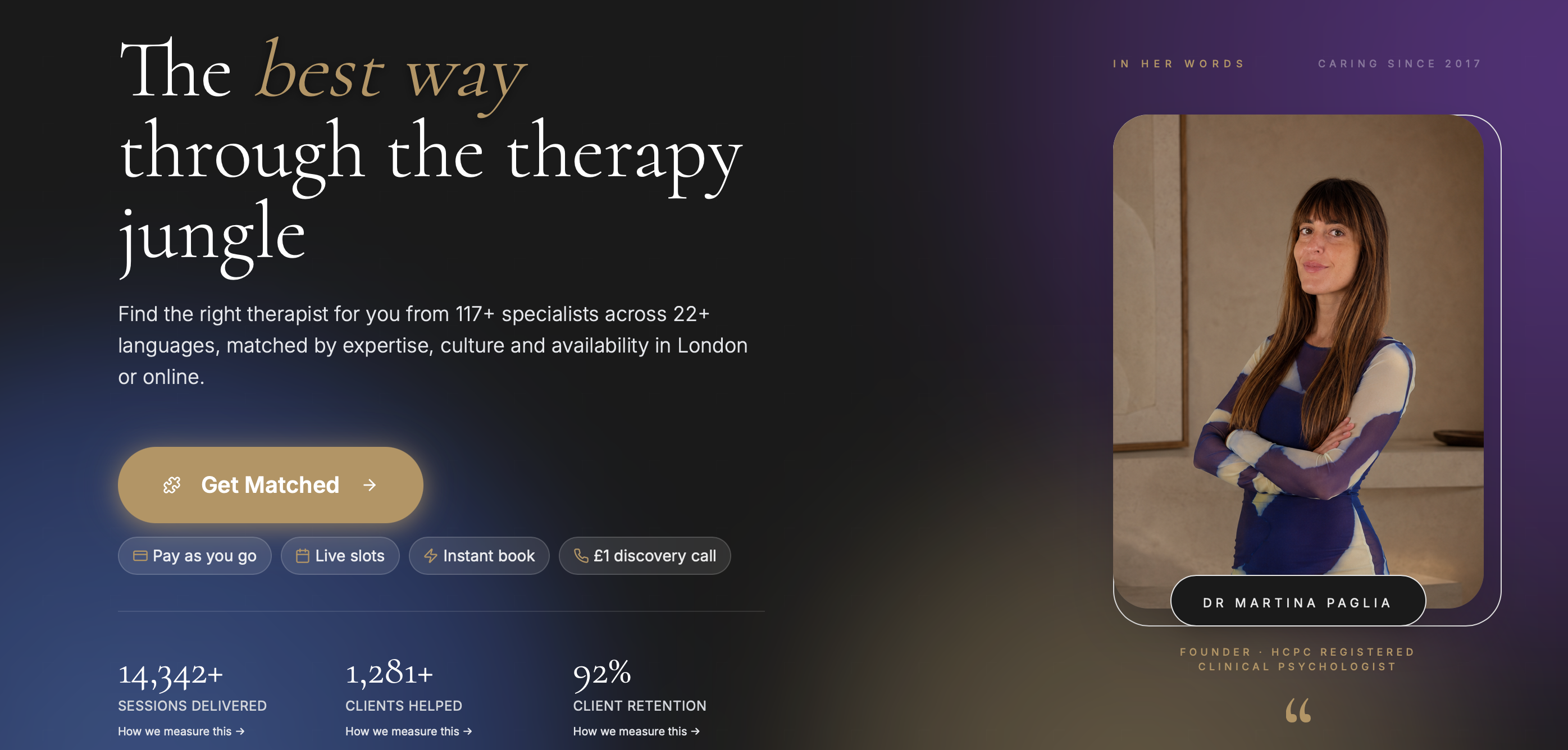
If your priority is returning to work with a structured plan, look for a therapist experienced in work-focused approaches through the services page, which lists CBT, EMDR and psychodynamic options alongside counselling and psychotherapy. If you'd rather test the fit first, book the £1 discovery call and see whether the approach and the therapist feel right before committing to a full course. Either way, you can be speaking to someone this week rather than in a few months' time.
Sources
- Work-focused cognitive behavioural therapy for common mental disorders: systematic review
- Work-related stress, depression or anxiety statistics (HSE)
This article is general information, not a substitute for advice from a qualified doctor. Consult a qualified healthcare professional about your own circumstances before acting on anything here.
FAQ
How do I let go of work stress once I've left the office?
A firm stop-work ritual helps: closing your laptop with a fixed phrase, changing clothes, or a short walk that marks the transition. Persistent inability to switch off, despite trying this, is often a sign that professional support such as work-focused CBT would help more than another self-help technique.
What is the 42% rule for burnout?
There is no clinically recognised "42% rule" for burnout; definitions of burnout thresholds vary between researchers and organisations. If you've seen this figure elsewhere, treat it as informal rather than an established diagnostic standard.
How can I cope with stress and anxiety at work?
Combine boundary-setting, workload negotiation and short daily recovery breaks with professional support if symptoms persist beyond a few weeks. NICE guidance recommends employers offer CBT, mindfulness training or stress-management support, so it's worth asking your employer what's already available before paying privately.
Why am I always stressed at work?
Persistent work stress usually traces back to a mismatch between demands and control, workload pressure, or a lack of managerial support, factors the HSE cites as leading causes among the 964,000 workers reporting work-related stress in 2024/25. If it's constant rather than tied to one bad project, a therapist can help identify the specific pattern driving it.
Does Mind a Porter offer therapy specifically for work stress?
Yes. Mind a Porter matches clients to therapists experienced in work-focused approaches, including CBT and EMDR, with same-day availability and no waiting list. Current pricing, including the £1 discovery call, is listed on the Mind a Porter site.
Keep Reading
Related Articles

5 Vetting Questions to Find ERP Care in the UK: ERP vs CBT for OCD
Learn how to distinguish specialized ERP from generic CBT and discover the five essential questions to ask when vetting an OCD therapist in the UK.

70% Symptom Free After EFT: Match Gottman vs EFT for UK Couples
Discover whether the emotional depth of EFT or the practical skill-building of the Gottman Method is the right therapeutic path for your relationship.

£40–£250: Private Therapy Cost in England, Book Fast Via Mind a Porter
Navigate the private therapy market in England by understanding session pricing, cost-saving strategies, and the trade-offs between public and private care.