
Burnout vs depression: how to tell them apart
Learn the vital distinctions between work-related burnout and clinical depression, including how to identify symptoms and when to seek professional support.

Clinically reviewed by
Dr Martina Paglia
Founder & CEO of Mind a Porter
HCPC-registered Clinical Psychologist
Special interests include anxiety, depression, trauma, OCD, burnout, workplace stress, relationship difficulties and high-performance mental wellbeing.
Last reviewed: 7 November 2026
All health information on Mind a Porter is clinically reviewed by our clinical lead. These resources are educational and do not replace professional advice.
Burnout is an occupational phenomenon tied to chronic workplace stress. Depression is a clinical mood disorder that affects your whole life, not just your working hours. The two conditions share symptoms, and one can lead to the other, but they are not the same thing.
If you recognise any of the following, treat this as urgent and speak to a GP or crisis service today rather than finishing your self-assessment:
- Thoughts of suicide or self-harm
- A loss of pleasure or interest in almost everything, not just work
- Major functional loss: struggling to get out of bed, wash, or manage basic daily tasks
The World Health Organization classifies burnout separately from depression, and NHS guidance sets a clear diagnostic threshold for depressive episodes. If you need to talk to someone without delay, Mind a Porter offers immediate therapist matching with no waiting list, which can be a useful first step alongside, not instead of, medical care.
Key Takeaways
Burnout is a work-specific stress response that often eases with rest, while depression is a pervasive mood disorder requiring at least two weeks of persistent symptoms and clinical assessment.
| Point | Details |
|---|---|
| Different origins | Burnout stems from chronic workplace stress; depression is a clinical mood disorder affecting all of life. |
| Watch the internal dialogue | A shift from "I can't cope" to "I am worthless" can signal progression towards depression. |
| Rest test matters | Symptoms that ease with time away point to burnout; symptoms that persist regardless point to depression. |
| Suicidal thoughts are urgent | Any suicidal ideation needs immediate contact with a GP or crisis service, not a wait-and-see approach. |
| Get matched quickly | Mind a Porter offers immediate therapist matching with no waiting list, alongside CBT and EMDR, as one route into support. |
Table of Contents
- Burnout vs depression: what burnout actually means
- What clinical depression looks like
- Where the two conditions overlap
- Burnout vs depression: the differences that actually matter
- Can burnout turn into depression?
- Why guessing at the label isn't reliable
- What happens during a clinical assessment
- Treating burnout and depression: what actually helps
- Getting assessed and treated without a long wait
- Sources
Burnout vs depression: what burnout actually means
The WHO defines burnout in the ICD-11 as resulting specifically from chronic workplace stress that has not been successfully managed. It is not classified as a disease. Three dimensions define it:
- Exhaustion — a depleted, drained feeling that rest doesn't fully fix
- Mental distance or cynicism — growing detachment from your job, or a negative, cynical attitude towards colleagues and work itself
- Reduced professional efficacy — a creeping sense that you're no longer doing your job well, even if your output hasn't actually dropped
Overload, lack of control over your workload, and moral distress (being asked to act against your values) are the classic triggers. A hospital nurse forced to cut corners on patient care, or a manager given targets with no authority to meet them, are textbook burnout scenarios. The telltale pattern is that things get worse across the working week and ease off, at least partially, during time away.
Pro Tip: Track your symptoms across a weekend or a week's leave. If you feel meaningfully better after two or three days away from work, that's a strong pointer towards burnout rather than depression.
What clinical depression looks like
Depression carries a specific diagnostic threshold. NHS guidance states that a depressive episode requires symptoms to persist for at least two weeks, with either a persistently low mood or loss of interest and pleasure (anhedonia) present alongside several other symptoms.
Those associated features typically include:
- Disrupted sleep, either insomnia or sleeping far more than usual
- Appetite and weight changes in either direction
- Poor concentration and indecisiveness
- Psychomotor changes: feeling physically slowed down, or agitated and restless
- Excessive guilt or feelings of worthlessness
- Recurrent thoughts of death or suicide
Meeting this two-week threshold is only the starting point. A GP or mental health clinician needs to rule out physical causes and assess severity, because self-scoring against a symptom checklist cannot substitute for a proper clinical interview.
Where the two conditions overlap
Exhaustion, poor concentration, irritability, and disrupted sleep show up in both burnout and depression, which is exactly why the two get confused so often. Research examining the relationship finds a substantial correlation between the two constructs, but the meta-analytic evidence stops short of treating them as identical.
A useful clinical hint sits inside that overlap:
- If your symptoms lift noticeably away from work, burnout is more likely
- If low mood and loss of interest persist regardless of setting, whether it's a Tuesday at your desk or a Sunday with family, that points towards depression
- Genuine co-occurrence is common: chronic burnout can sit alongside a depressive episode at the same time
Burnout vs depression: the differences that actually matter
Once you're past the overlapping symptoms, five differences do most of the diagnostic work.
Scope of effect. Burnout tends to stay tethered to your job. You might feel drained and cynical about work while still enjoying an evening with friends or a weekend hobby. Depression bleeds into everything: relationships, hobbies, appetite, sleep, and how you see your future.

Anhedonia. A genuine loss of pleasure in things you used to enjoy, not just tiredness or lack of time for them, is a hallmark depressive symptom rather than a burnout one.
Guilt and self-worth. Commentary from The Conversation notes that burnout tends to centre on helplessness in the face of demands ("I can't cope with this workload"), while depression involves pervasive hopelessness and a diminished sense of self-worth ("I am worthless"). Watching for that shift in internal language, from feeling overloaded to feeling fundamentally inadequate, is a genuinely useful marker of possible progression towards depression.
Response to rest. Burnout usually eases, at least somewhat, with genuine time off, a change in workload, or a new job. Depression typically does not respond to rest alone. Someone with depression can return from two weeks of annual leave feeling just as low as before they left.
Suicidal ideation. This is the one that overrides every other consideration. Thoughts of suicide or self-harm point towards a clinical depressive episode requiring urgent assessment, not workplace burnout, and they need immediate professional attention regardless of what else is going on.
| Signal | More typical of burnout | More typical of depression |
|---|---|---|
| Scope | Confined mainly to work | Affects most areas of life |
| Pleasure | Retained outside work | Lost across the board (anhedonia) |
| Self-view | "I can't handle this workload" | "I am worthless" |
| Response to rest | Improves with time away | Persists regardless |
| Suicidal thoughts | Not a defining feature | Requires urgent clinical care |
Can burnout turn into depression?
Long-term, unaddressed burnout raises your risk of developing a major depressive episode. The mechanisms are physiological as much as psychological: chronically elevated stress hormones, sustained sleep disruption, and gradual social withdrawal from colleagues, friends, and family all compound over time.
- Chronic activation of the body's stress response wears down resilience rather than building it
- Poor sleep and reduced social contact are both independent risk factors for depression on their own
- If symptoms persist even after a genuine workplace change (fewer hours, a new role, a supportive manager), that's a signal to seek a proper clinical assessment rather than waiting it out
Why guessing at the label isn't reliable
Online quizzes and symptom checklists can't rule out physical causes that mimic both conditions. An underactive thyroid, anaemia, and vitamin D deficiency all produce fatigue, low mood, and poor concentration that look remarkably like burnout or depression on paper.
- Rule out physical causes first. A GP can order blood tests that a self-assessment never will.
- Treat certain signs as non-negotiable red flags. Suicidal thoughts, severe withdrawal from people you'd normally see, or a marked drop in your ability to function at work, at home, or socially all warrant contact with a professional promptly.
- Use the two-week and rest tests together. If symptoms have lasted more than two weeks, or haven't improved despite time away from work, book a GP appointment or speak to a mental health professional.
What happens during a clinical assessment
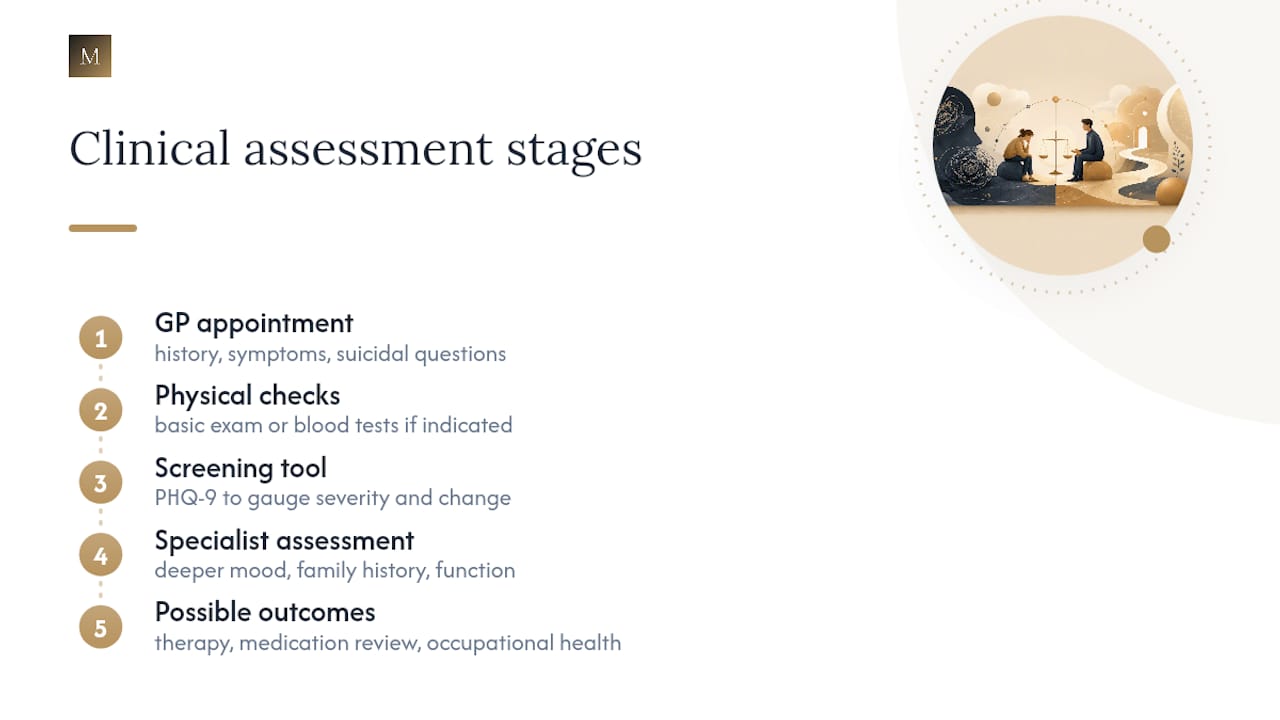
A GP appointment for suspected depression usually starts with a conversation about your medical history, current symptoms, and any risk factors, including direct questions about suicidal thoughts. Basic physical checks or blood tests may follow if a physical cause seems plausible.
Many GPs use a structured screening tool such as the PHQ-9 questionnaire to gauge symptom severity and track change over time. A specialist psychiatric assessment goes further, examining mood history, family history, and functional impact in more depth.
Depending on what emerges, you might be offered a referral to talking therapies, a review of whether medication is appropriate, or, if work is clearly implicated, a referral to occupational health for workplace adjustments.
Treating burnout and depression: what actually helps
Burnout responds best to changes at the source. Depression usually needs clinical treatment. When both are present, you need both approaches running in parallel.
For burnout:
- Set firmer boundaries around working hours and after-hours contact
- Negotiate workload directly with your manager, backed by specifics rather than a general complaint
- Ask for an occupational health referral if your employer offers one
For depression:
- Cognitive behavioural therapy (CBT) is a well-established, evidence-based talking therapy for depressive episodes
- Antidepressant medication may be appropriate depending on severity, prescribed and reviewed by a GP or psychiatrist
- A crisis plan, agreed with a clinician, matters if suicidal thoughts have featured at any point
When both overlap: a combined approach works best, addressing workplace pressures and clinical symptoms at the same time. Prioritise sleep, a stable daily routine, and staying connected to people rather than withdrawing, alongside whatever treatment your GP recommends. Practical, non-clinical recovery strategies can also help fill the gap while you're waiting for or attending formal treatment.
Pro Tip: If you're negotiating workload changes with your employer, put the specific asks in writing. "I need two afternoons a week without meetings" gets acted on far more reliably than "I'm struggling."
Getting assessed and treated without a long wait
Mind a Porter connects you with qualified therapists across more than 22 languages, matched by specialism, culture, and availability, with no waiting list for an initial conversation. That includes modalities such as CBT and EMDR, delivered online or in person, which suits burnout-related distress, depressive symptoms, or both together.
This is an access route, not a substitute for urgent medical care:
- If you're having suicidal thoughts, contact NHS urgent mental health services or your GP immediately, not a therapy platform
- If medication assessment or review is needed, that sits with a GP or psychiatrist, not a talking therapist
- For an initial session, it helps to have a rough timeline of when symptoms started, what's changed at work or at home, and whether things improve away from work
- Payment is typically out-of-pocket or via approved insurers, and sessions are confidential
Focus on impairment, not the label
Whether the right word is burnout or depression matters less than how much your life has narrowed. A clinician's job is to look at safety and functioning first: are you sleeping, working, connecting with people, and safe? Waiting to work out the "correct" diagnosis before asking for help is one of the most common and costly delays we see. If in doubt, ask sooner rather than later.
Book a discovery call with Mind a Porter
Mind a Porter matches you with a qualified therapist from a network of practitioners across London and the UK, filtered by specialism, language, and availability, so you're not stuck on a waiting list while symptoms worsen. Whether what you're dealing with looks more like burnout, depression, or a mix of both, the matching process accounts for it, and options include CBT, EMDR, and other evidence-based modalities delivered online or in person.

Sessions are confidential, and many clients use approved insurance to cover costs. If you recognise the exhaustion, the cynicism, or the low mood described in this article, the practical next step is a short discovery call to get matched with the right therapist. Book your first session with Mind a Porter and start without the wait.
If this is what you are dealing with, our burnout therapy in London page explains how we work and how to start.
Frequently asked questions
How can I tell if I have burnout or depression? Burnout typically improves when you take time away from your job, whereas depression is a pervasive mood disorder that persists regardless of your setting. While burnout remains tethered to work, depression affects all areas of your life including your sleep, relationships, and hobbies.
Can burnout develop into clinical depression? Yes, long term and unaddressed burnout can increase your risk of developing a major depressive episode. This happens because chronic stress and sleep disruption wear down your resilience over time. If your symptoms remain even after you make significant workplace changes, you should seek a professional assessment.
What symptoms require urgent medical attention? You must treat thoughts of suicide or self harm as an urgent matter and speak to a doctor or crisis service immediately. Other red flags include a loss of interest in almost everything and a major functional loss where you struggle to get out of bed or manage basic daily tasks.
Do I need to see a doctor for these feelings? Yes, you should visit a professional because online checklists cannot rule out physical causes like thyroid issues or vitamin deficiencies. A doctor can properly assess your symptoms and ensure you get the right support. It is safer to seek help sooner rather than waiting to work out a specific label.
Sources
Next Step
Reading is a start. Talking is the next step.
Tell us what you are looking for and we will match you with a qualified therapist who fits. Online across the UK, or in person in London.
Professional Support
Find the Right Therapy
Explore specialist treatment options related to this article.
Keep Reading
Related Articles

Reasonable Adjustments at Work for Mental Health
A plain guide to reasonable adjustments for mental health at work in the UK, covering what the law requires, which changes actually help, and how to ask without disclosing a diagnosis.

Access to Work: Funding Mental Health Support at Work
Access to Work is a government grant that can fund practical support, coaching and adjustments for mental health conditions. Here's what it covers, who qualifies, what the assessment involves, and how to combine it with therapy.

Redundancy and Your Mental Health: Getting Through It
Redundancy is rarely just about the job. Here's how to get through the consultation period, the money worry and the unsettling first weeks without work.