
Changing your therapist: a practical guide to switching well
Learn how to assess if a therapist is the right fit and follow professional steps to transition to a new provider without unnecessary guilt or complexity.

Clinically reviewed by
Dr Martina Paglia
Founder & CEO of Mind a Porter
HCPC-registered Clinical Psychologist
Special interests include anxiety, depression, trauma, OCD, burnout, workplace stress, relationship difficulties and high-performance mental wellbeing.
Last reviewed: 7 November 2026
All health information on Mind a Porter is clinically reviewed by our clinical lead. These resources are educational and do not replace professional advice.
Yes, you can change therapist, and you don’t owe a lengthy explanation to do it. If the relationship isn’t working, moving on is a normal, professional decision, not a failure on your part.
Start with three things:
-
Reflect on what’s wrong: is it a mismatch, a red flag, or normal discomfort?
-
Decide whether a conversation with your current therapist could fix it before you act.
-
If you’ve decided to switch, begin researching a new therapist straight away.
Therapists expect this. Endings are a routine part of clinical practice, and a good therapist will handle your departure professionally without requiring justification.
Key Takeaways
Changing therapist is a normal, low-friction decision that works best when you separate genuine poor fit from ordinary discomfort, use a short direct script to end things, and give a new therapist several sessions before judging fit.
| Point | Details |
|---|---|
| You don’t need permission | A brief, honest message is enough to end therapy; no lengthy justification required. |
| Distinguish discomfort from fit | Ordinary discomfort eases with time; feeling unheard for months signals a real mismatch. |
| Give it a few sessions | Trial a new therapist for several sessions before deciding, unless there’s a clear red flag. |
| Ask for continuity support | Request a treatment summary or referral letter to help your new therapist start informed. |
| Report genuine harm immediately | Boundary violations or breaches of confidentiality should go to a professional body, not be tolerated. |
| Use a matching service to speed things up | Mind a Porter filters therapists by specialism and language with no waiting list, easing the switch. |
Table of Contents
-
How to know if it’s a poor fit, normal discomfort, or something worse
-
What should you say to end therapy with your current therapist?
-
How do you keep continuity of care and stay safe during the switch?
-
What do experts say about switching therapists without guilt?
How to know if it’s a poor fit, normal discomfort, or something worse
Therapy is often uncomfortable by design. Talking through trauma or challenging thought patterns can feel raw, especially in the first few sessions. That discomfort is different from a genuine mismatch.
Signs you might have a fit problem:
-
You’ve made no progress after attending sessions for a reasonable amount of time.
-
You regularly feel unheard, dismissed, or like your concerns aren’t landing.
-
Your therapist doesn’t understand something central to your identity, culture, or background.
Other valid reasons to switch
Beyond the signs above, a few other situations justify changing therapist:
- Approach mismatch: you wanted practical tools but got exploratory talk therapy, or vice versa. Different approaches suit different people and problems, and realising the approach doesn’t fit you is a legitimate reason to move on.
- Lack of challenge: your therapist is warm and supportive but never challenges you. Good therapy should comfort the disturbed and disturb the comfortable; pure validation without challenge rarely creates change.
- Life changes: you’ve moved, your schedule no longer fits, cost has become unmanageable, or you need specialist expertise they don’t have. These are practical reasons, not a reflection of quality.
- Outgrowing the relationship: sometimes you’ve got what you needed from a particular therapist and are ready for someone who can take you deeper or bring a different perspective. This is growth, not rejection.
Signs that go beyond fit and into harm:
-
Boundary violations, including inappropriate contact outside sessions.
-
Any sexualised comments or behaviour.
-
Breaches of confidentiality or unprofessional disclosures about other clients.
-
Harassment, dismissiveness about safety concerns, or pressure to continue against your wishes.
Further red flags to watch for
A few additional warning signs are worth naming explicitly: discrimination on the basis of race, sexuality, gender identity, or disability; consistent lateness or cancellations; a therapist practising outside their competence; and sessions that leave you consistently worse, not just occasionally uncomfortable. Any of these justifies leaving immediately, without a gradual ending.
Professional guidance is clear that persistent feelings of being unheard or unable to trust your therapist signal a genuine lack of fit, not something you should push through indefinitely. Ordinary discomfort tends to ease as trust builds. A poor fit rarely does.
A real example of poor fit
One client, Marcus, spent six months with a therapist who was warm and professional, but sessions felt flat, and he regularly left feeling unheard, as though she were following a script rather than connecting with him. He assumed the problem was his own resistance, so he stayed. When a friend finally asked, “Would you stay in a relationship that wasn’t working because you felt guilty leaving?”, he decided to switch. Within three sessions with a new therapist, he felt the difference: genuinely heard, challenged in helpful ways, and making progress. People often blame themselves for a mismatch that has nothing to do with their own effort or resistance.
Have you given it a fair chance before switching?
Before you commit to switching therapists, run through a short self-check:
-
Progress: Have you noticed any shift, however small, in how you think or cope?
-
Emotional safety: Do you feel able to be honest, or do you hold back out of fear of judgement?
-
Competence: Does your therapist seem equipped to handle your specific issue (trauma, OCD, relationship conflict)?
-
Cultural fit: Do they understand your background, language, or lived experience well enough?
-
Practical constraints: Does cost, location, or availability make sticking with them unsustainable anyway?
As a rule of thumb, a few sessions is a reasonable trial period unless there’s a clear red flag, in which case you don’t need to wait that long at all. Weigh a single bad session against a pattern. One awkward exchange isn’t a verdict; three months of feeling dismissed is.
A session rule of thumb
As a specific benchmark, give a new approach three to four sessions before deciding whether it’s working, unless there’s a serious boundary violation or safety concern, in which case leave immediately.
Could switching be avoidance?
If you’ve switched therapists multiple times, each after only a few sessions, it’s worth asking whether the pattern itself is the issue. This doesn’t mean every switch is avoidance, but it’s a pattern worth raising honestly with your next therapist so they can help you tell the difference between genuine poor fit and difficulty staying with discomfort.
What are the steps to changing therapists?
Switching well is a sequence, not a single decision. Following it in order reduces the chance you’ll drop out of care altogether.
-
Reflect and decide. Pin down exactly what isn’t working, whether it’s fit, competence, or a red flag.
-
Research alternatives. Look at specialisms, modalities, and language options before you end anything.
-
Plan the conversation (or decide to skip it). Some people prefer to notify their therapist; others simply stop booking. Both are valid.
-
Request records or a summary. Ask for a brief treatment summary or referral note if it would help your new therapist.
-
Book an initial appointment with someone new, ideally before you formally end the old relationship.
-
Transfer care. Share relevant history with your new therapist so you’re not starting entirely from zero.
Give yourself roughly one to two weeks to research and book, rather than dragging the decision out for months. Momentum matters here.
Pro Tip: If starting over feels daunting, use a short discovery call with a prospective therapist to test rapport before fully committing. Many services, including Mind a Porter, offer this as a low-stakes first step.
Using your final sessions well
If you do have a proper ending conversation, consider using one or two closing sessions deliberately rather than just stopping. Review the progress you’ve made, identify what you still want to work on with your next therapist, and process the ending itself. Handling an ending well can be useful practice for endings elsewhere in life.
What should you say to end therapy with your current therapist?
You don’t need an elaborate explanation. Short and honest is enough.
In-session scripts:
-
Direct and brief: “I’ve decided this isn’t the right fit for me, and I’d like to end our sessions.”
-
Neutral and outcome-focused: “I think I need a different approach for what I’m working through, so I’m going to look elsewhere.”
-
Feedback-oriented: “I’ve valued our work together, but I don’t feel we’re making progress, and I’d like to try someone new.”
Message or email templates:
-
“Thank you for your support. I’ve decided to end our sessions and won’t be booking further appointments.”
-
“I’d like to stop our sessions as of [date]. Could you send a brief summary or referral if that’s possible?”
Requesting a summary or records release is a normal ask, and journalistic coverage of therapy endings confirms brief, direct notice is standard practice.
Softening the message
If you want to be honest but kind, try reframing rather than criticising. Instead of “you talk too much and don’t listen,” try: “I’m realising I need more space to explore my thoughts, and I think a less directive approach would suit me better.” Instead of “you’re terrible and never helped me,” try: “I think I need someone with a different approach, or more experience with [specific issue].”
If you can’t face a conversation
If a conversation feels like too much, a brief email is acceptable: “After consideration, I’ve decided to end therapy. Thank you for your support. I won’t be booking further sessions. Please send a final invoice if needed.” Where there’s a genuine boundary violation, you don’t owe a gradual ending at all: “I’ve decided not to continue therapy. Please send a final invoice” is enough.
Handling the logistics
Alongside the message itself, tie up the practical ends: give roughly one to two weeks’ notice where possible, settle any outstanding payments, request notes or records if you’ll need them, and ask if they can offer a referral.
Where should you look for a new therapist?
Search across a few channels rather than relying on just one. Options include NHS referral routes, professional directories such as the BACP register, a referral from your outgoing therapist, and matching platforms like Mind a Porter that filter by specialism and language.
Before booking, check:
-
Professional registration or accreditation.
-
Specialism and therapeutic approach (CBT, EMDR, psychodynamic, and so on).
-
Language and cultural fit, particularly if this mattered with your last therapist.
-
Location or online availability, and whether sessions fit your schedule.
-
Fees, and whether they accept your insurer if that’s relevant.
When you make first contact, ask a handful of screening questions: What’s their typical session structure? Have they worked with your specific concern before? How do they handle between-session contact or crises? A therapist who answers these clearly, without vagueness, is usually a good early sign.
Search based on what went wrong last time
Use what you’ve learned about the previous relationship to narrow your search. If your last therapist was too directive, look for approaches described as person-centred, client-led, or non-directive. If they weren’t challenging enough, look for integrative, psychodynamic, or Gestalt approaches. If you need specialist expertise, search for therapists who specialise in your specific issue, such as trauma, LGBTQ+ experience, or neurodivergence. If cultural understanding was missing, seek therapists from a similar background or those who state cultural competence explicitly.
Questions that reflect what you’ve learned
Make your screening questions specific to what didn’t work before, for example: “My last therapist was quite structured, which didn’t work for me. How would you describe your style?”; “I need someone who will challenge me, not just validate. Is that how you work?”; “I’m [identity marker]. Do you have experience working with [community]?” It’s also fine to have a short initial consultation with two or three therapists before choosing.
How do you keep continuity of care and stay safe during the switch?
Ask your outgoing therapist for a treatment summary, copies of relevant records, a referral letter, and any existing safety plan. Most practices can transfer these within days to a few weeks once you’ve signed a release form.

If you’ve experienced a serious ethical breach rather than an ordinary mismatch, stop contact and report it. UK routes include the therapist’s professional body (such as BACP or UKCP), an NHS complaints procedure if you were seen through the NHS, and crisis services if you’re at immediate risk. The NHS’s five steps to mental wellbeing is a useful interim resource while you’re between therapists.

What to tell your new therapist
Be open about your previous experience rather than starting from nothing: “I worked with someone for six months, but it wasn’t quite right. I needed [more challenge / a different approach / specialist expertise / better cultural understanding]. What I’m looking for now is [X].” You don’t need to badmouth your previous therapist, just describe what you’re seeking. Bring any notes or reflections from your previous therapy, and a clear sense of what “better” would feel like.
What do experts say about switching therapists without guilt?
Three points worth holding onto: normal discomfort and genuine poor fit are different things, so don’t confuse the two. Therapists are trained to manage endings professionally and rarely take them personally. New relationships need a handful of sessions to find their footing before you judge them.
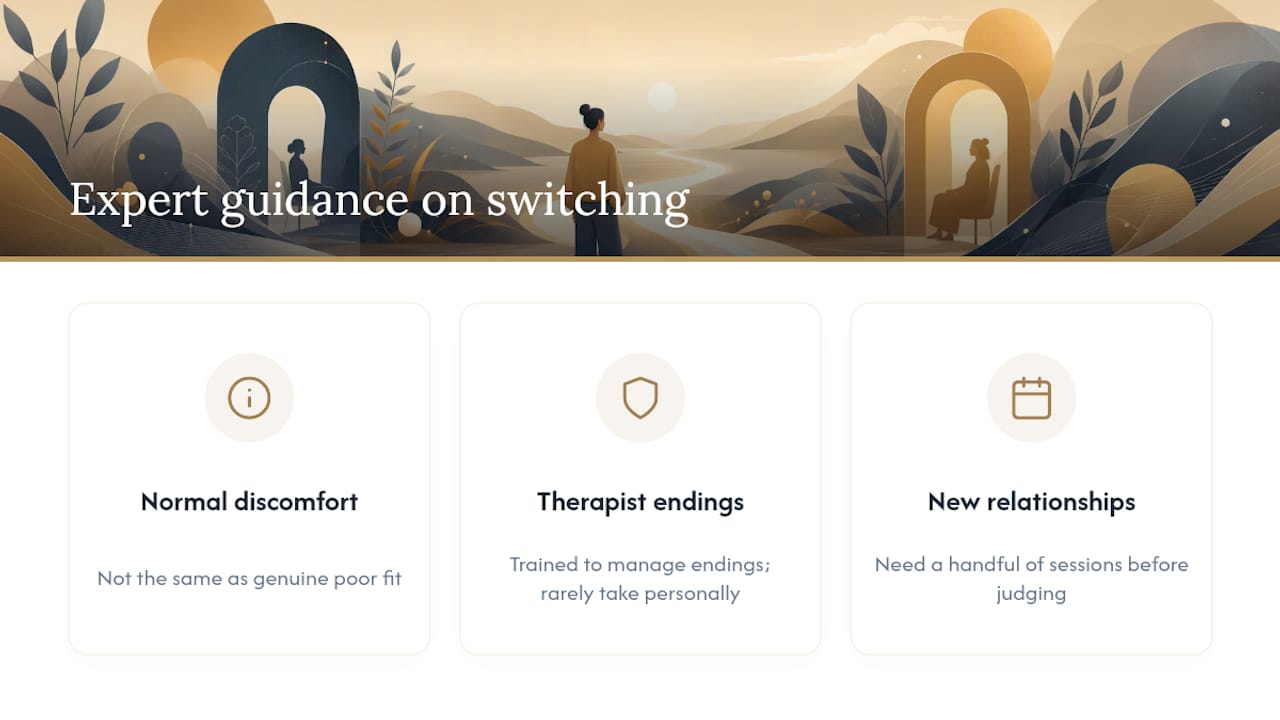
This reflects guidance from professional bodies and coverage of how people navigate ending therapy well.
In therapists’ own words
Therapists themselves tend to describe client departures matter-of-factly rather than personally:
"My first thought is: have I missed something? My second is: what would serve this client best? Often, it's not me, and that's fine."
"I'd rather a client tell me it's not working than stay out of guilt. That's not therapeutic for anyone."
"If I'm not the right fit, I'm grateful they're advocating for themselves to find someone who is."
A publisher’s perspective on switching therapists
Switching therapists isn’t a sign you’ve failed at therapy. It’s often the moment someone finally gets the right support. Mind a Porter exists partly because of this: matching by specialism, language, and availability makes it easier to find someone who fits the first time, or the second.
How a matching platform speeds up a safe switch
Searching directories, checking credentials, and waiting for callbacks can turn a difficult decision into a drawn-out one. A matching service shortens that gap considerably.

Mind a Porter filters hundreds of qualified therapists by specialism, language, and availability, so you’re not scrolling through profiles that don’t fit your situation. There’s no waiting list model, which matters when you’ve already spent months with a therapist who wasn’t right. The platform also supports the practical side of switching, including bookings and helping you get set up quickly with someone new.
What switching looks like on Mind a Porter
A few features are designed specifically around switching rather than starting cold. If your current Mind a Porter therapist isn’t the right fit, you don’t need to leave the platform; you simply rematch, and your account, history, and preferences stay with you. You can re-run the clinically-designed matching questionnaire with what you’ve learned, whether that’s a different modality, a more challenging style, a specialist expertise, a different language, or a different location, and get matched with therapists who fit the new brief. £1 discovery calls let you check the fit with a 15-minute call before committing to a full session, so you can ask the questions you wish you’d asked last time. Every therapist is already professionally registered, with BACP, UKCP, BABCP, BPS, HCPC, or GMC, so you don’t have to re-verify credentials each time you switch. The platform covers all modalities and professional types, so if you need to move from CBT therapy to psychodynamic work, from a counsellor to a clinical psychologist, or from therapy to psychiatry, the switch can be in approach, not just in person. You can also switch format, from online therapy to in-person across London or back again, and filter by language across 22+ languages if cultural or linguistic fit was the issue. If your therapy is insurance-funded, pre-authorisation and invoicing carry across therapists, so switching doesn’t mean restarting the insurance admin, and rates stay the same as going direct, with matching and support included.
If you’ve decided it’s time to move on, you can browse therapists on Mind a Porter and book an initial session without the usual delay.
Frequently asked questions about changing therapist
Do I have to explain why I’m leaving my therapist? No. A short, polite notice is standard practice, and therapists are trained to accept endings without requiring detailed justification.
How many sessions should I give a new therapist before deciding it’s not working? Most guidance suggests a few sessions, unless you notice a serious red flag that warrants leaving sooner.
Can I switch therapists if I’m using insurance? Yes, though you should check with your insurer whether the new therapist is in-network and confirm any pre-authorisation requirements before booking.
What if my therapist has crossed a boundary or behaved unethically? Stop contact and report it to their professional regulator, such as BACP or UKCP, rather than trying to resolve it directly.
How quickly can I start with a new therapist after leaving my old one? With a matching platform, you can often book an initial session within days, particularly where there’s no waiting list involved.
Will changing therapist hurt their feelings? No. Therapists are trained professionals who have their own therapists and supervisors, and they understand that not every client relationship works. Many see honest feedback about why you’re leaving as useful professional growth.
What if I’ve wasted time and money with my last therapist? Not if you’ve learned something, even if it’s only what doesn’t work for you. That knowledge makes your next choice more informed.
Do I have to start over and explain everything again with a new therapist? There’s some catching up, but a good therapist will move through your history efficiently. Being open about what didn’t work last time, and what you’re looking for now, helps them do this quickly.
Can I switch therapists on Mind a Porter without leaving the platform? Yes. If your current Mind a Porter therapist isn’t the right fit, you rematch rather than leave; your account, history, and preferences stay with you, and you can re-run the matching questionnaire with a different modality, style, language, or location.
This article is general information, not a substitute for advice from a qualified doctor. Consult a qualified healthcare professional about your own circumstances before acting on anything here.
Sources
Recommended
Next Step
Reading is a start. Talking is the next step.
Tell us what you are looking for and we will match you with a qualified therapist who fits. Online across the UK, or in person in London.
Professional Support
Find the Right Therapy
Explore specialist treatment options related to this article.
Keep Reading
Related Articles

Therapy and Medication Together: Why the Combination Often Works Better
Many people recovering from depression or anxiety find that therapy and medication work better as a pair than either does alone. Here's what the evidence says, and how to make the combination work for you.

How long does therapy take to work? A realistic timeline
The first change usually arrives in weeks three to six, but a full course runs longer. What the timeline really looks like, week by week.

Grief Counselling Options in the UK: How to Choose
Navigate the UK's bereavement support landscape by comparing costs, accessibility, and types of care to find the right therapeutic path for your specific needs.