
Five Minute Check: UK Therapist Qualifications to Verify Before You Book
Learn how to quickly verify your UK therapist’s credentials and professional registration to ensure you are choosing a qualified, accountable practitioner.

Clinically reviewed by
Dr Martina Paglia
Founder & CEO of Mind a Porter
HCPC-registered Clinical Psychologist
Special interests include anxiety, depression, trauma, OCD, burnout, workplace stress, relationship difficulties and high-performance mental wellbeing.
Last reviewed: 7 November 2026
All health information on Mind a Porter is clinically reviewed by our clinical lead. These resources are educational and do not replace professional advice.
Look for two things: registration with the Health and Care Professions Council (HCPC) if the title is legally protected, or membership of a Professional Standards Authority (PSA) accredited register such as BACP, UKCP, BABCP, or EMDR-UK if it isn't. Before you book a single session, search the therapist's name or registration number on the relevant register. That five-minute check tells you more than any bio page ever will.
TL;DR:
- The HCPC register confirms legal registration for practitioner psychologists using protected titles, and practitioners must be registered to avoid legal penalties.
- PSA-accredited registers like BACP, UKCP, BABCP, and EMDR-UK provide independent validation for therapists in voluntary, non-legally protected roles, signaling higher standards of training.
- Verifying registration or accreditation is quick and essential, involving checking registration numbers and current status on official online registers before booking a session.
- Accredited members usually have more extensive clinical experience and ongoing professional development, but a registered therapist with appropriate supervision can be equally suitable.
- Red flags include missing verifiable registration details, vague training claims, and pressure to book quickly without clearing credentials.
Table of Contents
- Quick checklist: what to look for before you book
- Statutory regulation versus voluntary registers: why it matters
- The main UK registers, and what each one tells you
- How to verify a therapist's registration, step by step
- Registered or accredited: what's the practical difference?
- What to ask before your first session
- Red flags that suggest a therapist's credentials don't hold up
- Why verified credentials build real trust
- Finding a verified therapist without the wait
- Sources
- FAQ
Quick checklist: what to look for before you book
A therapist's profile or first message should give you enough to verify them within minutes. If it doesn't, that's your first signal.
- A named registration body and a registration number, especially for protected titles like "practitioner psychologist," which must sit on the HCPC register.
- Membership of a PSA accredited register (BACP, UKCP, BABCP, EMDR-UK, or similar) and whether that membership is "registered" or "accredited."
- Confirmation of the therapy modality they practise (CBT, EMDR, psychodynamic, and so on), plus evidence of clinical supervision, professional indemnity insurance, and a published complaints procedure.
- If any of this is missing from a profile, ask directly. A qualified therapist will give you the details without hesitation.
Statutory regulation versus voluntary registers: why it matters
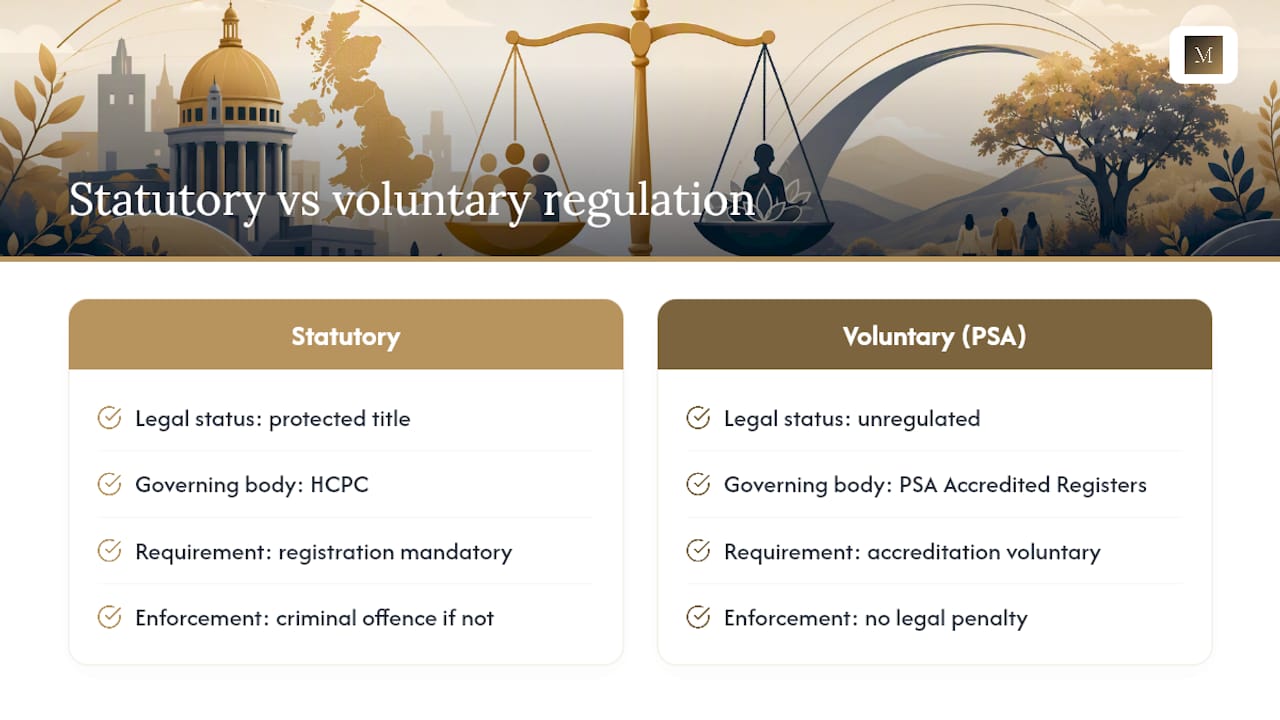
Not every therapy title carries the same legal weight. Practitioner psychologist titles are protected by law, so anyone using them must be registered with the HCPC, which lists registration status, a registration number, and any annotations against the practitioner's name. Practising without that registration while using a protected title is a criminal offence.
Counselling and psychotherapy sit in different territory. Neither is regulated by law in the UK, which means anyone can technically call themselves a counsellor with no formal training at all. That gap is why the Professional Standards Authority runs its Accredited Registers scheme, awarding a Quality Mark to organisations whose registers meet defined standards for education, complaints handling, and governance. Around 85,000 practitioners across unregulated professions now sit within PSA accredited registers.
Accreditation isn't compulsory, but it's the clearest independent signal that a therapist answers to somebody beyond themselves. Without it, you're relying entirely on personal recommendation.
The main UK registers, and what each one tells you
Every register carries a different meaning, so it's worth knowing what you're actually checking before you trust the letters after a therapist's name.
- HCPC – covers legally protected practitioner psychologist titles. The register confirms current status, a registration number, and any practice restrictions or annotations.
- BACP – registered membership (MBACP) is the entry-level standard for counsellors and psychotherapists. Accredited membership is a separate, higher tier reached only after a detailed application demonstrating clinical experience.
- UKCP – its national register covers psychotherapists and psychotherapeutic counsellors and is PSA accredited, reflecting substantial postgraduate training and supervised clinical hours.
- BABCP – the specialist register for cognitive behavioural therapy, confirming model specific training and supervised CBT practice.
- EMDR-UK – a voluntary register for practitioners trained in Eye Movement Desensitisation and Reprocessing, useful if you're specifically seeking that modality.
- BPS – the British Psychological Society oversees chartered psychologist status and routes into counselling psychology, sitting alongside HCPC regulation for many psychologist roles.
Modality registers like BABCP and EMDR-UK matter most when you want a therapist trained in one specific method rather than a generalist. Training for these routes typically demands set training hours plus ongoing supervised practice, so listing on the register is a genuine marker of competence in that model.
How to verify a therapist's registration, step by step
Verification takes minutes, and it's the single most useful thing you can do before committing to a therapist.
- Ask directly. If the registration body and number aren't listed on their profile, request both before booking.
- Search the HCPC register. Use the therapist's name or registration number through HCPC's official check tool to confirm current status and spot any annotations.
- Check the relevant professional register. Use the BACP, UKCP, BABCP, or EMDR-UK search tools, or look them up against the PSA's accredited register list, to confirm the specific membership claimed.
- Walk away if you can't verify. If a therapist can't produce evidence of training, insurance, or registration, choose someone whose credentials you can confirm independently.
Pro Tip: Take a screenshot of the register entry alongside the therapist's profile the day you check. Registers get updated, and having a dated record protects you if a dispute ever arises later.
Registered or accredited: what's the practical difference?
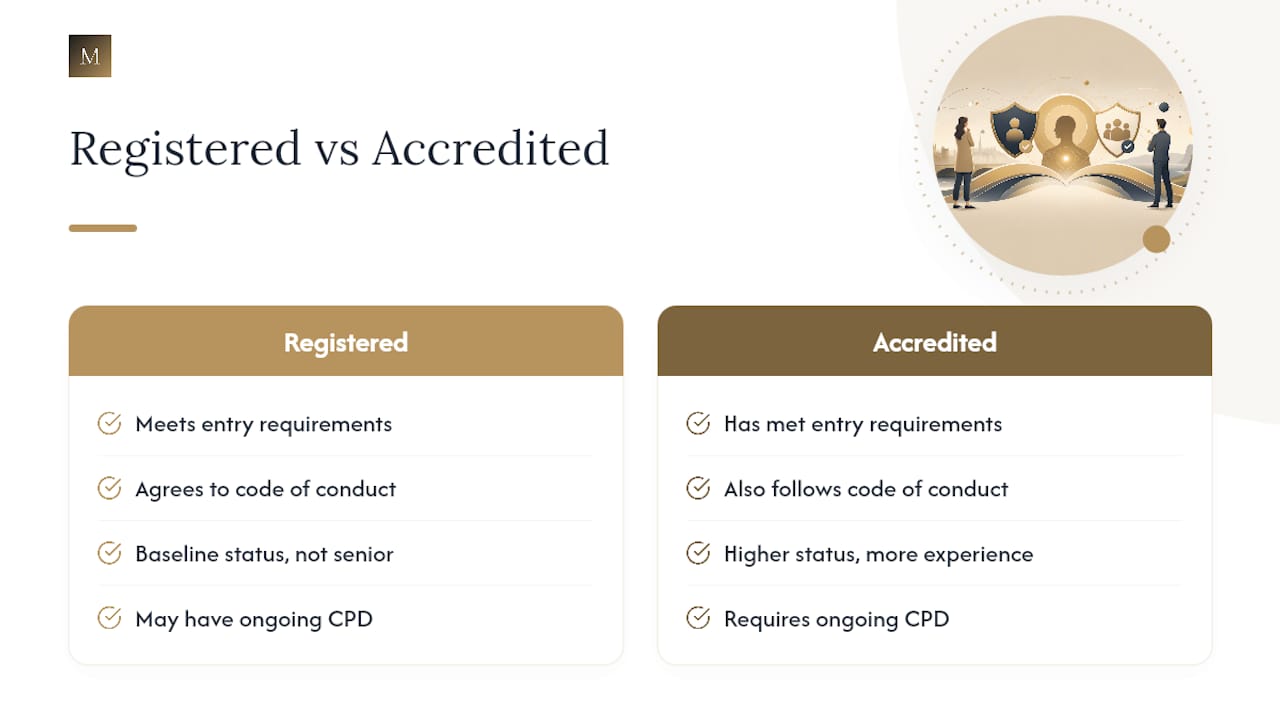
"Registered" means a therapist has met the entry requirements for their professional body and agreed to follow its code of conduct. It's the baseline, not a mark of seniority.
"Accredited" is a separate, higher status. It usually requires years of documented clinical hours, ongoing continuing professional development, and a formal assessment of casework, so an accredited member has generally demonstrated more depth of experience than a registered one alone.
Neither label guarantees the right fit for you personally. A registered therapist with strong supervision and relevant experience in your specific issue can suit you better than an accredited generalist. Use the label as one input, not the whole decision.
What to ask before your first session
A short conversation before booking should cover more than logistics. It's your chance to confirm both competence and safety.
- Which register are they on, and what's their registration number?
- What experience do they have with your specific issue, and which modalities do they practise (CBT, EMDR, psychodynamic, and others)?
- Who supervises their clinical work, do they carry professional indemnity insurance, and what's their complaints process if something goes wrong?
- What are their fees, and what's the cancellation policy if you need to reschedule?
A therapist confident in their own standing will answer all of this without friction.
Red flags that suggest a therapist's credentials don't hold up
Certain warning signs should stop you before you book, regardless of how polished a profile looks.
- No verifiable registration, or reluctance to share registration details when asked directly.
- Vague or inflated training claims, promises of a guaranteed cure, or no visible complaints route or insurance cover.
- Pressure to commit quickly, or insistence on a particular package rather than an open discussion of your options.
Why verified credentials build real trust
Clients deserve a straightforward way to check who they're trusting with something this personal. Independent oversight through the HCPC or a PSA accredited register gives you somewhere to go if things go wrong, which matters more than any qualification list on its own.
That said, plenty of skilled, ethical therapists practise without formal accreditation, particularly earlier in their careers. Registration and accreditation aren't the only measures of a good therapist, but they're the only ones you can check independently before you've met them.
Finding a verified therapist without the wait
A therapy matching platform can connect you to therapists who have been screened for registrations and specialisms, easing the verification process. The platform matches clients across multiple languages and therapy modalities, aiming to provide timely access to therapy sessions.

Once you're matched, it's still worth running your own quick check against the HCPC or the relevant PSA accredited register, treat that as good practice with any therapist, anywhere. You can start with a low-cost Discovery Call to see if a therapist feels right, or browse individual therapy, couples counselling, and other services directly to find UK-based support that fits your needs now.
This article is general information, not a substitute for advice from a qualified doctor. Consult a qualified healthcare professional about your own circumstances before acting on anything here.
You can browse our therapists and see each one's registration and training.
Sources
- Practitioner psychologist — Regulated professions service
- About Accredited Registers — Professional Standards Authority
- BACP register — British Association for Counselling and Psychotherapy
FAQ
Do all UK therapists need to be registered by law?
No. Only protected titles, such as practitioner psychologist, legally require HCPC registration. Counsellors and psychotherapists work under voluntary registers overseen by the PSA.
What's the difference between BACP and UKCP?
BACP registers counsellors and psychotherapists with a tiered system of registered and accredited membership, while UKCP maintains a national register with its own postgraduate training and supervised practice requirements. Both are PSA accredited registers.
Is an accredited therapist always better than a registered one?
Not necessarily. Accreditation signals more documented clinical experience, but a registered therapist with strong supervision and relevant expertise can still be the right fit for your situation.
How do I check if a therapist is genuinely qualified?
Search their name or registration number on the HCPC register for protected titles, or on the relevant PSA accredited register such as BACP, UKCP, BABCP, or EMDR-UK.
Does Mind a Porter check therapist credentials?
Mind a Porter matches clients with therapists across CBT, EMDR, and other modalities without a waiting list; readers should still confirm registration status directly on the HCPC or relevant PSA accredited register before their first session.
Next Step
Reading is a start. Talking is the next step.
Tell us what you are looking for and we will match you with a qualified therapist who fits. Online across the UK, or in person in London.
Professional Support
Find the Right Therapy
Explore specialist treatment options related to this article.
Keep Reading
Related Articles

Therapy and Medication Together: Why the Combination Often Works Better
Many people recovering from depression or anxiety find that therapy and medication work better as a pair than either does alone. Here's what the evidence says, and how to make the combination work for you.

How long does therapy take to work? A realistic timeline
The first change usually arrives in weeks three to six, but a full course runs longer. What the timeline really looks like, week by week.

Grief Counselling Options in the UK: How to Choose
Navigate the UK's bereavement support landscape by comparing costs, accessibility, and types of care to find the right therapeutic path for your specific needs.