
Fast Access to Autism Friendly Therapy in the UK With Mind a Porter
Learn how to identify neurodiversity-affirming therapists and request effective sensory and communication adaptations to ensure your therapy sessions meet your needs.

Clinically reviewed by
Dr Martina Paglia
Founder & CEO of Mind a Porter
HCPC-registered Clinical Psychologist
Special interests include anxiety, depression, trauma, OCD, burnout, workplace stress, relationship difficulties and high-performance mental wellbeing.
Last reviewed: 7 November 2026
All health information on Mind a Porter is clinically reviewed by our clinical lead. These resources are educational and do not replace professional advice.
Autism-friendly therapy means a therapist actively adapts the environment, communication and structure of sessions to your sensory and processing needs, rather than expecting you to fit a standard format. Start by asking any prospective therapist whether they have neurodiversity-affirming training and whether they offer flexible session formats. Mind a Porter is one direct option that matches clients to therapists with these adaptations built in.
TL;DR:
- Autism-friendly therapy prioritizes personalized adjustments in environment, communication, and session structure, with ongoing dialogue rather than fixed checklists.
- Adaptations like dimmable lighting, visual agendas, and literal language are highly valued, but therapists usually require explicit requests to tailor sessions effectively.
- Evidence supports adapted therapies like CBT for anxiety and sensory-integrated occupational therapy, but effectiveness varies based on individual profiles and needs.
- Selecting a suitable therapist involves verifying autism-specific training, willingness to share adaptation examples, flexible formats, and clear cost and schedule information.
- Online platforms like Mind a Porter facilitate immediate access to neurodiversity-affirming therapists across a range of languages and modalities, easing barriers related to availability and matching.
Table of Contents
- What does autism-friendly therapy look like in practice?
- Therapy types and what the evidence says
- What sensory and communication adaptations should you request?
- How do you choose the right autism-friendly therapist?
- How do you access autism-friendly therapy in the UK?
- How can family members and carers get involved?
- How should therapy address co-occurring conditions?
- Why does cultural sensitivity matter in autism-friendly therapy?
- Why matching by specialism actually reduces access barriers
- Finding autism-friendly therapy through Mind a Porter
- Sources
What does autism-friendly therapy look like in practice?
The starting point is a neurodiversity-affirming stance. This means the therapist treats autism as a difference to be understood and worked with, not a deficit to be corrected, and involves you in decisions about how sessions run rather than dictating a fixed approach. Shared decision-making of this kind changes the whole dynamic of a session.
Environmental adjustments matter more than most people expect. A survey of 130 autistic adults asked participants to rate 55 possible therapy adaptations, and neurodiversity-affirming practices scored highest of all. Roughly half of the adaptations tested were rated positively at group level, which tells you something important: there is no single "correct" setup, and a good therapist treats adaptation as an ongoing conversation rather than a one-off checklist.
Communication and pacing adjustments follow the same logic. Concrete language instead of abstract metaphor, visual agendas set out before the session starts, and permission to process in silence without it being read as disengagement all reduce the strain of a typical talking-therapy format.
- Dimmable or natural lighting instead of fluorescent strip lights
- A visual or written agenda shared ahead of the session
- Clear, literal language rather than idiom or implied meaning
- Flexibility on eye contact, fidgeting, or stimming during sessions
Pro Tip: Ask a prospective therapist to describe one adaptation they've made for a previous autistic client. A specific answer tells you far more than a general claim of "autism awareness".
Therapy types and what the evidence says
No single modality works for every autistic person, and the evidence base reflects that unevenly. Several approaches turn up repeatedly in clinical practice, each adapted differently depending on the client's profile.
- Adapted cognitive behavioural therapy (CBT): modified language and structure, often used for anxiety
- Occupational therapy: sensory integration work addressing processing difficulties
- Speech and language therapy: support for communication differences, including alternative and augmentative communication
- EMDR: adapted for trauma processing where verbal recall is difficult
- Play-based and arts-based therapies: often used with children or clients who find verbal-only formats exhausting
Adapted CBT has reasonably strong evidence for reducing anxiety in older autistic children with IQs of 70 or above, though the evidence weakens for younger children or different cognitive profiles. A broader systematic review and meta-analysis pooling 149 trials found non-pharmacological interventions produced larger pooled effects on core outcomes than pharmacological approaches, though the studies varied enormously in quality and design.
That variability is the honest caveat here. Behavioural and psychosocial interventions show promise across multiple reviews, but "shows promise in a review" is not the same as "will work for you". Modality selection should follow individual assessment, not a generic recommendation list.
What sensory and communication adaptations should you request?
Most therapists will not volunteer every adaptation unless you ask, so it helps to know what is reasonable to request before or during a first contact.
- Sensory options: dimmable lamps, a designated quiet area, a fragrance-free room, and a choice of seating rather than a fixed chair
- Structural options: predictable, unchanging session times, the ability to submit an agenda beforehand, and formats beyond face-to-face, including online sessions or walk-and-talk therapy
- Booking and contact preferences: text-based booking and check-ins instead of unscheduled phone calls, which many autistic clients find genuinely stressful
- Communication style: plain, literal language, visual supports where useful, and a preference for behavioural observation over emotion-labelling when that fits how you process feelings
That last point has real clinical backing. Sensory-processing informed practice guidance recommends therapists build an individual vocabulary of feeling with clients who experience alexithymia, rather than assuming standard emotion words will land. Occupational therapists often extend this into daily life through sensory diets and caregiver training, so gains from sessions carry over at home.
Pro Tip: Send your agenda or list of topics by email or text the night before a session. It removes the pressure of having to think on the spot and lets the therapist prepare their pacing accordingly.
How do you choose the right autism-friendly therapist?
Selecting a therapist comes down to a few concrete checks rather than a gut feeling.
- Specific training in autism or neurodiversity-affirming practice, not just general mental health qualifications
- Willingness to describe actual adaptations they've made, with examples
- Flexible session formats: online, in-person, or hybrid
- Clear information on cost, session length, and any waiting list
On first contact, ask directly: "What adaptations do you typically offer autistic clients?", "Have you worked with autistic adults or children before?", and "Can sessions be arranged around sensory or scheduling needs?" Vague or defensive answers are worth noting.
A therapist who insists there is only one correct way to run sessions, or who treats a request for adjustment as an inconvenience, is showing you exactly how future sessions will go. Autistic adults consistently rate proactively offered adjustments higher than adjustments they had to ask for themselves.
Affordability and accessibility matter just as much as clinical fit. A therapist who ticks every box on paper is no use if the cost or format makes ongoing attendance unrealistic.
How do you access autism-friendly therapy in the UK?
NHS routes exist through GP referral to specialist autism or mental health teams, but waiting times for a diagnostic pathway or specialist therapy slot are often long, and availability of neurodiversity-trained therapists within NHS services varies by region. Private and online therapy are practical alternatives when waiting is not an option, particularly for anxiety, trauma, or relationship support that does not require a formal diagnostic pathway first.
- Have your GP summary, any existing diagnosis letters, and a short description of your main concerns ready for referral
- Ask whether self-referral is possible for the specific service, as some talking therapy services allow this without a GP
- Book by text or online form where available, rather than a phone call, if phone contact adds stress
- Check whether your employer or insurer covers private sessions before assuming NHS is the only funded route
Online platforms have made private matching considerably faster than searching directory listings one by one.
How can family members and carers get involved?
Caregivers often want to help but are unsure where the boundary sits between support and taking over. The clearest approach is to ask the client, early on, what role they want you to play.
Some autistic clients want a parent or partner briefed after each session on general themes, without confidential detail being shared. Others want a caregiver present for part of the session to help communicate context the client finds hard to put into words unprompted. Neither approach is wrong, but the therapist should agree the arrangement explicitly rather than assume one model fits everyone.
For children, caregiver involvement tends to be more structural. Occupational therapists frequently prescribe sensory strategies that only work with consistent caregiver training at home, and behavioural approaches generally need reinforcement outside the therapy room to hold. A caregiver who understands the logic behind a strategy, not just the instructions, is far more likely to apply it consistently when things get difficult at home or school.

Practical, structured activities can help bridge sessions and daily life. Resources like this guide to social skills activities for parents give caregivers concrete exercises to practise between appointments, rather than leaving them to guess what "reinforcement" should look like. Ask your therapist directly what role they want you to play, and revisit that agreement as the client's needs or age change.
How should therapy address co-occurring conditions?
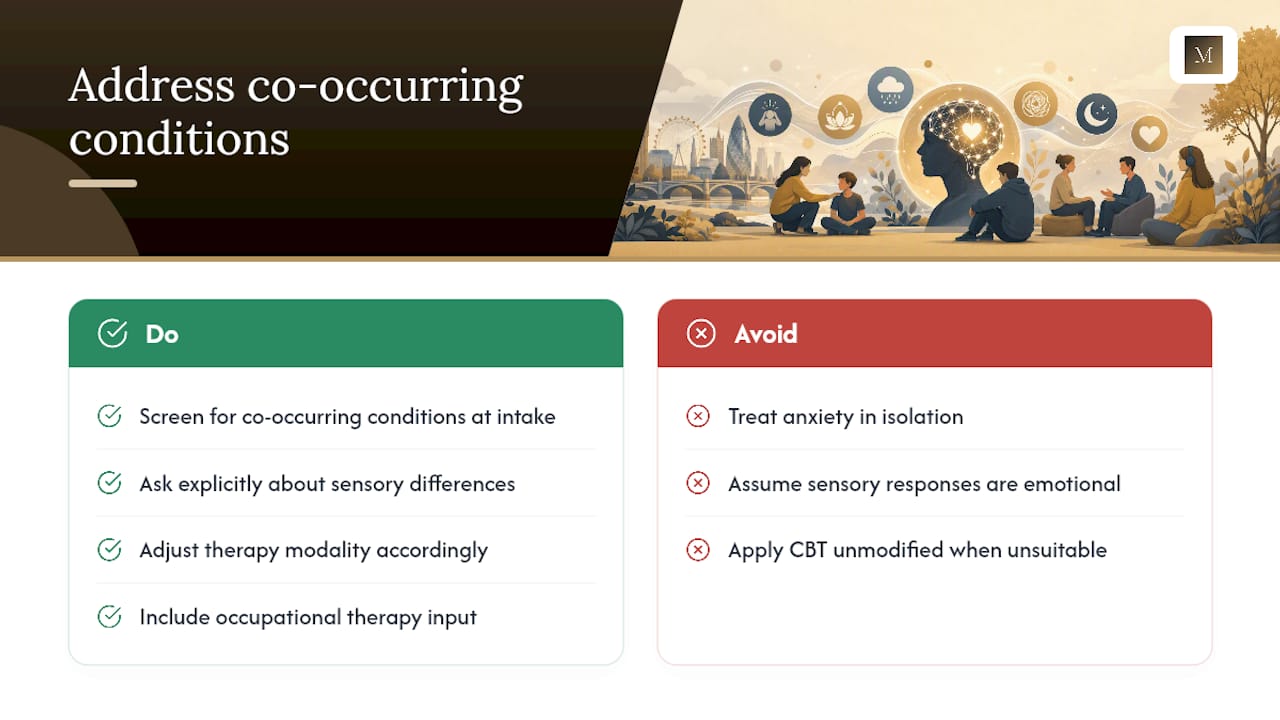
Anxiety, depression, ADHD, and sensory processing differences appear alongside autism far more often than the general population, and therapy that ignores this overlap tends to misfire. A therapist treating anxiety in isolation, without recognising that its root is sensory overwhelm rather than generalised worry, will apply the wrong technique regardless of how skilled they are.
Assessment at the outset should explicitly ask about co-occurring conditions rather than waiting for them to surface accidentally mid-treatment. This matters because standard anxiety or depression protocols sometimes need real adjustment for autistic clients. Adapted CBT for anxiety, for instance, works best in older children and adolescents with specific cognitive profiles, and applying it unmodified to someone with a co-occurring processing difference can reduce its effectiveness considerably.
Sensory processing differences deserve particular attention because they are frequently mistaken for emotional dysregulation. A client who appears anxious or shut down may be responding to lighting, noise, or fabric texture rather than the topic under discussion. Occupational therapy input alongside talking therapy often addresses this more effectively than either approach alone, since sensory-informed strategies tackle the trigger rather than just the emotional aftermath. A therapist who screens for ADHD, sensory sensitivities, and mood conditions at intake, and adjusts their modality accordingly, is treating the whole picture rather than a single symptom in isolation.
Why does cultural sensitivity matter in autism-friendly therapy?
Autism presentation and disclosure are shaped by culture as much as by neurology. Some families or communities carry significant stigma around autism diagnosis, which affects whether a client discloses openly, seeks formal assessment at all, or trusts a therapist enough to discuss sensory or communication needs honestly.
Language matters here too. A therapist working with a client whose first language is not English, or whose cultural background frames emotional expression differently, needs more than a generic script of adaptations. Concepts like eye contact, personal space, or direct disagreement carry different social weight across cultures, and an autistic client navigating both cultural norms and autistic communication style faces a genuinely layered challenge. A therapist who assumes one cultural default risks misreading behaviour that is neither a symptom nor a deficit, simply a difference in norm.
Access to therapists who share a client's language or cultural background, or who have direct experience working across that combination, tends to improve trust and disclosure substantially. This is one of the less discussed but most practical reasons that matching services offering therapists across a wide range of languages and backgrounds serve autistic clients particularly well: the client is not managing two separate translation problems, cultural and neurological, with the same person.
Why matching by specialism actually reduces access barriers
Most of the barriers autistic people describe in therapy are not about a shortage of good therapists. They are about the mismatch between need and availability: the right specialism exists, but finding it while managing sensory overwhelm, executive function difficulties, or diagnostic uncertainty is exhausting in itself.
Mind a Porter's model tackles that mismatch directly, connecting clients with hundreds of qualified therapists across more than 22 languages and filtering by specialism, culture, and availability rather than leaving clients to search directories alone.
Neurodiversity-affirming practice tends to build stronger therapeutic alliance precisely because it removes the guesswork. When a client does not have to explain or justify their sensory needs from scratch, more session time goes toward actual therapeutic work, and retention improves as a result.
Finding autism-friendly therapy through Mind a Porter
Mind a Porter exists to remove exactly the barrier this article has described: the mismatch between needing a specific kind of support and having no efficient way to find it. Instead of scrolling through generic directories hoping a bio mentions "neurodiversity", you filter directly by specialism, language, and accessibility needs, and get matched to therapists who already work this way.
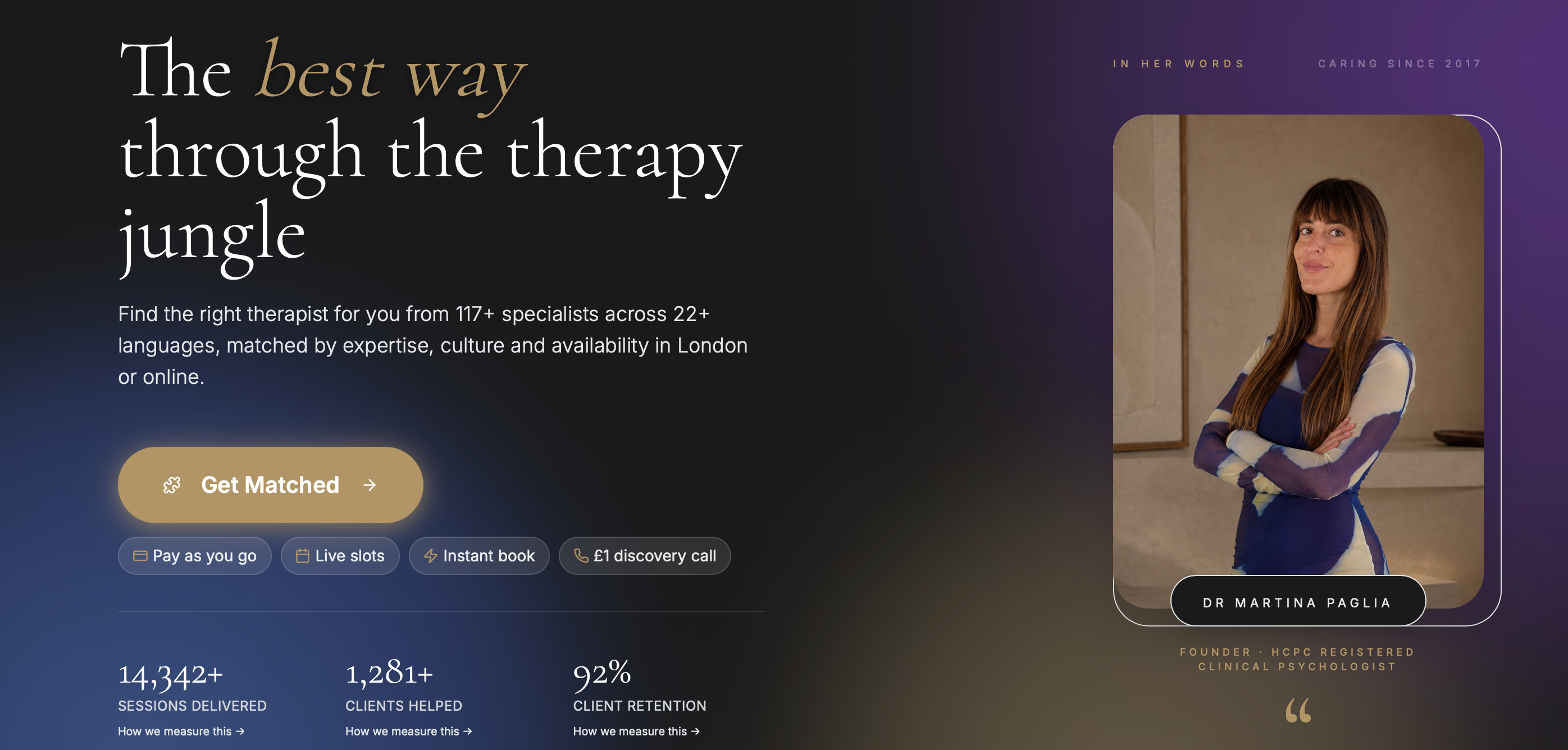
The platform covers both online and in-person sessions across London and UK-wide, with no waiting list standing between you and a first appointment. Therapists work across modalities including CBT, EMDR, and psychodynamic approaches, so the adaptations discussed throughout this guide, flexible formats, sensory considerations, plain communication are things you can specify from the outset rather than negotiate after weeks of waiting. If you're ready to find a therapist who adapts to you rather than the other way round, start your search on Mind a Porter and see who's available now.
This article is general information, not a substitute for advice from a qualified doctor. Consult a qualified healthcare professional about your own circumstances before acting on anything here.
If this is what you are dealing with, our autism therapy in London page explains how we work and how to start.
Frequently asked questions
How can I tell if a therapist is autism-friendly? You should ask if they have specific training in neurodiversity-affirming practice rather than just general mental health qualifications. A good therapist will be able to describe actual adaptations they have made for autistic people in the past. If they seem vague or defensive when you ask about these adjustments, you may want to look elsewhere.
Which sensory adjustments are reasonable to request? It is entirely reasonable to ask for changes like dimmable lighting or the use of a quiet, fragrance-free room. You can also request to use a specific seat rather than a standard chair. These simple environmental changes help make the session space feel much more comfortable and manageable for your own sensory needs.
Can I have therapy without a formal diagnosis? Yes, you can access private therapy even without having an official diagnostic pathway. Some services also allow you to self-refer without needing a GP to arrange it for you. It is worth checking your workplace or insurance policies to see if you can access private sessions through those routes as well.
How should my family support my therapy sessions? The best approach is to agree on a clear role with your therapist from the start. Some people prefer to have a family member present to help communicate, while others just want them to receive a brief update after the session. You and your therapist should decide together what level of involvement feels right for you.
Sources
- How can we make therapy better for autistic adults? Autistic adults’ ratings of helpfulness of adaptations to therapy
- A systematic review and meta-analysis of pharmacological and nonpharmacological interventions for autism spectrum disorder | Nature Mental Health
- Sensory-processing informed autism practice for child-centred therapists
Next Step
Reading is a start. Talking is the next step.
Tell us what you are looking for and we will match you with a qualified therapist who fits. Online across the UK, or in person in London.
Professional Support
Find the Right Therapy
Explore specialist treatment options related to this article.
Keep Reading
Related Articles

Coming Out Later in Life: Therapy, Family and Identity
Coming out in your forties, fifties or later brings its own mix of relief, grief and practical questions. Here is what affirming therapy can and cannot do, and how to talk to the people closest to you.

Therapy With an Interpreter: How It Works and When to Ask
If therapy in English leaves out half of what you mean, a professional interpreter can change that. Here is how it works, and how to ask.

Faith and Mental Health: Finding a Therapist Who Respects Both
How to tell when faith is supporting your recovery and when it might be delaying care, and how to find a therapist who takes your beliefs seriously.