
£40–£250: Private Therapy Cost in England, Book Fast Via Mind a Porter
Navigate the private therapy market in England by understanding session pricing, cost-saving strategies, and the trade-offs between public and private care.

Clinically reviewed by
Dr Martina Paglia
Founder & CEO of Mind a Porter
HCPC-registered Clinical Psychologist
Special interests include anxiety, depression, trauma, OCD, burnout, workplace stress, relationship difficulties and high-performance mental wellbeing.
Last reviewed: 24 September 2026
Private therapy in England typically costs between £40 and £150 per session, with London rates and specialist practitioners often reaching £250. Online sessions tend to run 20 to 40% cheaper than face-to-face appointments. NHS Talking Therapies remains free, but for anyone needing faster access, a specific specialism, or more choice over who they see, understanding the private market first makes budgeting far easier.
TL;DR:
- Private therapy fees vary significantly by practitioner type, with psychologists and specialist therapists charging £100 to £250 or more for a 50-minute session in London.
- The total cost depends on treatment length, with six sessions costing around £420 and longer courses exceeding £1,200, excluding initial assessments.
- Online therapy tends to be 20 to 40% cheaper than in-person sessions, mainly because of savings on room hire and overheads.
- NHS Talking Therapies generally provides around eight sessions for free, which may suit most common issues, but private options are preferable for urgent needs or specialized treatments.
- Costs can be reduced through concessions, online platforms, group therapy, or by using low-cost community or university clinics, especially outside major cities.
Table of Contents
- How much does private therapy cost by practitioner type?
- How many sessions will you need, and what's the total cost?
- What actually determines the price you're quoted?
- Is NHS Talking Therapies a realistic alternative to paying privately?
- Does insurance or your employer cover the cost?
- What if you can't afford private therapy fees?
- How does England's pricing compare with elsewhere?
- Does the type of therapy change the price?
- Why fit matters more than the price tag
- Book a therapist in England without the wait
- Sources
- FAQ
How much does private therapy cost by practitioner type?
The single biggest driver of price is who you're seeing, not where you live. A trainee counsellor working under supervision might charge £30 to £60 a session, while a doctorate-level clinical psychologist in London can bill £250 or more for the same 50 minutes.
Most standard sessions run 50 minutes, though some therapists offer 90-minute intensives for EMDR or couples work at a proportionally higher rate. Here's how the market typically breaks down:
- Trainee or reduced-fee counsellors: £30–£60 per session, often through university clinics or supervised placements
- Qualified counsellors and psychotherapists: £50–£90 per session for general talking therapy
- CBT therapists: £60–£120 per session, broadly in line with published UK price guides
- Clinical or counselling psychologists: £100–£180, with premium London providers charging £150–£250 or more
- Couples therapy: usually 20–40% above an individual session, since sessions often run longer and involve two clients' histories
Expect an initial assessment to cost the same as, or slightly more than, a standard session, since it usually takes longer and shapes the whole treatment plan. London and the South East sit consistently above the national average, largely because room hire and professional indemnity costs are higher there. Outside major cities, the same qualifications often command 15 to 25% less.
How many sessions will you need, and what's the total cost?
Course length depends on the problem being treated, not just personal preference. Short-term, focused work such as CBT for a specific phobia might resolve in six sessions, while trauma-related or long-standing relationship difficulties can take sixteen sessions or more.
- Six sessions (a short, focused course): at £70 a session, that's £420 in total, a realistic budget for a single, well-defined issue.
- Eight sessions (a common NHS-style course length, mirrored by many private CBT therapists): at £90 a session, expect around £720.
- Twelve sessions (typical for anxiety, low mood, or early trauma work): at £100 a session, the total reaches £1,200.
- Sixteen-plus sessions (open-ended psychodynamic work or complex trauma): at £120 a session, sixteen sessions comes to £1,920, and many courses run longer still.
These totals exclude the initial assessment, which some therapists bill separately. A longer 90-minute session, common in EMDR work, usually costs proportionally more than a 50-minute equivalent, so always ask whether the quoted fee covers a full clinical hour or a shorter slot before you commit to a course.
What actually determines the price you're quoted?
Location explains part of the gap, but it's far from the whole story. A therapist renting consulting rooms in central London faces overheads that a home-based practitioner in the North East simply doesn't carry, and that difference shows up directly in the fee.
Format matters too. Online therapy is commonly 20 to 40% cheaper than in-person sessions, largely because therapists save on room costs, though it isn't clinically suitable for every presentation, severe crisis situations often need in-person assessment first.
Beyond location and format, several other factors push fees up or down:
- Specialist training: EMDR, child and adolescent work, and eating disorder specialisms typically carry a premium over generalist counselling
- Indirect work: reports for solicitors, GP liaison, or safeguarding write-ups often incur separate charges, since this work happens outside the session itself
- Session length: a standard 50 minutes costs less than an extended 90-minute session
- Cancellation policies: most therapists charge full fee for cancellations inside 24 to 48 hours, so check this before booking
Pro Tip: *Ask upfront whether the quoted fee includes preparation time and admin, or only the session itself.
Is NHS Talking Therapies a realistic alternative to paying privately?
NHS Talking Therapies offers free, NICE-approved treatment across England, and its performance has genuinely improved. Around 88% of referrals now start within the six-week access target, against a national ambition that 75% of people start treatment within six weeks and 95% within eighteen.

Referrals average around 8.5 to 8.6 sessions per person, close to the shorter end of what many private courses look like. Reliable recovery rates for completed courses are near half in recent reporting.
For most common presentations, that's a strong, free option worth trying first. Private care tends to make more sense when you need a specific specialism the NHS pathway doesn't offer locally, want to choose your own therapist, or simply can't wait even six weeks because things feel urgent now.
Does insurance or your employer cover the cost?
Private medical insurance can reduce the bill significantly, but rarely eliminates it. Many policies cap the number of sessions or the amount reimbursed per session, and insurers often don't allow patients to top up the difference if their chosen therapist charges above the approved rate, according to British Psychological Society guidance on working with private insurers.
Employer-provided welfare counselling offers another route. Since April 2020, counselling that includes medical treatments such as CBT or interpersonal therapy can be exempt from income tax when delivered through an employee assistance programme, meaning it costs the employee nothing and isn't taxed as a benefit.
Before assuming cover exists, check a few things:
- Whether your policy requires pre-authorisation before your first session
- Whether there's a session cap or annual monetary limit
- Whether indirect work such as reports is excluded, since this is commonly not reimbursed
What if you can't afford private therapy fees?
Cost shouldn't be the reason someone goes without support, and England has more low-cost routes than most people realise. Sliding-scale services, where fees adjust to income, exist through many charities and community counselling services, often charging £15 to £40 a session.

University training clinics are a genuinely underused option: trainee psychologists and counsellors, working under close supervision, deliver therapy at a fraction of qualified rates while completing their clinical hours. Mental health charities also run free or donation-based counselling for specific issues such as bereavement, relationship breakdown, or addiction.
A few practical moves can bring costs down further:
- Ask directly about concessions: many private therapists hold a small number of reduced-fee slots they don't advertise
- Book in session blocks: some practitioners discount a course of six or more paid upfront
- Try online subscription platforms or group therapy: both usually cost less per session than individual, in-person work
- Always check registration with the BACP, HCPC, or UKCP before booking, regardless of price
Pro Tip: A registered therapist will happily share their registration number. If someone hesitates or can't produce one, treat that as a genuine red flag, not a minor detail.
How does England's pricing compare with elsewhere?
England's private therapy market sits in a broad middle ground internationally, but the internal variation matters more for most readers than the international comparison. Scotland, Wales, and Northern Ireland generally see slightly lower average fees than England, mirroring the same pattern of NHS provision and private overheads acting together.
Within England itself, the gap between London and everywhere else is the sharpest divide. A qualified counsellor charging £90 in central London might charge £60 to £70 for identical training and experience in the North West, Yorkshire, or the South West. Rural areas and smaller towns often sit at the lower end again, partly because room hire is cheaper and partly because local demand supports lower fees.
Compared with the United States, where private therapy commonly runs $100 to $250 per session with far less free alternative provision, England's combination of NHS Talking Therapies and a comparatively affordable private market gives readers more genuine choice. Compared with much of continental Europe, where public mental health provision and pricing structures differ significantly by country, England's fee bands sit roughly in line with Western European private rates, though direct comparison is difficult given how differently each country's public system is structured.
The practical takeaway: if you're flexible on location, particularly with online therapy removing geography from the equation almost entirely, you have real room to shop around within England before considering anything more drastic.
Does the type of therapy change the price?
Modality affects price less than practitioner qualification does, but it isn't irrelevant. Standard CBT and person-centred counselling sit at the more affordable end, generally £60 to £120 a session, because the training pathway is shorter and providers are more plentiful.
Psychodynamic and psychoanalytic therapy often costs somewhat more, reflecting longer, more intensive training and typically longer treatment courses, even when the per-session fee looks similar to CBT. EMDR, used widely for trauma, frequently commands a premium because practitioners need specific accredited training on top of their core qualification, and sessions sometimes run 90 minutes rather than the standard 50.
Systemic and family therapy tends to sit at the higher end too, partly because sessions often involve multiple family members and run longer than an individual hour. Integrative therapists, who blend approaches, price themselves according to their base qualification rather than the label "integrative" itself.
The honest advice: don't choose a modality purely on price. If EMDR is clinically indicated for your trauma history, a cheaper CBT course won't deliver the same outcome, and you'll likely end up paying for both.
Why fit matters more than the price tag
The evidence consistently points one way: the relationship between you and your therapist predicts progress better than modality or fee ever will. A £250 psychologist who doesn't feel right won't outperform a £60 counsellor you trust.
Treat the first session as a genuine trial, not a commitment. If it doesn't feel right after two or three sessions, switching isn't wasted money, it's part of finding what actually works. Services like Mind a Porter exist precisely to shorten that search, matching you against several suitable therapists quickly rather than leaving you to gamble on one.
Book a therapist in England without the wait
Mind a Porter is the alternative to trawling directories and cold-emailing therapists one by one: instead of guessing who's right for you, the platform matches you against qualified therapists based on your specialism, language, and availability, then lets you book without sitting on a waiting list.
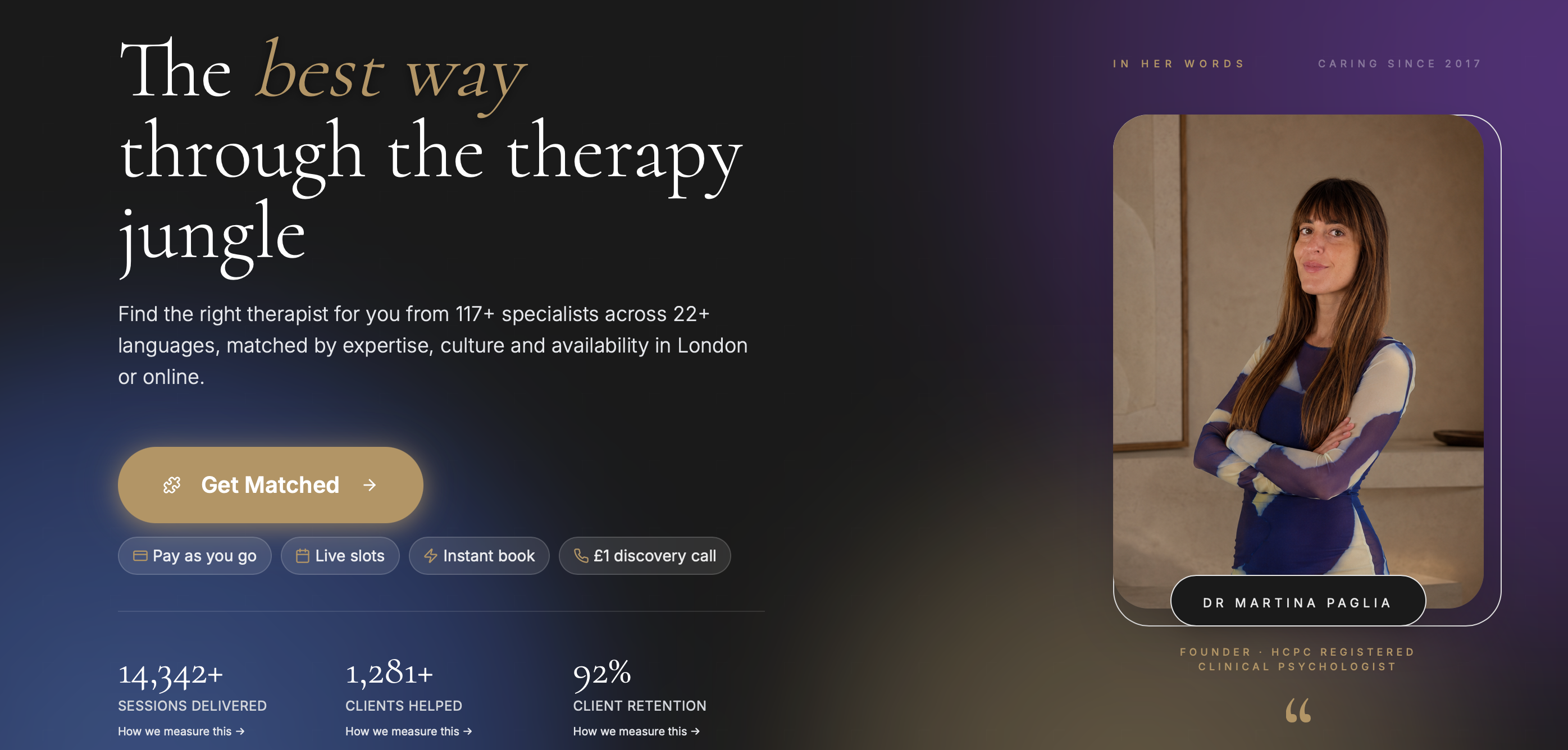
With hundreds of therapists working across more than 25 languages, Mind a Porter covers individual therapy, couples counselling, family therapy, and specialist assessments including ADHD, autism, and dyslexia, alongside modalities like CBT and EMDR. Many therapists provide a discovery call at a low cost, offering a way to check fit before committing to a full course, which matters given how much outcomes depend on that relationship. If you'd rather give someone else the gift of starting therapy, the Mind a Porter E-Gift Card covers sessions from £25 to £500. Book your discovery call today and get matched with a therapist who suits your needs, not just your postcode.
Sources
- NHS Talking Therapies monthly statistics, performance March 2026
- HMRC: Employment Income Manual EIM21845 (welfare counselling tax treatment)
- Private CBT cost in UK: session prices and course fees | All Health and Care
- Analysis of private pay and insurance acceptance among psychotherapy providers (peer‑reviewed article)
This article is general information, not a substitute for advice from a qualified doctor. Consult a qualified healthcare professional about your own circumstances before acting on anything here.
FAQ
Is private therapy worth it?
Private therapy is worth it when you need faster access, a specific specialism, or more choice over your therapist than local NHS provision allows. For many common presentations, NHS Talking Therapies delivers comparable, free care, so the value of paying privately depends on urgency and personal preference rather than clinical superiority.
Is NHS or private therapy better?
Neither is universally better; NHS Talking Therapies uses the same NICE-approved approaches private therapists use, and recent figures show roughly 88% of referrals starting within six weeks. Private therapy wins on speed, choice of practitioner, and specialist availability, while NHS care wins on cost, since it's entirely free.
Is therapy covered by the NHS in the UK?
Yes, NHS Talking Therapies provides free, NICE-approved counselling and CBT across England, with no charge to patients. Waiting times vary by area, though national reporting shows strong performance against the six-week access target in recent months.
I need therapy but can't afford it. What are some options I can try in England?
Start with NHS Talking Therapies, which is free and self-referral in most areas. Beyond that, sliding-scale charities, university training clinics, and low-cost online platforms typically charge £15 to £40 a session, and it's always worth asking a private therapist directly whether they hold reduced-fee slots.
How much does Mind a Porter charge for a first session?
Most therapists on Mind a Porter offer a discovery call for £1, a low-cost way to check fit before booking a full course. Full session prices vary by therapist and are available on the Mind a Porter site.
Keep Reading
Related Articles

Couples or Individual Therapy in the UK: An Evidence Led Way to Decide
Learn how to determine whether couples or individual therapy is the right choice based on your specific relationship dynamics, mental health needs, and safety.

32% Recovery After CBT for OCD: UK Evidence and How to Start
Discover how CBT and ERP work to treat OCD, review the latest recovery statistics, and learn practical steps to prepare for your first course of therapy.

Choose Right: Psychotherapy vs Counselling UK, 6–16 Sessions
Learn to distinguish between counselling and psychotherapy to determine which approach best addresses your specific needs, goals, and personal history.