
70% Symptom Free After EFT: Match Gottman vs EFT for UK Couples
Discover whether the emotional depth of EFT or the practical skill-building of the Gottman Method is the right therapeutic path for your relationship.

Clinically reviewed by
Dr Martina Paglia
Founder & CEO of Mind a Porter
HCPC-registered Clinical and Performance Psychologist · BSc, MSc, MA (Dist.), CP Licensure, MBA
Special interests include anxiety, depression, trauma, OCD, burnout, workplace stress, relationship difficulties and high-performance mental wellbeing.
Last reviewed: 24 September 2026
For deep emotional disconnection and attachment injuries, Emotionally Focused Therapy (EFT) usually fits best. For repeated conflicts and skill deficits, the Gottman Method often helps more. Both are evidence-based, and many skilled therapists blend the two rather than picking a side. The rest of this guide breaks down the research and helps you match your relationship's pattern to the right starting point.
TL;DR:
- EFT is best suited for couples with emotional disconnection, attachment injuries, or pursuit-withdraw patterns, requiring trust-building and vulnerability work.
- The Gottman Method effectively addresses couples with recurring arguments and poor conflict skills, emphasizing practical techniques and structured exercises.
- Combining both approaches is common; therapists often start with EFT to establish safety, then incorporate Gottman skills as the relationship stabilizes.
- Therapy outcomes are generally positive, with about 70% of couples symptom-free after EFT, especially those with higher initial distress or attachment anxiety.
- Picking a therapist trained in the specific model and prepared to adapt approaches increases the likelihood of effective, personalized support.
Table of Contents
- Gottman vs EFT: core focus, pace and fit
- How EFT and the Gottman Method actually work
- Which approach fits your relationship problem?
- How effective are EFT and the Gottman Method?
- What does therapy actually look like week to week?
- How do you choose the right therapist?
- A practitioner's view on choosing between the two
- Book a therapist trained in EFT or the Gottman Method
- Sources
- FAQ
Gottman vs EFT: core focus, pace and fit
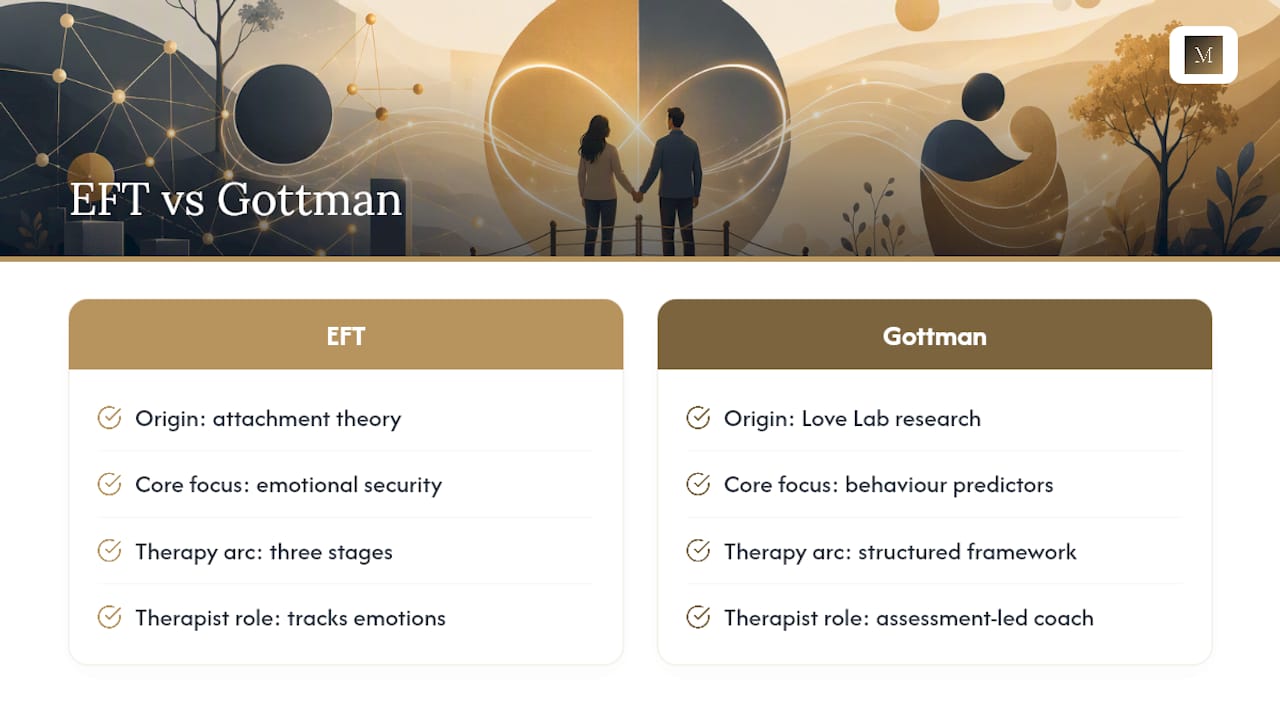
Emotionally Focused Therapy targets the emotional bond between partners. It treats conflict as a symptom of insecure attachment and works to rebuild felt safety before anything else. The Gottman Method, by contrast, treats conflict as a skills problem as much as an emotional one, drawing on decades of observed couple behaviour to teach specific, repeatable habits.
The choice between Gottman Method therapy and EFT relationship therapy often comes down to what is actually broken in the relationship.
- EFT core focus: attachment bonds, emotional accessibility, and repairing ruptures such as infidelity or emotional withdrawal.
- Gottman core focus: communication patterns, conflict management, and building shared meaning through structured exercises.
- Pace: EFT tends to move at the speed of emotional safety; Gottman work often follows a clearer, staged curriculum.
- Indicators for EFT: numbness, chronic distance, one partner pursuing while the other withdraws.
- Indicators for Gottman: the same arguments on repeat, poor conflict skills, a couple wanting concrete tools.
Many therapists trained in both traditions integrate them rather than choosing one exclusively, sequencing techniques according to what the couple needs at each stage.
How EFT and the Gottman Method actually work
Emotionally Focused Therapy grew out of attachment theory, the idea that adults seek the same emotional security from partners that children seek from caregivers. Sessions usually move through three stages: de-escalating the negative cycle, restructuring the interaction by accessing softer, more vulnerable emotions underneath the anger or shutdown, and then consolidating new patterns of reaching for each other. A skilled EFT therapist tracks the couple's moment-to-moment emotional shifts and choreographs exchanges designed to create a corrective emotional experience, not just insight.
A typical EFT moment: a withdrawn partner who usually says "I'm fine" is guided to admit, "I go quiet because I'm terrified of getting it wrong and disappointing you." That single sentence often shifts the whole room.
The Gottman Method comes from decades of observational research, sometimes called the "Love Lab" studies, which identified behaviours that reliably predict relationship breakdown. The most cited of these are the Four Horsemen: criticism, contempt, defensiveness, and stonewalling. Therapy is built around the Sound Relationship House framework, a structured model covering trust, commitment, conflict management, and shared meaning, with formal assessment and targeted skills training at each level.
A typical Gottman session: the therapist reviews assessment results and teaches a specific technique, such as the "softened startup," where a couple practises raising a complaint without blame, then rehearses it live.
Pro Tip: Ask a prospective therapist which framework they lean on for the first few sessions. Their answer tells you more about session style than any brochure will.
Which approach fits your relationship problem?
Matching the method to the problem saves time and money. Consider these patterns before booking:
- Choose EFT first if you feel emotionally disconnected, one of you shuts down under pressure, there's an attachment injury such as an affair, or you're stuck in a pursue-withdraw loop where one partner chases closeness and the other retreats.
- Choose Gottman first if you argue about the same three things repeatedly, you want practical communication tools you can use that week, or your relationship is fundamentally stable but conflict handling is poor.
- Consider an integrative therapist if your relationship shows both patterns, which is common. Clinical guidance suggests many practitioners use EFT to de-escalate a hostile or numb dynamic first, then bring in Gottman-style skills once emotional safety has returned, because teaching communication tools to a couple still in survival mode rarely sticks.
Couples recovering from infidelity or a major betrayal tend to need EFT's attachment repair work before any skills training makes sense. Couples who are simply exhausted by circular arguments, but not emotionally shut off from each other, often see faster results starting with Gottman's structured approach. If you're unsure which describes you, a good therapist will ask assessment questions in the first session that clarify it quickly, so this is not a decision you need to get perfectly right before you start.
How effective are EFT and the Gottman Method?
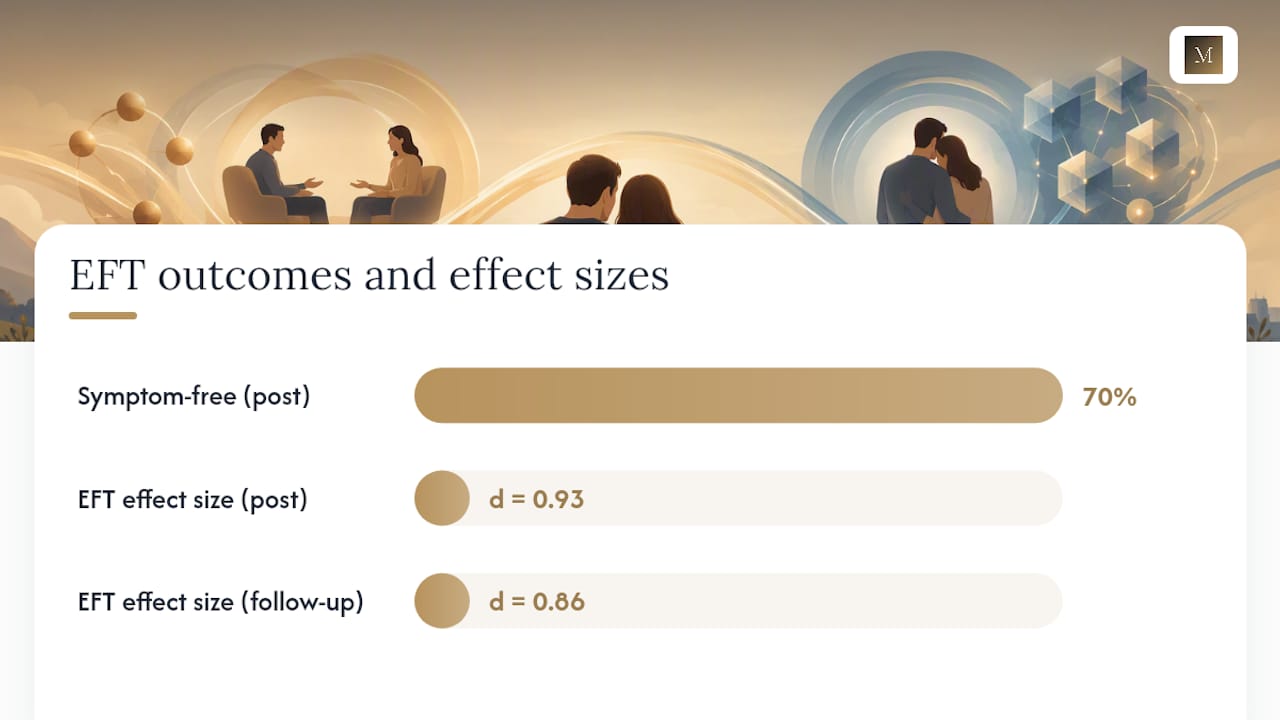
70% of couples were symptom-free by the end of treatment, according to a 2025 meta-analysis on Emotionally Focused Couple Therapy, which found a large pre-to-post treatment effect (d = .93). Gains held up at follow-up too, with an effect size of d = .86, suggesting the improvements are not simply a short-lived bounce from finishing therapy.
Couple therapy in general performs strongly across modalities. A broader 2020 meta-analysis of couple therapy outcomes reported large within-group effects on relationship satisfaction (Hedges g ≈ 1.12), with meaningful improvement across communication, intimacy, and partner behaviour, regardless of which specific model was used.
Outcomes aren't uniform, though. A few patterns worth knowing before you start:
- Higher baseline attachment anxiety and stronger emotional control both predict larger gains in EFT, meaning couples who feel more anxious about the relationship at the outset sometimes have further to climb, and do.
- Higher initial distress tends to predict bigger overall gains from couple therapy, which is a reason to seek help earlier rather than waiting for things to calm down on their own.
- No study promises a fixed number of sessions. Complex trauma or long-standing patterns generally take longer than a single presenting complaint.
Neither the Gottman Institute nor ICEEFT publishes a head-to-head trial pitting the two methods directly against each other, so claims that one is definitively more effective than the other outrun the current evidence.
What does therapy actually look like week to week?
Assessment style differs early on. Gottman-trained therapists typically start with the Gottman Relationship Checkup, a structured questionnaire covering conflict, trust, and shared goals, followed by individual interviews and a feedback session, an intake process that can extend the number of early contacts but gives both partners a clear roadmap. EFT intake instead maps the couple's negative cycle, identifying who pursues, who withdraws, and what triggers each move.
Homework reflects the same divide:
- Gottman homework tends to be exercise-based: structured conversations, rituals of connection, weekly check-ins.
- EFT homework is lighter on paperwork and heavier on noticing emotional patterns between sessions.
- Both approaches expect practice outside the therapy room, not just talking during the hour itself.
Session counts vary widely by couple, but complex attachment injuries or long-running contempt patterns generally need more time than a single, isolated argument style.
Online delivery works for both models, though some clinicians note that the intense emotional work central to EFT can be harder to hold safely over video for certain couples, particularly where dissociation or high distress is present. In-person sessions may suit that situation better, at least initially.
Pro Tip: If you're leaning towards EFT and considering online sessions, ask the therapist directly how they manage safety if a session becomes emotionally intense over video.
How do you choose the right therapist?
Training matters more than the label on the method. Ask these questions before booking:
- What's your training and supervision history? Look for completed levels through the Gottman Institute or certification through ICEEFT, not just a weekend workshop.
- How do you decide which model to use with a given couple? A thoughtful answer usually mentions assessment, not a fixed script.
- What does a typical caseload of couples work look like for you? Experience with couples specifically, rather than individual therapy alone, matters here.
- How do you handle safety concerns, such as high-conflict escalation or a disclosure of abuse, during sessions?
Watch for red flags: a therapist who insists their single model works for every couple, anyone who guarantees a specific outcome or timeline, and any provider who skips a proper intake or safeguarding conversation entirely.
If your relationship's main problem is obvious, an argument pattern, or a specific attachment wound, starting with a therapist trained in the matching model is reasonable. If your situation feels mixed, look for someone with integrative training who can move between frameworks as the work unfolds.
Pro Tip: A therapist confident enough to say "I'd actually recommend a different approach for this" is usually more trustworthy than one who fits every couple into their preferred framework.
A practitioner's view on choosing between the two
Both models earn their reputation. What decides outcomes more than the label is whether the therapist actually knows how to use it, and whether they are honest about switching approach when the first one isn't landing.
My advice: match the starting point to the presenting problem, emotional disconnection points towards EFT, repeated conflict points towards Gottman, but ask any prospective therapist directly whether they can move between frameworks. Rigid loyalty to one method, regardless of what the couple in front of them actually needs, is the pattern to avoid. Services like Mind a Porter exist precisely because matching a couple to the right trained therapist, not just the right method, is where the real work happens.
— Dr Martina Paglia
Book a therapist trained in EFT or the Gottman Method
Finding a therapist who genuinely specialises in the approach your relationship needs shouldn't mean weeks of cold emails and unanswered enquiries. Mind a Porter connects you directly with qualified couples therapists across London and UK-wide, filtered by specialism, so you can search specifically for Gottman Method or Emotionally Focused Therapy training rather than guessing from a generic bio page.
Booking starts with a low-cost Discovery Call for £1, giving you a chance to describe your relationship's specific pattern before committing to full sessions. From there, you can browse couples counselling and other therapy options filtered by modality, language, and availability, with no waiting list standing between you and a first appointment. If a session as a gift feels more fitting for someone close to you, gift cards from £25 to £500 cover that too. Start with the discovery call and describe what's actually happening in your relationship. The right therapist match follows from there.
Sources
The research and outcome figures in this guide draw on the 2025 meta-analysis on Emotionally Focused Couple Therapy, the 2020 meta-analysis of couple therapy outcomes, and research on predictors of EFT outcomes. For training pathways and method background, the Gottman Institute's own comparison and practitioner guidance on combining the two frameworks offer useful further reading. Prospective clients researching therapist credentials can also check professional body listings such as AAMFT.
This article is general information, not a substitute for advice from a qualified doctor. Consult a qualified healthcare professional about your own circumstances before acting on anything here.
- A comprehensive meta-analysis on the efficacy of Emotionally Focused Couple Therapy
- Meta-analysis of couple therapy: Effects across outcomes, designs, timeframes, and other moderators
- Predictors of outcome in emotionally focused couple therapy
FAQ
Is EFT incompatible with the Gottman Method?
No, the two are not incompatible, and many trained therapists combine them deliberately. A common pattern is using EFT to de-escalate a hostile or shut-down dynamic first, then introducing Gottman-style communication skills once the couple feels emotionally safer with each other.
How successful is EFT for couples?
A 2025 meta-analysis found that approximately 70% of couples were symptom-free by the end of treatment, with gains sustained at follow-up. Couples with higher baseline attachment anxiety sometimes show larger gains, according to separate outcome research.
What are the criticisms of the Gottman Method?
Critics point out that its assessment-heavy intake process can feel clinical or slow for couples wanting immediate emotional relief, and that its skills focus can undertreat deeper attachment wounds if used alone. Some clinicians argue it works best paired with an emotion-focused approach for couples dealing with disconnection rather than just conflict habits.
What are the red flags to watch for in a Gottman-trained therapist?
Be wary of a therapist who applies the framework rigidly regardless of what a couple actually presents with, or who skips proper assessment and safeguarding conversations. A guarantee of a specific outcome or session count is also a warning sign, since no reputable model promises that.
Can Mind a Porter help me find an EFT or Gottman therapist?
Yes. Mind a Porter's therapy services let you filter by specialism, so you can search specifically for therapists trained in Emotionally Focused Therapy or the Gottman Method and book without a waiting list.
Keep Reading
Related Articles

5 Vetting Questions to Find ERP Care in the UK: ERP vs CBT for OCD
Learn how to distinguish specialized ERP from generic CBT and discover the five essential questions to ask when vetting an OCD therapist in the UK.

Start Therapy This Week: W‑CBT for Work Stress in the UK
Discover how work-focused CBT can help you manage career-related stress and effectively navigate the UK healthcare system to access timely professional support.

£40–£250: Private Therapy Cost in England, Book Fast Via Mind a Porter
Navigate the private therapy market in England by understanding session pricing, cost-saving strategies, and the trade-offs between public and private care.