
Prepare in 15 Minutes for Your First Therapy Session in the UK
Learn how to efficiently prepare for your initial therapy intake, understand what to expect during the session, and identify key signs of a good therapist.

Clinically reviewed by
Dr Martina Paglia
Founder & CEO of Mind a Porter
HCPC-registered Clinical Psychologist
Special interests include anxiety, depression, trauma, OCD, burnout, workplace stress, relationship difficulties and high-performance mental wellbeing.
Last reviewed: 7 November 2026
All health information on Mind a Porter is clinically reviewed by our clinical lead. These resources are educational and do not replace professional advice.
Your first therapy session is an intake assessment lasting roughly 45 to 60 minutes, designed as much for you to size up the therapist as for them to understand you. Discovery calls, by contrast, run shorter, usually 10 to 20 minutes. You don't need a polished life story or a tidy explanation of what's wrong. Turning up is enough.
TL;DR:
- The first therapy intake usually lasts 45 to 60 minutes and follows a structured format of consent, history, and next steps, helping you understand what to expect.
- Preparing a clear one-sentence explanation for "why now" and testing your tech ahead of the session can reduce nerves and technical disruptions.
- Asking about the therapist's approach, boundaries, confidentiality, and fees ensures you're comfortable and can evaluate if they are a good fit for your needs.
- Red flags include pressure to disclose too much early, vague confidentiality answers, boundary violations, or judgmental language, prompting consideration to find a different therapist.
- A discovery call with Mindaporter costs £1 and allows quick compatibility assessment before committing to a full intake.
Table of Contents
- What happens in the first counselling session?
- How do I prepare for therapy in 15 minutes?
- What should I bring, and what should I ask?
- How do you know if a therapist is the right fit?
- What happens after the first session?
- How Mindaporter gets you from decision to first session
- A short word on starting therapy
- Book a discovery call with Mindaporter
- Sources
- FAQ
What happens in the first counselling session?
A first session follows a fairly predictable rhythm, even though every therapist has their own style. Knowing the shape of the hour in advance takes the edge off, because you stop wondering what's coming next and can focus on answering honestly.
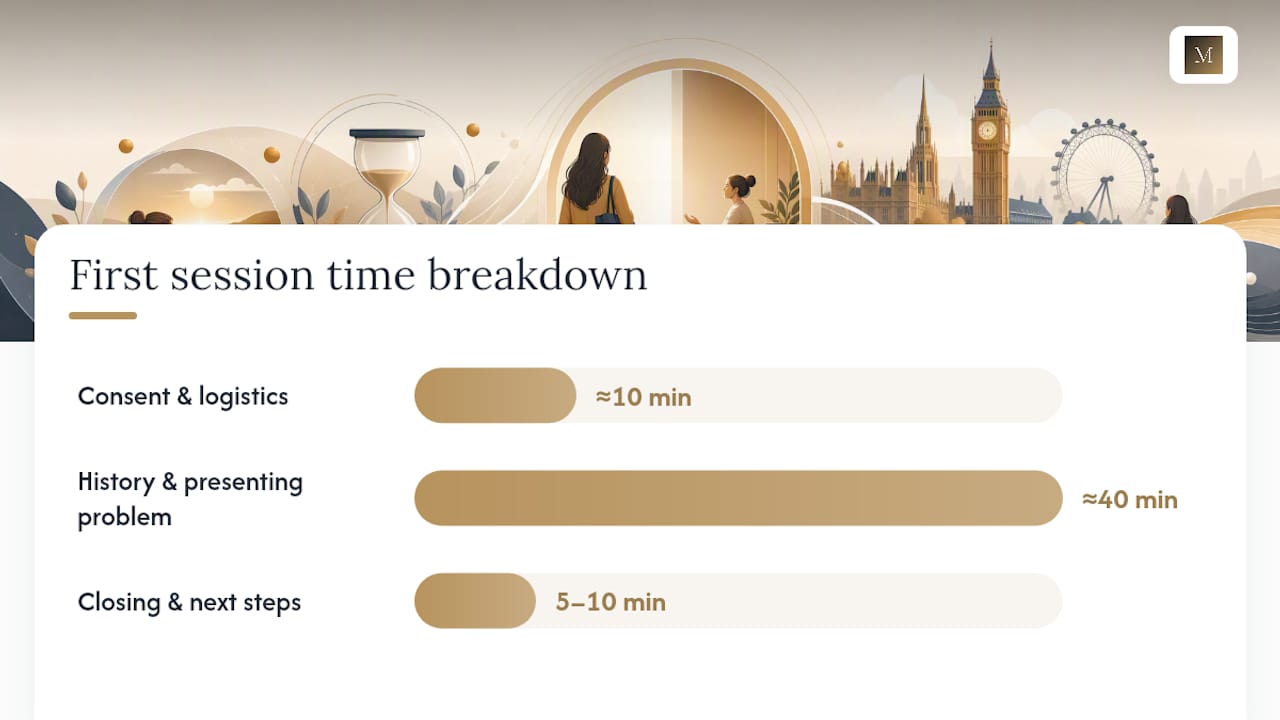
Most clinicians work through three broad stages. The BSMHFT breaks a typical intake into roughly 10 minutes on consent and logistics, 40 minutes on history and the presenting problem, and 5 to 10 minutes summarising impressions and agreeing next steps.
- Consent and confidentiality. Your therapist explains how sessions work, what stays private, and the specific limits on confidentiality, such as risk to yourself or others. This comes early because you need to know the rules before you start talking.
- The main interview. Expect questions about why you're seeking help now, how your difficulties show up day to day, sleep, substance use, relationships, and relevant history. Routine screening questions about risk are standard safety practice, not a judgement on you, so answer them plainly.
- Closing and next steps. Towards the end, a competent therapist will offer an early impression and a suggested focus for future work, drawing on what clinicians typically frame as an intake structure: consent, history, and a closing plan.
Many therapists also use short screening tools such as the PHQ-9 for depression or the GAD-7 for anxiety. These give a baseline score, not a diagnosis on their own, and get repeated later to track whether things are improving. Notes from the session go into a confidential clinical record, kept under the same rules covered in that opening consent conversation.
Pro Tip: If your therapist doesn't offer a short summary before the session ends, ask for one. It's a completely reasonable request, and most will give you a working impression on request.
If you've booked a discovery call rather than a full intake, expect something lighter: a quick conversation about what you're looking for, availability, and whether the therapist feels like a workable match, all inside 20 minutes.
How do I prepare for therapy in 15 minutes?
Preparation for a first counselling session doesn't need to be elaborate. A few focused minutes beforehand does more for your nerves than hours of rehearsing what to say.
- Write one sentence on "why now." What tipped you into booking this session, rather than last month or last year? A single clear sentence beats an over-prepared life story, and gives your therapist an immediate thread to follow.
- Test your tech if the session is online. Check your camera, microphone, and internet connection the day before, not five minutes beforehand. Testing your setup in advance and choosing a private space with headphones cuts out the interruptions that derail a session just as it's getting started.
- Sort the practical logistics. Have your payment method or insurance details ready, along with a current medication list if applicable, and any forms the practice sent you.
- Think about timing either side. Booking earlier in the day tends to suit people who find themselves ruminating before evening appointments. Leave some quiet time afterwards too, rather than jumping straight into a meeting or the school run.
None of this needs to be exhaustive. The point of prepping is to lower friction on the day, not to write an essay about your life.
What should I bring, and what should I ask?
A short checklist covers most of what you'll actually need in the room or on the call.
Bring or have ready:
- Payment method or insurance details, if your sessions are covered
- A current medication list, including dosage and how long you've been taking each one
- Prior clinical records or a referral letter, if relevant to your history
- Your one-sentence "why now," plus a few concrete examples of recent symptoms or incidents
Questions work both ways in this room, and a first counselling session is your chance to check the fit before committing further. Reasonable questions to raise include the therapist's training and accreditation, which therapeutic approach they use and why it might suit your situation, how clinical supervision works for them, and what the exact limits on confidentiality are. It's also fair to ask about cancellation policy and fees upfront, and how they handle your data and emergency contact procedures if something urgent comes up between sessions.
How do you know if a therapist is the right fit?
Deciding whether a therapist suits you matters more than most people expect. The quality of that working relationship, often called the therapeutic alliance, is one of the strongest predictors of whether therapy actually helps, so it's worth taking seriously rather than dismissing as a soft factor.

Signs of a good fit tend to be straightforward: you felt genuinely heard, the therapist explained their thinking clearly, you left with something that resembled a collaborative plan rather than a lecture, and boundaries around time and confidentiality were transparent from the start.
Red flags are just as recognisable once you know to look for them:
- Pressure to disclose more than you're comfortable with, especially in session one
- Vague or shifting answers about confidentiality limits
- Boundary violations, such as unclear session timing or inappropriate personal disclosure
- Dismissive, shaming, or judgemental language about your experiences
Pro Tip: Give it two or three sessions before making a final call on fit, not just one. Nerves and unfamiliarity in session one can easily masquerade as a mismatch that isn't really there.
If something feels off, raise it directly with the therapist first. Ask for an adjustment, whether that's pacing, approach, or how a topic gets handled. If concerns persist past that conversation, it's entirely reasonable to look elsewhere. Checking that a therapist holds accreditation through a recognised body such as the BACP, BABCP, or UKCP, and that they work under regular clinical supervision, gives you a solid baseline of trust before you even get to the personal chemistry.
What happens after the first session?
Most therapists close the intake with an early impression and a proposed focus for the work ahead, even if it's provisional. That summary matters because it gives you something concrete to react to, rather than leaving the whole hour feeling open-ended.
Expect the practical side to follow shortly after:
- A proposed session frequency, commonly weekly to start
- Baseline measures like the PHQ-9 or GAD-7 repeated at intervals to track change over time
- A rough sense of what the next few sessions will focus on
It's also normal to feel drained once the call ends. A first counselling session covers a lot of emotional ground in a short window, so give yourself some downtime rather than diving straight into other demands. Jotting a few reflections while they're fresh can help you notice patterns before the next session, and it also gives you material to raise if something about the fit or the plan needs revisiting.
How Mindaporter gets you from decision to first session
Mindaporter connects you with therapists across the UK and online, matched on specialism, language, and cultural background rather than whoever happens to have a free slot. The platform covers modalities including CBT, EMDR, and psychodynamic work, alongside couples and family therapy, without a waiting list standing between you and a booking.
A discovery call through Mindaporter works differently from a full intake. It's a shorter conversation focused on compatibility rather than clinical history, so all you really need ready is your one-sentence "why now" and a rough idea of what you're looking for in a therapist.
A short word on starting therapy
Feeling nervous before a first session is genuinely common, and therapists expect it and know how to work with it rather than around it. Preparation helps, but it doesn't need to be perfect. Give the relationship two or three sessions before deciding whether it fits, and don't hesitate to ask direct questions about boundaries, confidentiality, or how your records are kept. You're allowed to be curious about the process you're paying for.
Book a discovery call with Mindaporter
Mindaporter's discovery call costs £1 as a one-off fee and exists precisely for the moment you've just read about: checking compatibility before committing to a full intake. It's a short conversation about what you need, what a therapist offers, and whether the working relationship feels workable, plus the practical admin of scheduling and payment sorted out in advance.

Booking takes a few minutes. Have your one-sentence "why now" ready, along with a sense of language, cultural background, or specialism preferences, since matching is built around exactly those factors. From there, you can move straight into individual therapy, couples counselling, or one of the other services Mindaporter offers, depending on what the discovery call surfaces. If you're arranging support for someone else, a Mindaporter e-gift card covers sessions from £25 to £500. A discovery call isn't the only route into therapy, but it's a fast, low-cost way to check the fit before you commit further.
To arrange a first session, you can get matched with a therapist in a few minutes.
You can read more about private therapy in London and how sessions are structured.
Sources
- What to expect from your first therapy session | BSMHFT
- Your first therapy session | Psychology Today
- Your first therapy session: What to expect | Cerevity
- Preparing for your first therapy session | Grow Therapy
This article is general information, not a substitute for advice from a qualified doctor. Consult a qualified healthcare professional about your own circumstances before acting on anything here.
FAQ
What do you do in your first therapy session?
You'll cover consent and confidentiality, then move into a main interview about why you're seeking help now, your history, and daily life, before closing with an early impression and suggested next steps. The whole process typically takes 45 to 60 minutes.
Is the first therapy session the hardest?
Many people find it the most nerve-wracking simply because it's unfamiliar, but it's rarely the hardest in terms of emotional depth. Feeling anxious beforehand is extremely common, and therapists are trained to help you settle in rather than expect a polished performance.
What is a red flag in therapy?
Red flags include pressure to disclose more than you're comfortable with, vague answers about confidentiality limits, boundary violations, or dismissive and shaming language. If any of these persist beyond a conversation with the therapist about it, it's reasonable to look elsewhere.
Is it normal to feel anxious before my first therapy session?
Yes, it's one of the most common feelings people report beforehand. Therapists expect this and will usually invite you to name the nerves directly, since normalising pre-session anxiety is a standard part of how a first session opens.
How much does a discovery call with Mindaporter cost?
A discovery call through Mindaporter costs £1 as a one-off fee. It's a short compatibility check rather than a full clinical intake, designed to help you decide on fit before booking further sessions.
Next Step
Reading is a start. Talking is the next step.
Tell us what you are looking for and we will match you with a qualified therapist who fits. Online across the UK, or in person in London.
Professional Support
Find the Right Therapy
Explore specialist treatment options related to this article.
Keep Reading
Related Articles

Therapy and Medication Together: Why the Combination Often Works Better
Many people recovering from depression or anxiety find that therapy and medication work better as a pair than either does alone. Here's what the evidence says, and how to make the combination work for you.

How long does therapy take to work? A realistic timeline
The first change usually arrives in weeks three to six, but a full course runs longer. What the timeline really looks like, week by week.

Grief Counselling Options in the UK: How to Choose
Navigate the UK's bereavement support landscape by comparing costs, accessibility, and types of care to find the right therapeutic path for your specific needs.