
Six to 12 Months to Rebuild Trust: UK Couples Therapy for Infidelity
Discover the essential phases of infidelity recovery, proven therapeutic methods, and the practical steps to finding the right UK specialist for your healing journey.

Clinically reviewed by
Dr Martina Paglia
Founder & CEO of Mind a Porter
HCPC-registered Clinical and Performance Psychologist · BSc, MSc, MA (Dist.), CP Licensure, MBA
Special interests include anxiety, depression, trauma, OCD, burnout, workplace stress, relationship difficulties and high-performance mental wellbeing.
Last reviewed: 22 September 2026
Couples therapy for infidelity can help partners rebuild trust and repair a relationship, but only when both people commit to the process and basic safety is established first. Expect a staged path: creating safety, processing betrayal trauma, building accountability, and gradually restoring intimacy. Approaches such as Emotionally Focused Therapy, the Gottman Trust Revival Method, and trauma-informed care all offer proven routes, and platforms like Mind a Porter can match UK couples with a specialist quickly.
TL;DR:
- Safety measures such as ending contact with the affair partner and establishing transparency are essential before progressing in therapy.
- The recovery process typically involves three phases: stabilization, acute processing, and rebuilding trust, which can take six to twelve months or longer.
- Effective therapy combines approaches like EFT, Gottman trust revival, and trauma-informed care, tailored to the couple's evolving needs.
- Choosing a therapist with specific experience in infidelity, trauma, and couples work is crucial, and clear questions about credentials and methods help identify the right fit.
- Couples should avoid joint therapy during ongoing contact with the affair partner or if safety concerns, severe shame, or active addiction are present, prioritizing individual support first.
Table of Contents
- What does couples therapy for infidelity actually involve?
- What happens in the first few sessions?
- Which therapy approaches work best for affair recovery?
- How long does rebuilding trust actually take?
- How do you choose the right therapist for this work?
- When is couples therapy not the right first step?
- How Mind a Porter supports couples through affair recovery
- The messy reality no one puts in the brochure
- Ready to book a therapist who understands affair recovery?
- Sources
What does couples therapy for infidelity actually involve?
Affair recovery counselling differs from general marriage counselling. Where standard couples therapy might focus on communication styles or shared goals, therapy for infidelity starts by treating the affair as a trauma event, and works to establish safety before anything else.
That safety work is concrete, not abstract. In the earliest sessions, therapists usually ask for specific agreements:
- Ending all contact with the affair partner, including deleting numbers and blocking social media
- Basic transparency around phone access, whereabouts, and finances
- Clear boundaries about what information gets shared, and when
- A plan for managing emotional flooding when sessions get overwhelming
Emotional flooding is common and expected. The betrayed partner may cycle through anger, numbness, and intrusive images of the affair within a single session. A skilled therapist slows the pace, teaches grounding techniques, and prevents the room becoming a second wound.
Guided disclosure is one of the more misunderstood parts of the work. It is not a demand for every explicit detail. Therapists help the unfaithful partner share what the betrayed partner genuinely needs to know, at a pace that avoids re-traumatising anyone, while discouraging drip-fed confessions that reopen the wound weeks later.
Most practitioners blend individual and joint sessions. The unfaithful partner often needs private space to process shame without performing contrition in front of their partner, while the betrayed partner may need somewhere to voice rage or grief that would derail joint work. Combined formats like this are common in practice and often improve outcomes for both people.
Three outcomes are all realistic, and a competent therapist will name this early: full repair and reconnection, a structured separation handled with less damage, or one partner choosing individual therapy to process the relationship's end. Therapy is not designed to save every relationship. It is designed to help both people make an informed decision and survive the process with less lasting harm.
What happens in the first few sessions?
The opening sessions follow a fairly predictable shape, even though every couple's story is different.
- Intake and safety screening. The therapist asks about the affair's timeline, whether contact has genuinely ended, and screens for abuse, coercive control, or acute risk before agreeing to joint work.
- History taking. Expect questions about the relationship before the affair, prior betrayals, and each partner's attachment history, since old wounds often shape how someone reacts now.
- Individual goals. Each partner is usually asked, separately or in the room, what they actually want: reconciliation, clarity, or simply to stop hurting long enough to think straight.
- Ground rules. The therapist sets out their role as mediator and boundary enforcer, not judge, and explains how sessions will be structured going forward.
- A decision point on pacing. Some couples move straight into joint work; others benefit from a few weeks of individual sessions first, particularly if one partner is in acute crisis.
Preparation genuinely helps. Write down the two or three questions you most need answered before the first session, rather than trying to say everything at once. Think about what you will tell children, if there are any, and agree this with your partner beforehand rather than improvising under stress. Confirm confidentiality arrangements, especially if you share a therapist with mutual friends or a small community.
Pro Tip: Bring a notebook to early sessions. Betrayal trauma disrupts memory and concentration, and you will forget half of what gets agreed within 48 hours without writing it down.
There is no single right answer on whether to start immediately or wait. What matters more is that the decision is made together, rather than one partner forcing the pace on the other.
Which therapy approaches work best for affair recovery?
No single method suits every couple, and most experienced therapists draw from several.
- Emotionally Focused Therapy (EFT) treats the affair as an attachment injury. It works well when a couple's fights are really about disconnection and fear of abandonment rather than the facts of the affair itself, and it aims to make both partners more emotionally accessible to each other.
- The Gottman Trust Revival Method offers a structured three-phase route: atone, attune, attach. The unfaithful partner first takes full responsibility without minimising or deflecting; the couple then works on understanding what made the relationship vulnerable; only later do they rebuild connection and intimacy.
- Trauma-informed and integrative models treat the betrayed partner's symptoms, hypervigilance, intrusive thoughts, sleep disruption, as a genuine trauma response rather than "overreacting." A staged integrative approach combining cognitive-behavioural and insight-oriented techniques has research backing for exactly this kind of presentation.
- EMDR (Eye Movement Desensitisation and Reprocessing) is sometimes used alongside couples work, usually in individual sessions, when the betrayed partner has flashbacks or intrusive images that couples therapy alone struggles to shift.
- CBT helps address the anxious thought spirals and checking behaviours (scrolling a partner's phone at 2am, for instance) that keep both partners locked in a hypervigilant loop.
A therapist trained across these approaches will typically move between them as the couple's needs change, leaning on EFT for connection work one month and CBT for intrusive thoughts the next.
How long does rebuilding trust actually take?
Recovery tends to move through three recognisable phases, though the timeline varies enormously between couples.
- Stabilisation. The immediate priority is stopping further harm: ending contact, agreeing transparency measures, and reducing the sense of ongoing threat. This phase often softens within weeks to a couple of months, though the intensity rarely disappears that fast.
- Acute processing (one-way repair). The unfaithful partner needs to bear witness to their partner's pain without becoming defensive, explaining themselves, or rushing to be forgiven. This is often the hardest phase for the unfaithful partner emotionally, and the most necessary one for the betrayed partner's healing.
- Rebuilding. Communication patterns improve, trust behaviours become consistent rather than performative, and intimacy is reintroduced gradually, usually well after the emotional groundwork is done rather than before it.
Deeper trust repair commonly takes six to twelve months or longer, and some couples continue lighter maintenance work well beyond that. Pace depends heavily on whether secrecy has genuinely ended, whether addiction or compulsive behaviour is involved, and whether the unfaithful partner's accountability is consistent rather than sporadic. Couples who backslide into half-disclosures tend to restart the acute processing phase from closer to the beginning.
How do you choose the right therapist for this work?
Not every couples counsellor has real experience with infidelity, and choosing the wrong one can waste months.
Start with credentials. Look for professional registration (BACP, UKCP, or an equivalent recognised body), plus specific training in couples work and trauma-informed care, not just a general counselling qualification. Ask directly whether they have handled affair recovery before, and which modalities they actually use: EFT, the Gottman method, EMDR, or an integrative mix.
Practical questions matter just as much as clinical ones:
- What does a typical session structure look like, and how often will we meet?
- What are your fees, and what is your cancellation policy?
- How do you handle confidentiality if we have mutual friends or overlapping social circles?
- What is your approach if one of us wants to end contact with the therapist mid-process?
High client satisfaction rates are a useful indicator to ask about, as they reflect whether couples generally feel the process helped rather than harmed them.
Watch for red flags. A therapist who minimises the affair's impact, promises fast forgiveness, or suggests surveillance apps and tracking as a "solution" is not practising trauma-informed care. Rebuilding trust is behavioural and relational, not technological. A matching platform such as Mind a Porter shortens this search considerably, since it filters therapists by specialism and language before you ever book a call, rather than leaving you to vet credentials from a static directory.
When is couples therapy not the right first step?
Joint sessions are unlikely to help while an affair is still active or contact with the affair partner continues. Safety has to come first.
- If there is abuse, coercive control, or a significant safety risk, prioritise individual safety planning over joint work
- Severe shame, active addiction, or acute suicidality usually call for individual therapy before couples sessions begin
- A therapist who blames the betrayed partner, has no safety plan, or pushes fast reconciliation is a red flag worth acting on
- If you hit any of these signs, seek a second opinion, raise concerns with the therapist's professional body, or pause joint sessions until individual support is in place
How Mind a Porter supports couples through affair recovery
Mind a Porter matches couples with therapists by specialism, language, and availability, so you are not stuck choosing between whoever has a free slot and whoever actually understands affair recovery. The platform lists therapists trained across CBT, EMDR, and EFT, covering both the trauma-processing and attachment-repair sides of this work.
The numbers reflect that fit matters: Mind a Porter reports a very high client satisfaction rate across many sessions delivered, with therapists working in a wide range of languages. For couples where one partner is more comfortable working in a first language, that range genuinely changes what "good fit" means clinically, not just culturally.
Booking follows a straightforward path:
- Complete a short intake describing what you need, including specialism and language preference
- Get matched with a therapist without a waiting list
- Book a first session, which typically opens with the same safety screening and history-taking described earlier in this guide
The messy reality no one puts in the brochure
Most guides on this subject promise too much or too little. They either suggest three sessions will fix everything, or they treat every affair as a relationship death sentence. Neither is honest.
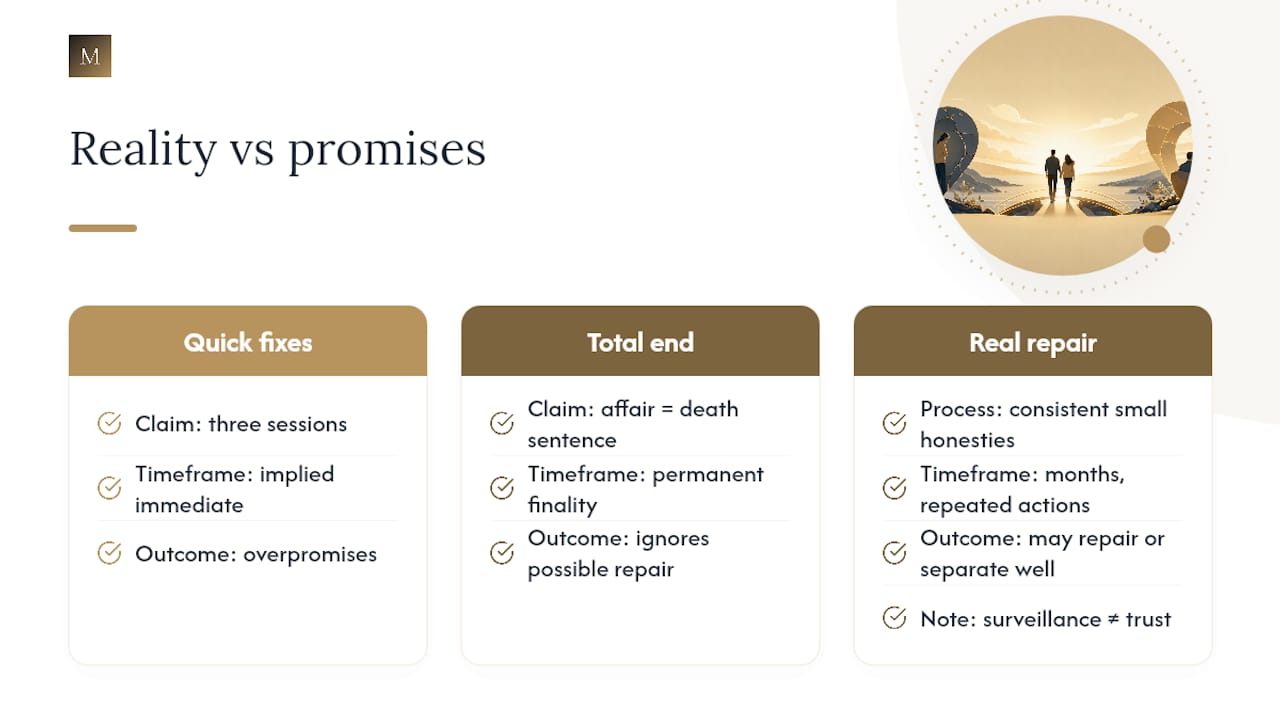
What tends to get missed is that a "good" outcome sometimes looks like separating well rather than staying together badly. Surveillance, tracking apps, constant location checks, feels like control, but it is not trust, and it will not become trust with enough time. Real repair is slower and less dramatic: consistent small honesties, repeated over months, that eventually outweigh one enormous dishonesty.
If you are reading this mid-crisis, the only decision that matters today is whether you are both willing to sit in a room with someone qualified and find out what is actually possible.
Ready to book a therapist who understands affair recovery?
Mind a Porter is the practical alternative to spending weeks scrolling directories and cold-calling practices that may not even specialise in infidelity work. Its matching filters connect you directly with therapists experienced in EFT, EMDR, and CBT, chosen for your specific situation, language, and availability, with no waiting list standing between you and a first appointment.
Booking starts with a short questionnaire on Mind a Porter's platform, where you outline what you are dealing with and what kind of therapist you are looking for. From there, matching happens quickly, and your first session can be scheduled without the usual multi-week wait most couples face when searching alone.
This article is general information, not a substitute for advice from a qualified doctor. Consult a qualified healthcare professional about your own circumstances before acting on anything here.
Sources
Keep Reading
Related Articles

How to choose a therapist who is right for you
Learn how to find the ideal therapist by prioritizing personal rapport and using discovery calls to ensure the right fit for your mental health goals.

Betrayal trauma therapy: how it helps you heal and stabilise
Discover how a paced therapeutic approach prioritizes nervous system regulation and stability before addressing the deeper wounds of betrayal trauma.

Questions to Ask When Choosing a Therapist
A practical guide to the questions that matter when choosing a therapist — qualifications, approach, style, practicalities, the therapeutic relationship, and what to listen for beyond the answers — with a quick-reference summary.