
Yes, therapy helps adults with ADHD: what to try first
Discover effective therapeutic approaches for managing adult ADHD and learn practical steps to access support regardless of your formal diagnosis status.

Clinically reviewed by
Dr Martina Paglia
Founder & CEO of Mind a Porter
HCPC-registered Clinical Psychologist
Special interests include anxiety, depression, trauma, OCD, burnout, workplace stress, relationship difficulties and high-performance mental wellbeing.
Last reviewed: 7 November 2026
All health information on Mind a Porter is clinically reviewed by our clinical lead. These resources are educational and do not replace professional advice.
Therapy works for adults with ADHD. Evidence-backed approaches such as cognitive behavioural therapy (CBT), ADHD coaching, mindfulness and dialectical behaviour therapy (DBT) reduce functional impairment and teach skills that last well beyond the session room. Therapy commonly runs alongside medication, but it can start before a formal diagnosis or without one at all. If you're wondering what to do this week rather than this year.
- Speak to your GP about a referral or interim support
- Check charity resources such as ADHD UK for local groups and guidance
- Try an online platform if NHS waiting lists feel too long for your current situation
Key Takeaways
Cognitive behavioural therapy has the strongest evidence base for adult ADHD, but coaching, DBT-adapted skills work, and family therapy each address gaps that CBT alone doesn't cover.
| Point | Details |
|---|---|
| CBT leads the evidence | Systematic reviews rank CBT as the most studied non-pharmacological treatment for adult ADHD. |
| No diagnosis needed to start | Many therapists and coaches address ADHD traits before or without a formal assessment. |
| DBT suits emotional reactivity | Adapted DBT skills help adults whose ADHD includes rejection sensitivity or mood swings. |
| Family therapy reduces friction | Couples and family sessions reframe ADHD behaviours as symptoms, not character flaws. |
| Mind a Porter offers fast access | The platform matches clients to ADHD-aware therapists across 22+ languages with no waiting list. |
Table of Contents
- [Types of ADHD therapy for adults and what each one targets](#types-of-adhd-therapy-for-adults-and-what-each-one-targets)
- What can therapy actually achieve, and how long does it take?
- Do you need a diagnosis before starting therapy?
- How to choose a therapist or coach for adult ADHD
- NHS, private and online access: costs and waiting times compared
- What does the evidence actually say?
- Can DBT be adapted specifically for adult ADHD?
- Why therapy for ADHD adults looks different from standard talking therapy
- How family and couples therapy supports adults with ADHD
- Combining therapy with daily habits that actually stick
- What does ADHD therapy cost, and does insurance cover it?
- How Mind a Porter gets you to the right ADHD-aware therapist faster
- A practical note on starting sooner rather than later
- Frequently asked questions
- Sources
Types of ADHD therapy for adults and what each one targets
Not every therapy does the same job, which is why matching the approach to the problem matters more than picking the "best" one in the abstract.
CBT for ADHD focuses on the practical stuff: breaking tasks down, building planning systems, and catching the unhelpful thoughts ("I always fail at this") that follow years of missed deadlines. It's the approach with the deepest evidence base for adults, according to NHS guidance.
ADHD coaching and executive-function coaching sit outside clinical therapy but fill a real gap. A coach helps you build routines, holds you accountable week to week, and works directly on task initiation and time-blindness rather than exploring underlying emotions.
DBT and emotional regulation work suits adults whose ADHD comes with intense emotional reactivity, rejection sensitivity, or rapid mood swings that CBT alone doesn't fully address.
Mindfulness-based programmes, often run in groups, train attention control and reduce the reactivity that fuels impulsive decisions.
Other options exist, with far less consistency behind them:
- Interpersonal therapy, for relationship-focused difficulties
- Occupational therapy, for workplace adaptations
- Neurofeedback, where evidence remains mixed and inconclusive
Pro Tip: Ask any prospective therapist which modality they'd start with for your specific complaint. A vague answer is often a sign they don't specialise in adult ADHD.
What can therapy actually achieve, and how long does it take?
Therapy and medication solve different problems. Medication typically manages core symptoms like inattention and hyperactivity in the moment. Therapy builds the skills and habits that stop those symptoms wrecking your calendar, your relationships and your self-esteem long term. Confusing the two leads to disappointment either way.
A rough timeline for CBT:
- Weeks 1 to 4: assessment, goal-setting, and early strategies for one or two specific problems (usually time management or organisation)
- Weeks 5 to 12: skills practice and troubleshooting, often within an 8 to 20 session package
- Ongoing: coaching or top-up sessions for maintenance, particularly around big life transitions
The systematic review published in Psychological Medicine found CBT has the strongest evidence base of any non-pharmacological intervention studied for adult ADHD, though it works best when paired with clear, measurable goals rather than vague hopes of "feeling better." Review progress every 6 to 8 weeks and adjust the plan if a goal isn't moving.
Do you need a diagnosis before starting therapy?
No, not always. Many therapists and coaches work with ADHD-type traits, executive function struggles and emotional dysregulation without requiring a formal diagnosis first, and charity guidance on ADHD treatments backs this approach for adults who want support now rather than after months on an assessment list.
A formal diagnosis becomes worth pursuing when:
- You're considering medication, which requires a clinical diagnosis
- You need documentation for workplace adjustments or educational support
- You want confirmation because symptoms are affecting major life decisions
Assessment routes include an NHS referral through your GP, private clinics offering faster turnaround for a fee, and second-opinion services when an earlier assessment felt rushed or incomplete. If you've had a diagnosis that didn't sit right, this practical guide to getting an ADHD second opinion walks through when that step is worth taking.
How to choose a therapist or coach for adult ADHD
Credentials matter here more than in general counselling, because ADHD-specific training isn't universal even among qualified therapists.
- Check specialism first. Ask directly how many adult ADHD clients they've worked with, not just whether they "understand" ADHD.
- Confirm registration. For therapists, look for BACP accreditation or an equivalent body; coaches should belong to a recognised coaching association.
- Decide practical fit. Online versus face-to-face, session length, frequency, and whether they work in your preferred language all affect whether you'll actually keep appointments.
- Ask outcome-focused questions. How many sessions do they typically recommend, how do they measure progress, and what's their cancellation policy?
Watch for red flags: anyone promising a guaranteed cure, unable to name a professional registration, or applying sales pressure to book multiple sessions upfront.
Pro Tip: Write your screening questions down before the first call. ADHD makes it easy to forget half of them once the conversation starts moving.
NHS, private and online access: costs and waiting times compared
Access routes vary enormously, and picking the wrong one for your situation wastes months.
The NHS referral pathway, via your GP, remains free at the point of use but waiting times vary significantly by local trust and current capacity. RCPsych guidance notes that standard NHS treatment for adult ADHD typically combines medication, education, skills training and psychological counselling once you're seen.
- Private assessment and therapy move faster but fees vary widely by clinic and region; some insurers cover ADHD-related therapy, so check your policy wording before booking.
- Online platforms match you with a therapist more quickly and offer flexible scheduling, though it's worth confirming credentials and ADHD-specific experience regardless of how the booking happens.
- Lower-cost interim options include trainee therapist clinics, ADHD UK peer-support groups, and charity-run workshops while you wait for something more formal.
What does the evidence actually say?
Systematic reviews consistently place CBT ahead of other non-pharmacological interventions for adult ADHD, both in the volume of studies and the consistency of reported benefit.
The Cambridge Core systematic review found CBT is by far the most studied non-drug treatment for adults with the condition, with a reasonably consistent evidence base behind it. Mindfulness and cognitive remediation show some benefit too, though the research supporting them is smaller and more mixed. Other talking therapies have limited adult-ADHD-specific evidence, which doesn't mean they don't help individuals, just that the research hasn't caught up yet.
Clinical guidance from RCPsych recommends combining medication, when clinically indicated, with psychological therapy for the best functional outcomes rather than treating either as a standalone fix.
Can DBT be adapted specifically for adult ADHD?
Dialectical behaviour therapy was originally built for borderline personality disorder, but clinicians increasingly adapt its core skills modules for adults whose ADHD comes with heavy emotional reactivity, a pattern common enough that it shapes much of the day-to-day struggle beyond attention and organisation.
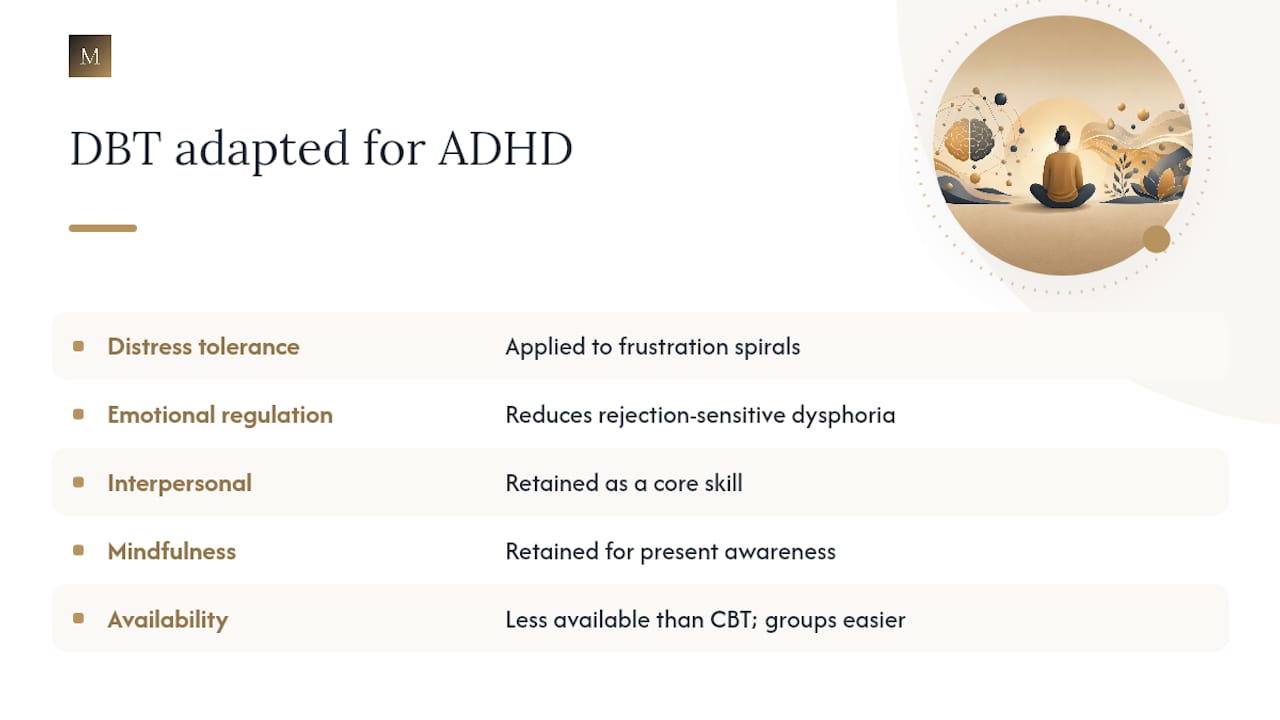
The adaptation usually keeps four DBT pillars: distress tolerance, emotional regulation, interpersonal effectiveness and mindfulness, but reframes the practical exercises around ADHD-specific triggers. Instead of using distress tolerance skills purely for crisis moments, an ADHD-adapted programme might apply them to the frustration spiral after a missed deadline or a forgotten commitment, the kind of moment that spirals into shame far faster for someone with ADHD than for someone without it.
Where this approach earns its place is with adults who've tried standard CBT and found the organisational tools helpful but insufficient, because the bigger barrier wasn't planning, it was the emotional flooding that made planning impossible to sustain. Rejection sensitive dysphoria, a heightened emotional response to perceived criticism or failure that many adults with ADHD describe, responds particularly well to DBT's emotional regulation skills.
It's worth being clear-eyed about availability: DBT adapted for ADHD is less widely offered than standard CBT, and group-based DBT skills training tends to be easier to find than individual sessions. If your local options are thin, ask a prospective therapist whether they incorporate DBT-informed techniques into a broader ADHD treatment plan even if they don't run a formal DBT programme. Many do, blending elements rather than delivering the full structured model.
Why therapy for ADHD adults looks different from standard talking therapy
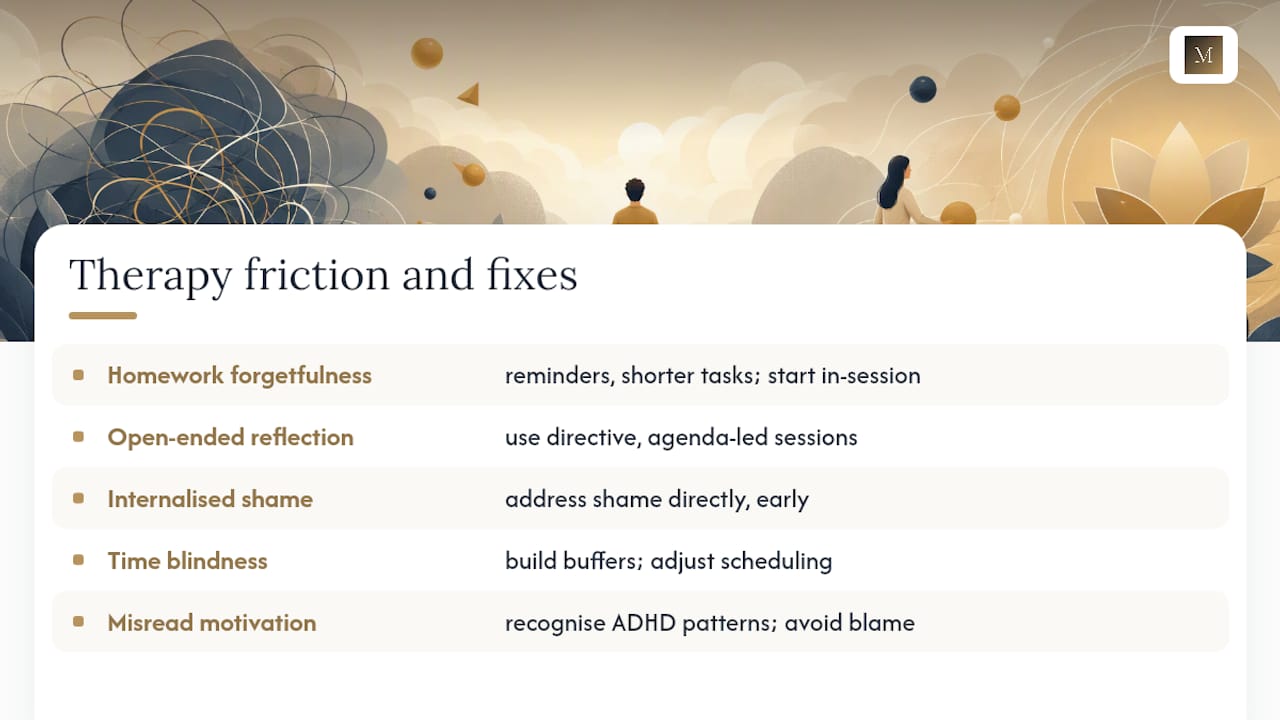
Adults with ADHD hit specific friction points in therapy that don't show up as often in general counselling, and a therapist who hasn't seen this pattern before can misread it as resistance or lack of motivation.
Forgetting homework or between-session tasks is one of the most common. Standard CBT relies heavily on practising skills outside the room, but that's precisely the kind of unstructured follow-through that ADHD makes hardest. Good ADHD-aware therapists build in external scaffolding: text reminders, shorter tasks, or session time devoted to actually starting the homework rather than assigning it cold.
Difficulty sitting with open-ended reflection trips up adults used to more structured, goal-driven conversation. Therapists experienced with ADHD often shift toward more directive, agenda-led sessions rather than the free-flowing exploration that suits other clients.
Shame from years of "just try harder" messaging shows up early and often. Many adults arrive at their first session already convinced they're lazy or broken, having internalised decades of criticism before anyone mentioned executive function. Addressing that shame directly, rather than assuming it will dissolve once symptoms improve, tends to speed up everything else.
Time blindness affecting the sessions themselves, arriving late, losing track of session length, or misjudging how long between appointments has passed, is common enough that experienced therapists build in buffers rather than treating it as a boundary issue.
None of this makes therapy less effective for ADHD. It just means the standard delivery format sometimes needs adapting, and asking a prospective therapist how they handle these patterns tells you more than asking about their general approach.
How family and couples therapy supports adults with ADHD
ADHD rarely stays contained to one person's diary. Partners often absorb the practical fallout, missed bills, forgotten plans, half-finished projects, long before anyone frames it as a symptom rather than a character flaw. That's where couples therapy earns its place alongside individual work rather than instead of it.
A couples therapist familiar with ADHD helps both partners separate the condition from intent. The non-ADHD partner often needs support reframing "he never listens" as a genuine attention difficulty rather than deliberate carelessness, while the partner with ADHD needs space to explain the effort invisible to an outside view. This reframing alone resolves a surprising amount of resentment that's built up over years.
Family therapy plays a similar role for parents, adult children living at home, or siblings navigating a late-in-life diagnosis. It's particularly useful when a diagnosis arrives after decades of family friction that everyone assumed was just personality. Older relatives sometimes struggle to accept ADHD as a real condition rather than an excuse, and a family session with a neutral, informed therapist can do more to shift that view than any amount of one-on-one persuasion.
Practically, look for a couples or family therapist who has specific experience with ADHD rather than general relationship counselling. The dynamics differ: standard couples therapy often assumes both partners have equal capacity to change behaviour through willpower and communication, an assumption that doesn't hold when one partner's executive function genuinely limits what's achievable without external support or medication.
Combining therapy with daily habits that actually stick
Therapy sessions are an hour a week at most. What happens in the other 167 hours often determines whether the skills stick or fade.
Sleep is the most underrated lever. Poor sleep worsens attention, emotional regulation and impulse control, effectively amplifying every ADHD symptom therapy is trying to address. A therapist working on organisational skills while sleep stays chaotic is fighting an uphill battle.
Exercise, even brief and irregular, supports the same neurological systems that ADHD medication and therapy both target. You don't need a structured programme, a short walk before a demanding task can measurably improve focus for the following hour.
External structure beats internal willpower every time. Visual timers, phone reminders, body-doubling apps, and physically placing things where you'll trip over them all outperform "just remembering" for adults with ADHD. Therapy can help you design these systems, but building them into daily life is where the actual behaviour change happens.
Nutrition and caffeine timing matter more than most adults realise. Blood sugar crashes mimic and worsen attention lapses, and caffeine taken too late compounds sleep problems already undermining the whole system.
The most effective adults with ADHD tend to treat therapy as the place where a strategy gets designed and refined, not the place where the strategy gets executed. Execution happens in the kitchen, the calendar app, and the five minutes before bed when tomorrow's tasks get laid out. Therapy that ignores this daily layer, focusing purely on insight and conversation, tends to produce slower, shakier progress than therapy that treats habit design as core business.
What does ADHD therapy cost, and does insurance cover it?
Cost is often the real barrier, more than motivation or scepticism about whether therapy works.
Private ADHD-specific therapy fees vary by region, therapist experience and modality, so it's worth requesting a clear rate before booking rather than assuming a standard price applies. Many private health insurance policies in the UK cover therapy for diagnosed mental health conditions, but ADHD-specific cover varies by insurer and policy tier. Always check whether your policy requires a formal diagnosis first, since some insurers won't authorise sessions for trait-based support alone.
If insurance isn't an option, several routes reduce the financial burden without cutting corners on quality. Trainee therapist clinics, supervised by qualified professionals, typically charge a fraction of standard private rates. Charity-run groups, including those coordinated through ADHD UK, offer free or low-cost peer support that complements rather than replaces individual therapy. Some employers now include therapy access within employee assistance programmes, worth checking even if ADHD wasn't the reason you signed up.
Sliding-scale fees are more common among independent therapists than large practices, so it's worth asking directly rather than assuming the advertised rate is fixed. A short, low-cost discovery call before committing to a full course of sessions also helps you confirm fit without paying full price for a mismatch.
Weigh cost against consistency. A slightly higher-priced therapist you'll actually see every week tends to deliver better outcomes than a cheaper option with a long, unpredictable gap between sessions.
How Mind a Porter gets you to the right ADHD-aware therapist faster
Everything above points to the same practical problem: knowing what kind of help you need is only useful if you can actually get it, without months of waiting or a long trial-and-error search for the right fit.

Mind a Porter matches you directly with qualified therapists experienced across CBT, EMDR, psychodynamic approaches and other modalities discussed here, in more than 22 languages, without the waiting list that often comes with NHS referrals. You filter by specialism, language, and availability, so you're not starting with a generalist and hoping they happen to know ADHD. Sessions run online or in person across London and UK-wide, giving you the flexibility to fit therapy around a schedule that ADHD already makes harder to manage. Mind a Porter reports a very high client satisfaction rate across thousands of sessions delivered. If you're ready to move from reading about options to actually booking one, start with Mind a Porter and book a discovery call to find a therapist matched to your specific ADHD-related challenges.
A practical note on starting sooner rather than later
Starting therapy while you're still waiting on a formal assessment isn't jumping the queue. It's using the time productively instead of losing months to it. Before your first session, write down three specific challenges, not "ADHD" in general, and pick one measurable behavioural goal. Then book a discovery call. Momentum matters more than perfect timing here.
Frequently asked questions
Does ADHD therapy for adults actually work without medication? Yes, for many adults. CBT and coaching build organisational and emotional regulation skills that don't depend on medication, though some adults find combining both approaches works better than either alone.
What's the difference between ADHD coaching and therapy? Coaching focuses on practical routines, accountability and task management. Therapy, particularly CBT, also addresses the thought patterns and emotional responses underlying those difficulties, and typically involves a registered mental health professional.
How long does adult ADHD counselling usually take to show results? Many adults notice initial improvements within the first four to six sessions of structured CBT, with fuller skill-building typically spanning 8 to 20 sessions depending on the goals set at the outset.
Can I get ADHD therapy for adults through the NHS? Yes, via GP referral, though waiting times vary by local trust. Many adults use private or online options for faster access while remaining on an NHS list for formal assessment.
Is ADHD coaching regulated in the same way as therapy? No. Therapists typically hold registrations such as BACP accreditation, while ADHD coaching lacks equivalent statutory regulation, so checking a coach's specific training and experience with ADHD matters more than assuming standard oversight applies.
This article is general information, not a substitute for advice from a qualified doctor. Consult a qualified healthcare professional about your own circumstances before acting on anything here.
Sources
Next Step
Reading is a start. Talking is the next step.
Tell us what you are looking for and we will match you with a qualified therapist who fits. Online across the UK, or in person in London.
Professional Support
Find the Right Therapy
Explore specialist treatment options related to this article.
Keep Reading
Related Articles

Coming Out Later in Life: Therapy, Family and Identity
Coming out in your forties, fifties or later brings its own mix of relief, grief and practical questions. Here is what affirming therapy can and cannot do, and how to talk to the people closest to you.

Therapy With an Interpreter: How It Works and When to Ask
If therapy in English leaves out half of what you mean, a professional interpreter can change that. Here is how it works, and how to ask.

Faith and Mental Health: Finding a Therapist Who Respects Both
How to tell when faith is supporting your recovery and when it might be delaying care, and how to find a therapist who takes your beliefs seriously.