
Before You Walk Onstage: EMDR for Performance Anxiety in 2–4 Sessions
Discover how targeted EMDR therapy can reprocess past memories to help performers overcome stage fright and regain confidence in just a few sessions.

Clinically reviewed by
Dr Martina Paglia
Founder & CEO of Mind a Porter
HCPC-registered Clinical Psychologist
Special interests include anxiety, depression, trauma, OCD, burnout, workplace stress, relationship difficulties and high-performance mental wellbeing.
Last reviewed: 22 September 2026
EMDR can help when performance anxiety traces back to specific past memories, such as a humiliating audition or a public mistake that still triggers a rush of fear. Pilot research links it to reduced anxiety intensity and better task performance, though the evidence base remains modest rather than definitive. Mind a Porter connects people to trained EMDR therapists who can assess whether it fits your particular history.
TL;DR:
- EMDR shows potential for quick relief from performance anxiety when a specific, identifiable traumatic memory triggers the fear.
- Systematic reviews suggest EMDR has large effects on situational anxiety but uncertain long-term impact on overall anxious temperament.
- EMDR benefits are most notable for performers with clear past triggers, like mistakes or humiliations, rather than diffuse or ongoing anxiety.
- Combining EMDR with skills training like CBT offers the best chance for lasting results, especially if avoidance or skill gaps remain.
- A qualified EMDR therapist should have accredited training and experience with performance-related issues, and phase-based treatment is essential.
Table of Contents
- What is EMDR for performance anxiety and how does it work?
- What does the research say about EMDR and performance anxiety?
- Who benefits most from EMDR, and when should you be cautious?
- What actually happens during an EMDR course for performance anxiety?
- Which grounding techniques from EMDR can you use before a performance?
- How does EMDR fit with CBT and skills training for lasting results?
- How do you choose a qualified EMDR therapist for performance anxiety?
- How does Mind a Porter support people seeking EMDR for anxiety?
- Why the "quick fix" narrative around EMDR misses the point
- Ready to explore EMDR for your performance anxiety?
- Sources
What is EMDR for performance anxiety and how does it work?
EMDR, or Eye Movement Desensitisation and Reprocessing, was developed to help the brain reprocess memories that stay "stuck" in their original emotional intensity. It follows an eight-phase model: history taking, preparation, assessment, desensitisation, installation, body scan, closure, and re-evaluation. During the desensitisation phase, the therapist guides you through bilateral stimulation, usually eye movements, tapping, or alternating tones, while you briefly focus on the distressing memory.
For performance anxiety specifically, clinicians often use a structure known as past, present, and future. This is where EMDR therapy's approach to anxiety becomes genuinely different from talking therapies:
- Past: the therapist identifies the earliest or most distressing memory linked to your fear, perhaps a botched recital, a coach's harsh comment, or the moment your mind went blank mid-presentation.
- Present: current triggers, the tightness in your chest before walking on stage, the sudden urge to freeze, get connected back to that original memory rather than being treated as a standalone problem.
- Future: once the emotional charge has genuinely reduced, the therapist installs a "future template", a guided mental rehearsal of you performing calmly and competently.
That future template matters because it is not simply positive thinking bolted onto an unresolved fear. It works after reprocessing, so the calm rehearsal is not competing against intrusive negative imagery that keeps resurfacing. Some clinicians use a dedicated variant called EMDR-PEP (Performance Enhancement Psychology protocol), which builds a structured performance history and targets self-defeating beliefs alongside specific performance blocks.
The clinical logic is straightforward: when a painful memory keeps its full emotional charge, it hijacks your nervous system the moment a similar situation arises, regardless of how well you have actually prepared. Reduce that charge, and your access to rehearsed skills, breathing techniques, and stage presence stops getting overridden by fear.
What does the research say about EMDR and performance anxiety?
The strongest available evidence comes from a small but specific pilot study, alongside a broader review of psychological interventions for performers.
A pilot trial tested an advanced EMDR protocol using one to two hour sessions, measuring anxiety through the STAI and a Likert scale at baseline and after several weeks. Participants reported reduced perceived anxiety intensity and improved performance on a physical finger-musculature task, compared with controls, according to this pilot study.
That is a genuinely useful early signal, but it is one trial with 50 people over a short interval, not proof that EMDR works for every performer.
A wider systematic review and meta-analysis of interventions for performing artists and athletes pooled 20 controlled studies and found:
- Large effects on state performance anxiety, the acute fear felt in a specific moment.
- Small to mixed effects on trait performance anxiety, the general disposition toward anxiety across many situations.
- Considerable heterogeneity across studies, driven by varying protocols, sample sizes, and outcome measures.
The practical takeaway sits between optimism and caution. Psychological interventions, EMDR included, tend to produce measurable short-term reductions in the fear you feel right before or during a specific event. Whether that translates into a lasting shift in your underlying anxious temperament is far less settled, and no single study answers that question conclusively. If you are hoping EMDR will make you a permanently calmer person rather than a calmer performer in specific situations, the current research does not fully support that expectation yet.
Who benefits most from EMDR, and when should you be cautious?
EMDR tends to help most when your anxiety has a traceable origin. If you can point to a specific moment, a forgotten line during a school play, a public correction from a conductor, a fall during a competition, that still feels raw when you recall it, you are likely a good candidate.
Populations who commonly benefit include:
- Musicians who freeze before recitals or auditions.
- Actors and public speakers who blank out mid-performance.
- Athletes whose confidence collapsed after a specific error or injury.
- Students with test anxiety linked to a particular exam failure.
- Presenters whose fear stems from one embarrassing meeting or pitch.
Caution is warranted in other circumstances. If you are currently experiencing unstable mental health, active suicidal ideation, or ongoing substance misuse, EMDR is not the appropriate starting point. Clinical guidance from the EMDR International Association stresses readiness assessment and stabilisation before any intensive reprocessing work, precisely because reopening distressing memories without adequate grounding can overwhelm rather than help.
If you have already tried CBT or skills training and still hit a wall, EMDR might address whatever memory-driven component is left behind.
Pro Tip: If you are unsure whether your anxiety is memory-driven or more generalised, mention specific incidents to your therapist during the first consultation. A clear "before and after" moment usually signals EMDR is worth exploring.
What actually happens during an EMDR course for performance anxiety?
A typical course starts with an assessment, not a session of eye movements. Your therapist needs to understand your history before touching the memory itself.
- Initial assessment and readiness checks. The therapist asks about your history, current stability, and specific performance incidents, then confirms you are ready for reprocessing work rather than needing stabilisation first.
- Target identification. Together, you pinpoint the memory or memories fuelling your anxiety, along with related beliefs such as "I always fail under pressure."
- Past reprocessing. Bilateral stimulation is used while you focus on the target memory, gradually reducing its emotional intensity across one or more sessions.
- Present trigger work. Current bodily sensations and situational triggers get connected back to the reprocessed memory, closing the loop between past and present reactions.
- Future template rehearsal. Once the charge has dropped, you rehearse the performance scenario mentally, this time without the interference of the old fear.
For a single clear-origin event, this can take as few as two to four sessions. More complex histories, layered failures, chronic criticism, or several distinct triggers, understandably take longer. Therapists typically track progress using subjective distress ratings during sessions, alongside real-world checks: did you manage the audition, the exam, the pitch, with less physical tension and fewer intrusive thoughts than before?
Which grounding techniques from EMDR can you use before a performance?
Two techniques drawn from EMDR practice are widely used as short-term grounding tools, though neither replaces a full course of therapy with a trained clinician.
The butterfly hug involves crossing your arms over your chest, hands resting on opposite shoulders, then alternating gentle taps left and right. This mimics the bilateral stimulation used in EMDR sessions and can calm acute activation in the minutes before you walk on stage or into an exam hall. Cleveland Clinic lists it among practical tools for breaking the performance anxiety cycle.
A simple pre-performance sequence:
- Find a quiet spot, even a corridor or car, two to three minutes before you go on.
- Cross your arms, tap alternately for 20 to 30 seconds.
- Breathe out for longer than you breathe in, aiming for a count of four in, six out.
- Name one thing you can see, hear, and feel to bring your attention back to the present moment.
Pro Tip: Practise the butterfly hug at home during a calm moment first. Your body needs to learn the pattern before you rely on it under pressure.
These techniques help in the moment, but they are stopgaps. If the same fear keeps recurring show after show, that is a sign to raise it with a therapist rather than keep managing it alone.
How does EMDR fit with CBT and skills training for lasting results?
EMDR and CBT tackle different parts of the same problem. EMDR targets the emotional charge attached to a specific memory, while CBT builds practical skills, cognitive reappraisal, graded exposure, structured self-talk, that you use in real time.
A common clinical pathway runs EMDR first to clear the memory-based interference, then moves into CBT-style skills work, or runs both approaches together depending on your circumstances. Clinicians often pair EMDR reprocessing with homework resembling CBT, including breathing exercises and rehearsal, to consolidate whatever gains reprocessing produced.
- Favour combination therapy if avoidance persists after reprocessing, or if you never learned solid performance skills to begin with.
- Ask any clinician you work with about collaborative, goal-based care rather than a single-modality default.
Neither approach alone suits everyone. The right mix depends on whether your anxiety is mostly memory-driven, skill-driven, or both.
How do you choose a qualified EMDR therapist for performance anxiety?
Start by confirming credentials. A legitimate EMDR practitioner should hold recognised training through an accredited EMDR institute or association, alongside standard clinical registration appropriate to their profession, whether that is as a psychologist, counsellor, or psychotherapist.
Before booking, ask:
- Have you worked with performance anxiety specifically, rather than anxiety in general?
- How long are sessions, and how many would you expect for a single-incident history versus a more complex one?
- What aftercare or grounding support do you offer between sessions?
- Do you offer both online and in-person sessions, and does that change the approach?
Watch for red flags. Any therapist promising an instant cure, skipping readiness checks, or refusing to explain the eight-phase model in plain terms is worth avoiding. Genuine EMDR practice is methodical, not rushed.
The practical first step is usually a short initial assessment, where the therapist reviews your history, checks stability, and outlines a realistic plan before any reprocessing begins.
How does Mind a Porter support people seeking EMDR for anxiety?
A mental health platform can match clients with therapists across multiple languages, using a no-waiting-list model that enables quick connections. Matching may consider specialism, language, culture, and availability, which matters when looking for a therapist trained in EMDR rather than a generalist. Booking often starts with a short discovery call, followed by filtering for therapists offering EMDR alongside other modalities, either online or in person.
Why the "quick fix" narrative around EMDR misses the point
The internet loves a dramatic before-and-after story, and EMDR attracts more than its share because of how it works: reprocess a memory, watch the fear drop. That framing does real damage. It sets people up to expect trait-level transformation from a therapy whose strongest evidence, per the meta-analysis on performance interventions, sits with acute, situational fear rather than your underlying temperament.
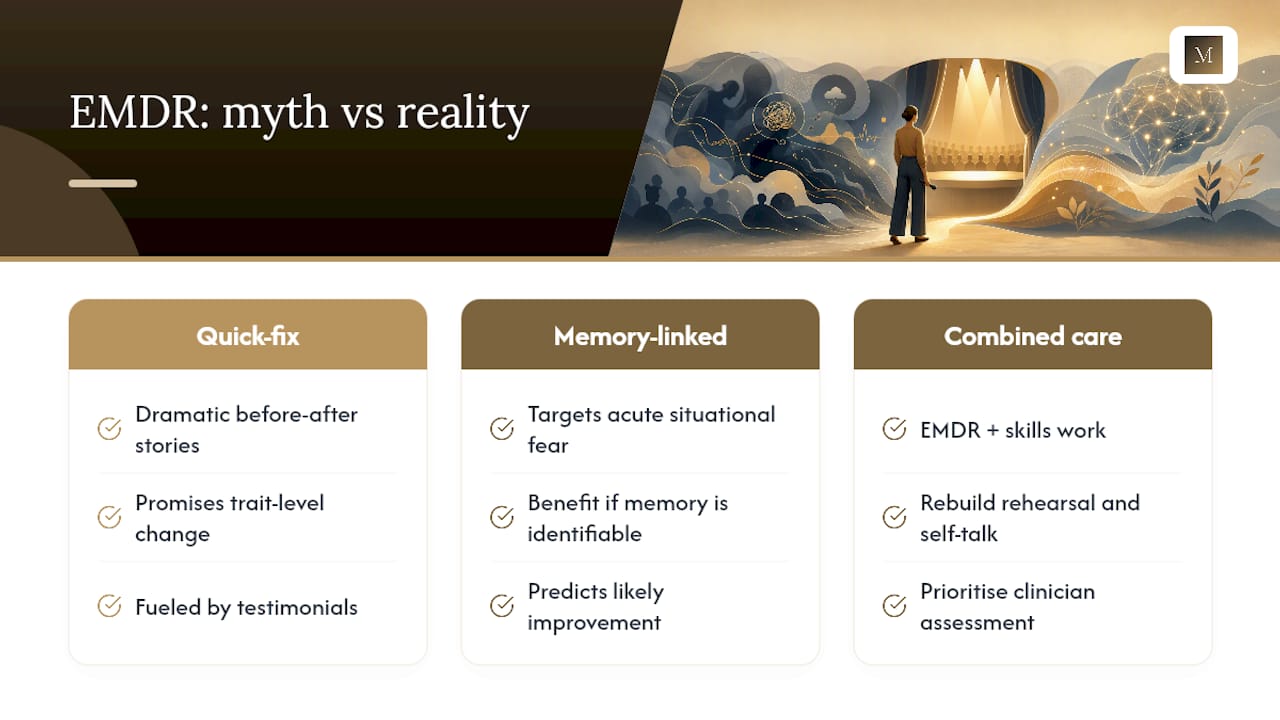
What actually matters is narrower and more useful: does your anxiety trace to an identifiable memory, or is it more diffuse? That single question predicts more about likely benefit than any testimonial ever could. Readers should prioritise an honest assessment with a trained clinician over chasing a method because it sounds neat and mechanical.
The overrated idea here is that reprocessing alone solves performance anxiety. The underrated idea is combining EMDR with skills work, because clearing the memory rarely rebuilds the rehearsal habits and self-talk patterns lost during years of avoidance.
Ready to explore EMDR for your performance anxiety?
If self-help grounding techniques have taken you as far as they can, the next sensible step is talking to a therapist trained in EMDR who understands performance-specific fear. The platform is designed to allow filtering by specialism, language, and availability to connect quickly without a waiting list.

On first contact, expect a short discovery call where you describe your history and current concerns. A good therapist will ask about readiness and stability before proposing an EMDR plan, not skip straight to reprocessing. Use that call to check their EMDR training and experience with performance-related anxiety specifically. When you are ready to find a therapist suited to your situation, visit the Mind a Porter platform to start the process.
This article is general information, not a substitute for advice from a qualified doctor. Consult a qualified healthcare professional about your own circumstances before acting on anything here.
Sources
- Reducing anxiety and enhancing physical performance by using an advanced version of EMDR: a pilot study
- Systematic review with meta-analysis on interventions for performance anxiety (performing artists and athletes)
- EMDR therapy & anxiety — EMDR International Association
- Performance anxiety: breaking the cycle — Cleveland Clinic
Keep Reading
Related Articles

Start NICE Backed Postnatal Depression Therapy This Week in the UK
Discover your options for accessing evidence-based postnatal depression treatment in the UK, including NHS pathways, private therapy, and combined recovery strategies.

8 sessions with Vitality mental health cover UK, Mind a Porter access
Discover how to leverage your Vitality health insurance for therapy sessions and digital support while exploring additional access options through providers like Mind a Porter.

Trauma Bond Recovery: Break the Neurological Hold with 10 Minutes a Day
Learn how to dismantle the neurological grip of a trauma bond using daily regulation habits, professional therapeutic support, and a structured path to recovery.