
Attachment Styles in Relationships: How to Become More Secure
Discover how your early attachment patterns shape your adult relationships and learn actionable steps to foster greater security and emotional intimacy.

Clinically reviewed by
Dr Martina Paglia
Founder & CEO of Mind a Porter
HCPC-registered Clinical Psychologist
Special interests include anxiety, depression, trauma, OCD, burnout, workplace stress, relationship difficulties and high-performance mental wellbeing.
Last reviewed: 22 September 2026
Attachment styles are the patterns of trust, closeness, and conflict a person learned from early caregiving, and they now run quietly beneath most of your adult relationships. Psychologists group them into four types: secure, anxious, avoidant, and disorganised and built from two underlying dimensions of anxiety and avoidance. Secure attachment tends to support intimacy, honest communication, and faster repair after arguments; the three insecure styles each generate their own predictable friction, from clinginess to shutdown to unpredictable swings between both.
TL;DR:
- Secure attachment is most stable but can improve with sustained positive experiences and therapy, especially through emotionally focused or cognitive-behavioral approaches.
- Insecure attachment patterns often stem from inconsistent or unresponsive caregiving, but meaningful change is possible over time with corrective relational experiences.
- Attachment styles influence conflicts like pursue–withdraw cycles, with secure pairs resolving issues quickly, while insecure pairs may get stuck in recurring patterns.
- Compatibility varies: secure couples tend to have less intense conflicts, while insecure pairings—especially anxious or avoidant—may experience persistent relationship tension.
- Professional therapy can effectively shift insecure attachment styles, but change is a gradual process that requires honest self-awareness and consistent support.
Table of Contents
- What are the four attachment styles in relationships?
- Where do attachment patterns actually come from?
- How do attachment styles affect love and conflict in couples?
- What actually helps you become more securely attached?
- What can partners say and do to repair things today?
- A clinical view on getting professional support
- Do attachment styles look different across cultures?
- How does attachment style carry into parenting?
- How is attachment style actually measured?
- Why the “just be more secure” advice misses the point
- Ready to work on your attachment pattern with support?
- Sources
What are the four attachment styles in relationships?
Every adult attachment style sits somewhere on two scales: how anxious you feel about being abandoned, and how avoidant you feel about depending on someone. Combine high and low scores on each dimension and you get four recognisable patterns, each with its own fingerprint in how couples argue, comfort each other, and handle distance.
Secure attachment shows up as low anxiety and low avoidance. Securely attached people tend to ask for what they need directly, tolerate a partner's bad mood without spiralling, and return to baseline quickly after a disagreement. If their partner is late replying to a text, they assume traffic, not betrayal. This isn't the absence of insecurity so much as a nervous system that has learned, through consistent care, that relationships are generally safe.
Anxious/preoccupied attachment pairs high anxiety with low avoidance. People with this style crave closeness but doubt they'll get enough of it, so they tend to use what researchers call hyperactivating strategies: protesting, seeking reassurance, replaying conversations for hidden meaning, or escalating a minor slight into a full argument to force a response. A partner going quiet for a few hours can trigger genuine physiological alarm, not just annoyance.
Avoidant/dismissive attachment is the mirror image: low anxiety, high avoidance. These individuals learned early that needs went unmet or that emotional displays were unwelcome, so they lean on deactivating strategies, withdrawing under pressure, minimising how much a relationship matters, and prizing independence almost as an identity. Closeness itself can register as a threat rather than a comfort, which is why an avoidant partner often pulls away exactly when intimacy deepens, according to a Psychology Today analysis of the pattern.
Disorganised/fearful-avoidant attachment combines high anxiety and high avoidance, producing contradictory behaviour: wanting closeness and fearing it in the same breath. This style is more strongly linked to earlier relational trauma or frightening caregiving, and it often looks like alternating between pursuing a partner intensely and then pushing them away without warning.
A quick way to sense your own leanings:
- You check your partner's phone activity, replay texts, or need frequent verbal reassurance: likely anxious traits.
- You feel suffocated by plans, prefer solving problems alone, and downplay how much you miss someone: likely avoidant traits.
- You want a partner close but sabotage things once you get them: possible disorganised traits.
- Conflict resolves in hours, not days, and you rarely doubt the relationship's stability: likely secure traits.
Where do attachment patterns actually come from?
Attachment theory, developed by John Bowlby and tested experimentally by Mary Ainsworth, rests on two ideas: a caregiver acting as a secure base for exploring the world, and a safe haven to return to when distressed. A child whose caregiver responds consistently learns that seeking comfort works, laying down what psychologists call an internal working model, essentially a mental template for how relationships behave.
Caregiver responsiveness maps directly onto the two adult dimensions. Inconsistent responsiveness, sometimes warm, sometimes dismissive, tends to produce higher anxiety, because the child never knows which version of the caregiver will show up. Consistently unavailable or rejecting responsiveness tends to produce higher avoidance, because the child learns not to bother asking. These early attachment working models then travel forward, shaping who you're drawn to and how you interpret a partner's silence decades later.
The reassuring part is that these patterns are durable, not fixed. Adult attachment can shift through sustained corrective experiences, a securely attached partner's steady presence, or structured therapy, because the nervous system updates its expectations when reality keeps contradicting the old model, according to research on attachment structure and change. Change is usually gradual rather than a single breakthrough moment.
How do attachment styles affect love and conflict in couples?
Individual attachment traits become couple-level patterns the moment two people start dating, and some pairings are far more combustible than others.
- The pursue–withdraw cycle. An anxious partner escalates to get a response; the avoidant partner withdraws to reduce pressure. The withdrawal increases the anxious partner's alarm, which increases the pursuing, which increases the withdrawal. Neither person is deliberately sabotaging the relationship; both are running the emotion-regulation strategy that once kept them safe, one hyperactivating, one deactivating, as Shaver's review of attachment styles describes.
- Two secure partners. Conflict still happens, but repair tends to be quick because neither person interprets distance as danger or closeness as a threat.
- A secure partner with an insecure one. The secure partner often acts as a buffer, staying steady enough that the anxious partner's alarm settles faster, or gently persisting past the avoidant partner's withdrawal without chasing.
- Two avoidant partners. The relationship can look calm on the surface because neither pushes for closeness, but intimacy often plateaus and both partners may feel a low-grade loneliness they rarely name.
- Two anxious partners. Reassurance-seeking can spiral in both directions at once, producing intense highs and equally intense conflict.
The tell that separates a chronic pattern from a rough patch is repetition without resolution: the same argument, the same withdrawal, the same reassurance-seeking, recurring for months regardless of what triggered it that particular week. If the content of the fight keeps changing but the shape of it never does, that's the attachment system talking, not the specific issue.
What actually helps you become more securely attached?
Attachment styles respond well to therapy that specifically targets the internal working model rather than just symptom management, and the strongest evidence sits behind a handful of named approaches.
- Emotionally Focused Therapy (EFT) works directly with couples' pursue–withdraw cycles, slowing the interaction down so each partner can name the vulnerable feeling underneath the protest or the shutdown. Structured couples therapy of this kind has been shown to improve relationship satisfaction by helping partners revise how they read each other's behaviour.
- Cognitive behavioural therapy (CBT) is useful for anxious attachment specifically, since it targets the catastrophic interpretations ("they haven't replied, so they're losing interest") that fuel hyperactivating strategies.
- EMDR (Eye Movement Desensitisation and Reprocessing) is often the better starting point where disorganised attachment traces back to specific traumatic experiences, since it processes the memory itself rather than just the relational pattern it produces.
Individual therapy tends to suit people working on their own reactions in isolation, or those not currently partnered; couples work is usually more effective once both people are willing to look at the cycle together, since one partner changing their behaviour in isolation can otherwise just shift who initiates the pursue–withdraw dance.
Small daily practices help alongside formal therapy: naming the physical sensation of anxiety before reacting to it, pausing ten seconds before sending a reassurance-seeking text, or scripting out what you actually want to say before a difficult conversation instead of leading with the accusation.

Pro Tip: If your presenting pattern is avoidance, look for a therapist experienced in slow-building alliance work rather than rapid emotional disclosure exercises, since being pushed to open up too fast tends to trigger the exact withdrawal the therapy is meant to resolve.
What can partners say and do to repair things today?
Small, specific language changes often do more than a long conversation about "the relationship" in the abstract.
- Reassuring an anxious partner: try "I'm not upset with you, I just need twenty minutes to think" rather than going quiet without explanation, since the silence itself is what triggers alarm.
- Inviting a withdrawn partner back in: try "No pressure to talk now, but I'd like to hear your thoughts later today" instead of demanding an immediate response.
- Avoid escalation triggers: phrases like "you always" or "you never" read as attacks to an anxious partner and as confirmation that closeness means criticism to an avoidant one.
- Rebuild safety with small rituals: a five-minute check-in at the same time each evening, or an agreed signal for "I need a pause, not an exit," does more for long-term trust than one big reconciliation talk.
- Suggesting therapy: frame it as a shared project rather than a diagnosis: "I'd like us to get some outside support with this pattern," lands better than "you need help."
A clinical view on getting professional support
The patterns described here are well documented in the clinical literature, and they respond to structured help far more reliably than to willpower alone. For attachment-specific concerns, matching with a therapist who names this as an area of focus from the first session tends to shorten the path to visible change.
Do attachment styles look different across cultures?
Attachment researchers have long debated how much culture shapes these patterns, and the honest answer is: somewhat, but the basic structure holds up widely. Collectivist cultures, where extended family and community routinely share caregiving, sometimes show different average rates of anxious versus avoidant presentation than more individualist cultures, where independence is prized earlier and more explicitly.
Individual differences matter just as much as cultural ones. Two people raised in the same household can develop different attachment styles depending on birth order, temperament, or which parent was the primary caregiver during formative years. Life events reshape attachment too: a formative friendship, a first serious relationship, or a period of therapy can shift someone from anxious towards secure, or the reverse can happen after a betrayal or loss. Attachment style is best understood as a current tendency shaped by history, not a permanent label stamped on at birth, which is exactly why the corrective-experience research matters so much for anyone who recognises an insecure pattern in themselves.
How does attachment style carry into parenting?
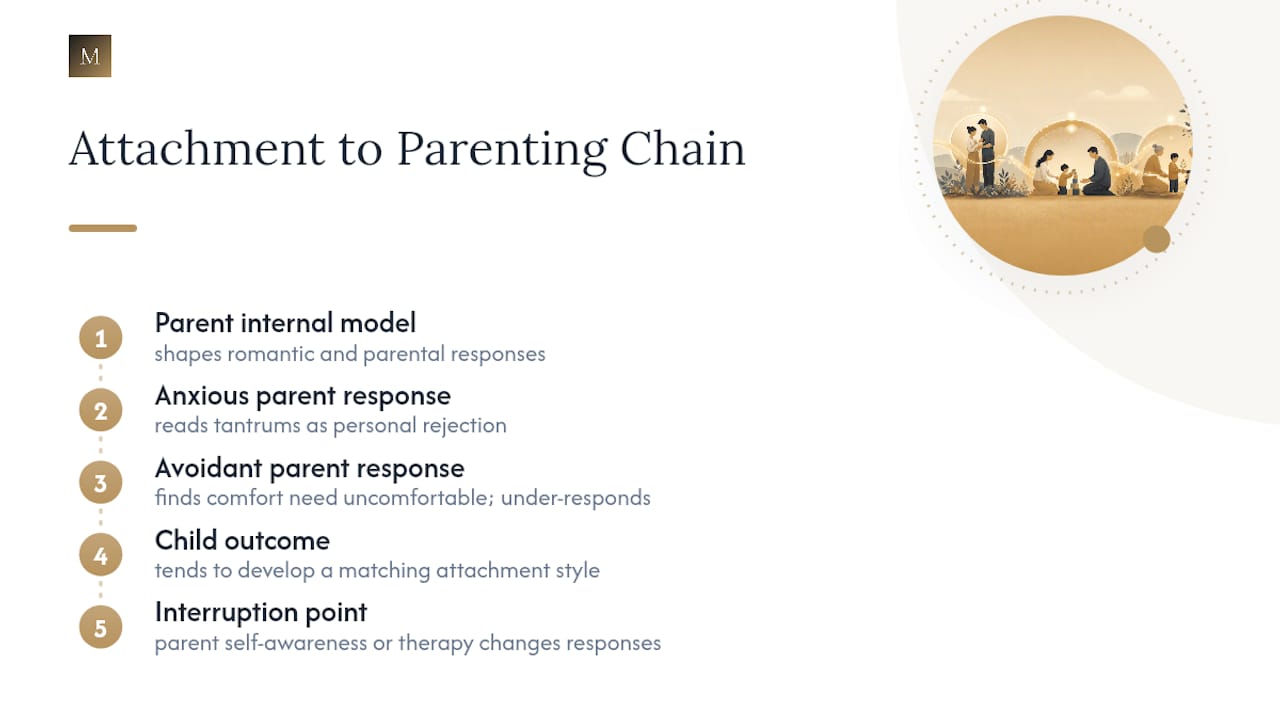
The same internal working model that shapes romantic relationships also shapes how adults parent, often before they've consciously connected the dots. A parent with unresolved anxious attachment may struggle to tolerate a toddler's normal bids for independence, reading a child's tantrum as personal rejection rather than typical development. A parent with strong avoidant tendencies may find a baby's constant need for physical comfort genuinely uncomfortable, and unintentionally under-respond to distress in ways that echo their own upbringing.
This is where the concept of the intergenerational transmission of attachment becomes practical rather than academic: children tend to develop attachment styles that mirror their primary caregiver's own patterns, unless something interrupts the cycle. That "something" is usually a parent's own self-awareness, often built through therapy, that lets them respond to their child differently from how they were responded to. Family relationships beyond the parent-child dyad follow similar logic. Siblings, co-parents, and even long-term friendships all carry the imprint of whichever attachment strategies feel automatic, which is why couples therapy sometimes surfaces parenting disagreements that look unrelated on the surface but trace back to the same underlying anxiety or avoidance.
How is attachment style actually measured?
Clinicians and researchers assess attachment differently depending on the setting. In research, the Adult Attachment Interview (AAI) is the gold standard: a semi-structured interview that scores not just what someone says about their childhood but how they narrate it, coherence and consistency matter more than the content itself. Self-report questionnaires like the Experiences in Close Relationships (ECR) scale measure the two core dimensions directly, asking respondents to rate statements about anxiety and avoidance in relationships, and these tools underpin much of the research on adult attachment structure.
In therapy, formal instruments matter less than a clinician's structured observation over several sessions. Many therapists use simplified checklists drawn from these validated tools as a conversation starter rather than a diagnostic verdict, since attachment style is a spectrum, not a category someone definitively fits into. If you want a general sense of your own leanings before a first session, a reputable self-report overview of attachment styles can offer a useful starting point, though it is not a substitute for a clinician's assessment.
Why the “just be more secure” advice misses the point
Most popular advice on attachment treats it as a personality quiz result: identify your type, adjust a few behaviours, done. That undersells how much these patterns are embedded in the nervous system's threat detection, not just conscious habits. Telling an anxious person to "just relax" or an avoidant person to "just open up" ignores that both are running protective strategies that once made sense.
What the evidence actually supports is slower and less satisfying to hear: consistent, corrective relational experience, whether from a securely attached partner or a skilled therapist, over time. That's not a weekend fix. It's also not a life sentence. The research on attachment change is genuinely hopeful; people do shift, often measurably, within structured therapy. What I'd prioritise first, before any communication script or repair ritual, is naming your own pattern honestly and getting outside support for it rather than expecting a partner to therapise you. Partners can help enormously, but they are not a substitute for professional treatment when the pattern runs deep.
Ready to work on your attachment pattern with support?
Recognising your attachment style is useful. Changing it usually takes more than self-help articles and good intentions, particularly if the pattern is disorganised or trauma-linked. Mind a Porter connects you directly with qualified therapists trained in CBT, EMDR, and EFT-informed approaches, matched to your specific concerns, language, and availability, with no waiting list standing between you and your first session.
Building the kind of trust that lets old patterns shift takes a therapist you actually feel safe with, which is exactly what consistent therapeutic rapport is built to support. Whether you recognise anxious, avoidant, or disorganised traits in yourself or your relationship, the starting point is the same: an honest assessment and a matched therapist, not another quiz result. You can begin that process directly through Mind a Porter's therapist matching service and book a session as soon as this week.
Sources
For readers who want the underlying research, the peer-reviewed overview of adult attachment structure and change is a strong starting point, alongside Shaver's foundational review of attachment theory and styles for a more clinical grounding.
Keep Reading
Related Articles

Family therapy reduces psychosis relapse: UK evidence and how to start
Discover how family therapy improves communication, reduces relapse rates for conditions like psychosis, and helps households build healthier, collaborative relationships.

Neurodiversity-affirming therapy: what it is and how to find one
Discover how to identify therapy that celebrates your unique neurotype instead of forcing you to mask and conform to neurotypical standards.

Self esteem therapy: what actually helps and where to start
Discover effective therapeutic approaches for rebuilding self-worth, practical exercises to try at home, and guidance on finding the right professional support.