
Backed by 90 trials: Interpersonal therapy explained in the UK
Discover how interpersonal psychotherapy uses structured, evidence-based techniques to improve your relationships and effectively treat depression.

Clinically reviewed by
Dr Martina Paglia
Founder & CEO of Mind a Porter
HCPC-registered Clinical Psychologist
Special interests include anxiety, depression, trauma, OCD, burnout, workplace stress, relationship difficulties and high-performance mental wellbeing.
Last reviewed: 7 November 2026
All health information on Mind a Porter is clinically reviewed by our clinical lead. These resources are educational and do not replace professional advice.
Interpersonal psychotherapy (IPT) is a time-limited, evidence-based talk therapy that reduces mood symptoms by improving your relationships and social functioning. It's typically delivered over a time-limited course of weekly sessions, usually around a dozen or a bit more, following a manualised structure rather than open-ended exploration. The core premise is straightforward: your mood and your relationships affect each other, so working through interpersonal problems eases the depression. Research backs this approach for depression and several related conditions.
TL;DR:
- IPT is most effective for depression when relationship issues, grief, or role transitions are directly linked to symptom onset or worsening.
- Active work on communication skills and role-play is central, with therapy focusing on current relationships rather than past experiences.
- Evidence from over 90 trials supports its moderate-to-large effects, especially when combined with medication for moderate to severe depression.
- Finding a trained IPT therapist involves verifying formal manualised training, adherence to a structured course, and matching the therapy's specific problem focus.
- IPT tends to work best when depression stems from interpersonal conflicts, losses, or life changes, rather than when symptoms are unrelated to social or relational issues.
Table of Contents
- What is interpersonal therapy? Core principles explained
- Who benefits from IPT, and which conditions does it treat?
- The four interpersonal problem areas IPT targets
- How IPT sessions are structured, phase by phase
- Interpersonal therapy techniques and the therapist's role
- Interpersonal therapy vs CBT: what's the practical difference?
- How effective is interpersonal therapy? What the research shows
- What to expect from IPT and how to find a trained therapist
- When interpersonal therapy makes the most sense
- Sources
What is interpersonal therapy? Core principles explained
IPT treats depression using what's known as a medical model. Rather than framing low mood as a personal failing, therapists explain it as an illness with biological and situational roots, similar to how a GP might explain a physical health condition. This reframing matters more than it might seem: giving a client permission to see their depression as a treatable illness rather than a character flaw tends to lower shame and increase engagement with treatment, a mechanism ISIPT's overview of IPT highlights as central to how the therapy works.
From there, IPT stays firmly in the present. It doesn't dig into childhood origins or unconscious patterns the way psychodynamic therapy does. Instead, sessions concentrate on what's happening in your relationships right now, and what changed around the time your symptoms started.
That here-and-now focus shapes everything else about the therapy:
- Time-limited by design. Sessions have an endpoint from day one, usually agreed at the start.
- Diagnosis-targeted. IPT was developed specifically for depression, then adapted for other conditions rather than built as a general talking cure.
- Symptom and function focused. Progress is tracked through both mood symptoms and how well you're managing daily relationships and roles.
- Collaborative, not exploratory. The therapist and client agree on a single problem area to work through, rather than following wherever the conversation leads.
The dual aim running through all of this is symptom remission alongside better social functioning. A client might leave IPT with fewer depressive symptoms and also a clearer sense of how to navigate a difficult relationship that had been feeding the depression in the first place. Neither goal is treated as secondary. IPT's theory holds that they reinforce each other: as relationships improve, mood tends to follow, and as mood lifts, relationships become easier to repair.
Who benefits from IPT, and which conditions does it treat?
The strongest evidence base for IPT sits with major depressive disorder, both in the acute phase and as a maintenance treatment to prevent relapse once symptoms have eased. That's where the therapy was originally developed and where most of the trial data comes from.
Beyond depression, IPT has been adapted for a wider range of presentations:
- Adolescents, where role transitions and peer disputes often map neatly onto the standard problem areas.
- Older adults, particularly around bereavement, retirement, and health-related role changes.
- Eating disorders, where interpersonal stress frequently triggers or maintains disordered eating patterns.
- Anxiety disorders, though the evidence here is less extensive than for depression.
- Perinatal depression, where role transition into parenthood is often the central focus.
IPT can be used as a standalone treatment or alongside antidepressant medication. Combined treatment is common in moderate to severe depression, and IPT also has a specific role as a maintenance therapy for people who've responded to medication but want to reduce relapse risk without staying on drugs indefinitely.
Suitability matters more than diagnosis alone. IPT tends to work best for people who can identify a relationship or role change connected to their symptoms, and who are willing to actively work on communication rather than simply talk through feelings. If someone's difficulties feel entirely disconnected from other people, or they're looking for deep exploration of past experience, a different approach may fit better.
The four interpersonal problem areas IPT targets
Every course of IPT centres on one, occasionally two, of four problem areas. Clinical application research on IPT identifies these as grief, role transitions, role disputes, and interpersonal deficits.
- Grief. This applies when the death of someone significant has triggered or is maintaining depressive symptoms. IPT distinguishes complicated grief, where mourning has stalled and mood hasn't lifted, from ordinary bereavement, which doesn't need clinical treatment.
- Role transitions. Any major life change counts here: a new job, retirement, becoming a parent, a relationship ending, or moving to a new country. The work focuses on grieving the old role and building skills for the new one.
- Role disputes. These are ongoing conflicts with someone important, such as a partner, parent, or colleague, where expectations don't match and communication has broken down.
- Interpersonal deficits. This area applies when someone struggles to form or sustain relationships altogether, often linked to social isolation rather than one specific conflict.
Therapists select the primary area collaboratively with the client during the initial sessions, based on which problem most plausibly connects to when the depression started or worsened.
How IPT sessions are structured, phase by phase
IPT follows a fixed structure. Research on IPT's principles and applications describes three phases: initial, middle, and termination, mapped onto a typical 12 to 16 week course.
- Initial phase (sessions 1 to 3). The therapist takes a detailed history, conducts what's called an interpersonal inventory (a review of your key relationships), and works with you to agree on the primary problem area. Psychoeducation about depression as a treatable condition happens here too.
- Middle phase (sessions 4 to 14). This is where the active work happens. Sessions focus on the chosen problem area, building communication skills, and testing new approaches to relationships between sessions. Mood is monitored throughout, often using symptom scales, to track whether the approach is working.
- Termination phase (sessions 15 to 16). The final sessions consolidate what's changed, review progress against the original goals, and build a relapse prevention plan. Ending is treated deliberately, since termination itself often mirrors the loss and transition themes explored earlier.
Some clients continue with less frequent maintenance sessions afterwards, particularly if depression has been recurrent. The clinical overview of IPT notes that this time-limited framework is deliberate: an endpoint from the outset keeps the work focused rather than open-ended.
Interpersonal therapy techniques and the therapist's role
Several specific tools distinguish IPT sessions from other talking therapies. The interpersonal inventory, conducted early on, maps out significant relationships past and present, and helps both therapist and client spot patterns worth addressing.
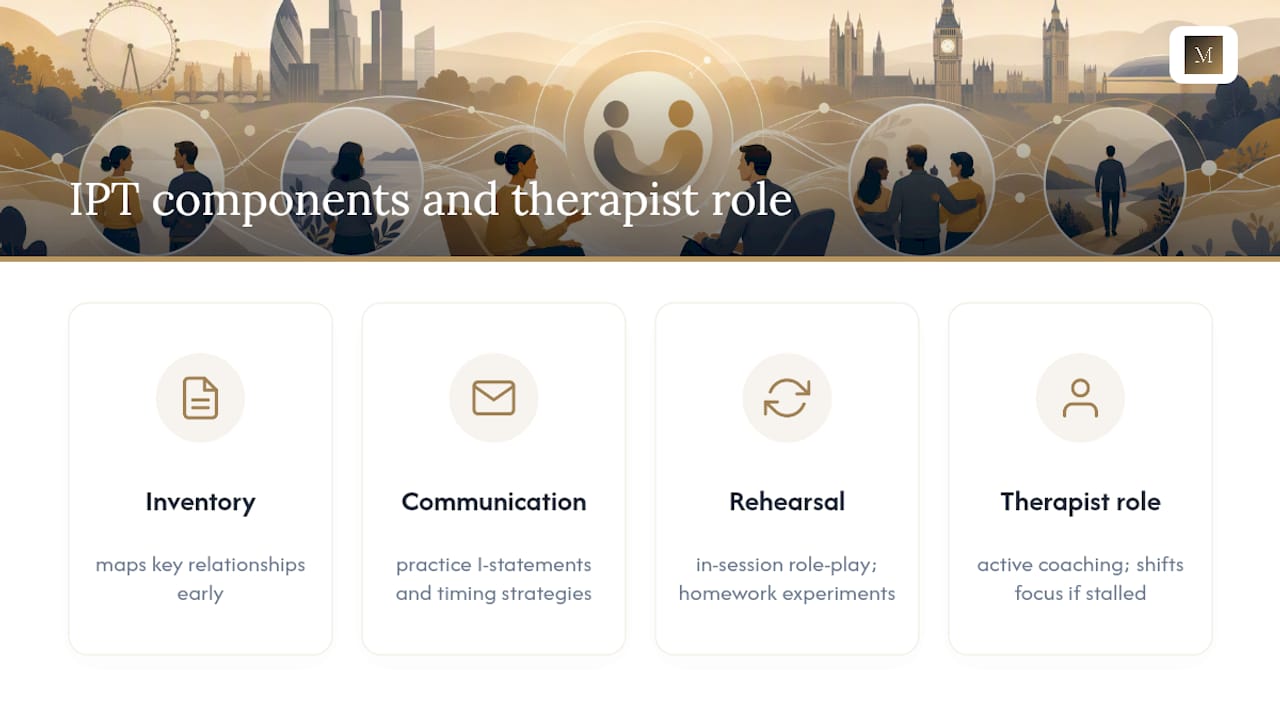
Communication training is central to the middle phase. Clients often practise using direct "I-statements" instead of accusatory language, and learn timing strategies, one memorable example being to "strike while the iron is cold" rather than raising a difficult topic mid-argument, when neither party can listen well.
Role-play and rehearsal happen inside sessions, letting clients practise a difficult conversation before attempting it for real. That rehearsal usually becomes homework: clients try a new communication approach with a partner, parent, or colleague between sessions, then report back on what happened. Research from Annual Reviews on IPT for depression describes these interpersonal experiments as a routine part of the model, not an optional add-on.
The therapist's role is notably active. Rather than sitting back and reflecting, IPT therapists coach directly, ask pointed questions, and guide the conversation toward the chosen problem area. Clinical application research notes that therapists will shift the focus deliberately if a chosen problem area isn't producing progress, rather than persisting with something that isn't working.
Pro Tip: If a therapist mentions "interpersonal inventory" or "communication analysis" early in your first session, that's a good sign they're working from the proper IPT manual rather than a loosely adapted version.
Interpersonal therapy vs CBT: what's the practical difference?
IPT and cognitive behavioural therapy (CBT) both hold strong evidence for depression, but they work through different mechanisms. Comparative research on IPT and CBT mechanisms sets out the core distinction clearly: IPT targets external relational dynamics and social support, while CBT targets internal cognitive distortions.
- What changes: IPT works on relationships and communication; CBT works on thought patterns and behaviours.
- Typical techniques: IPT uses interpersonal inventories and role-play; CBT uses thought records and behavioural experiments.
- Homework style: IPT homework tests new ways of relating to people; CBT homework tests and challenges specific thoughts.
- Evidence: many trials find broadly comparable effectiveness for depression between the two approaches.
Choosing between them often comes down to what's driving your symptoms. If a relationship breakdown, bereavement, or major role change sits at the centre of your depression, IPT's relational focus may fit more naturally. If your depression feels more tied to persistent negative thought patterns regardless of what's happening around you, CBT might suit better. Availability of a properly trained therapist matters too, since not every service offers both.
How effective is interpersonal therapy? What the research shows
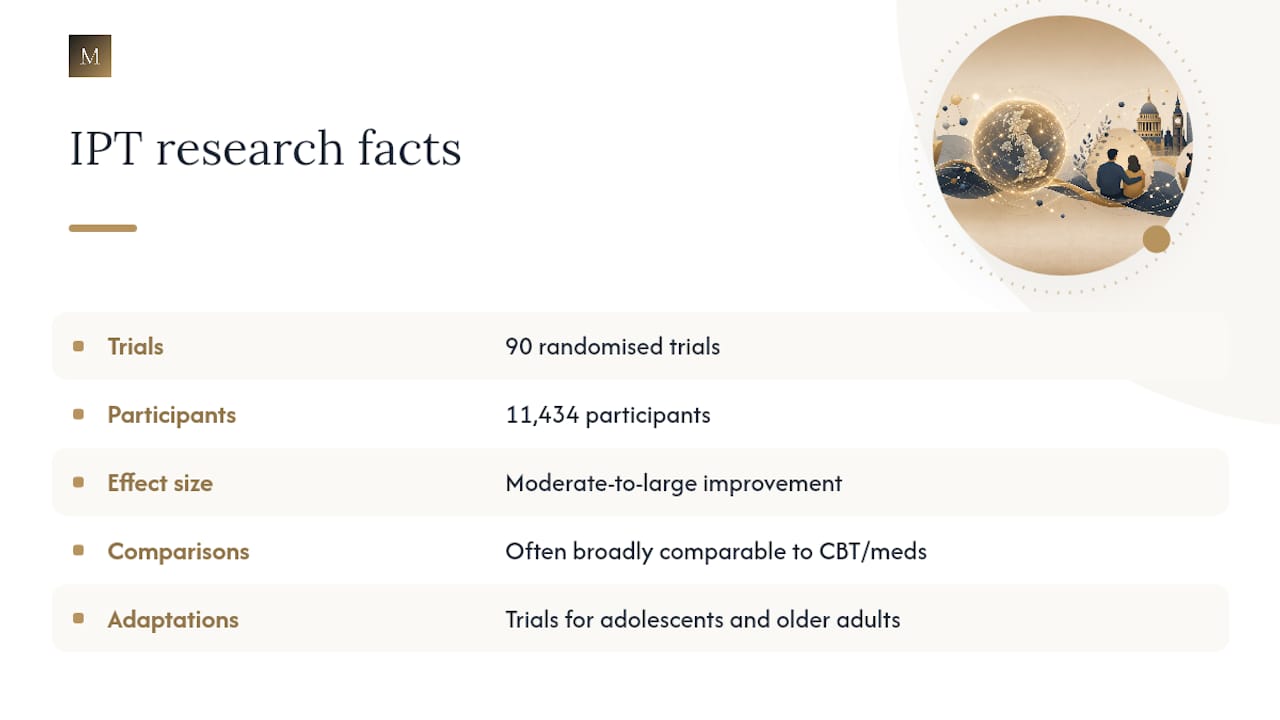
A meta-analysis pooling 90 randomised trials and 11,434 participants found that IPT produces moderate-to-large effects for acute-phase depression, placing it firmly among established, evidence-backed depression treatments.
In numbers: 90 trials, over 11,000 participants, and a consistent pattern of moderate-to-large improvement in depressive symptoms during active treatment.
That scale of evidence is unusual for a psychotherapy. Where the trials compared IPT directly against CBT or antidepressant medication, outcomes were often broadly comparable rather than one approach dominating, which is part of why guideline bodies list IPT alongside other first-line options rather than as a second choice.
IPT's manualised nature has helped its research base grow steadily. ISIPT's overview notes that IPT is referenced in international treatment guidance as a time-limited, diagnosis-targeted, evidence-based option, which matters because a manualised approach is easier to test consistently across different research teams than a loosely defined one.
Evidence also extends beyond adults with straightforward depression. Adaptations for adolescents and older adults have their own supporting trials, and ongoing research on IPT for depression points to its use as a maintenance treatment to prevent relapse after acute symptoms resolve.
None of this means IPT works identically for everyone. Trial populations vary, some studies carry a real risk of bias from small sample sizes or the difficulty of blinding talk therapy trials, and individual response depends heavily on how well the interpersonal focus matches what's actually driving a person's symptoms.
What to expect from IPT and how to find a trained therapist
The first session usually covers your history, a review of current symptoms, and the beginning of the interpersonal inventory, that map of your key relationships mentioned earlier. Between sessions, expect homework: trying out a new way of raising a difficult topic, or noticing patterns in how a relationship dispute plays out.
It's worth knowing that some people feel worse before they feel better. Directly confronting a role dispute or working through unresolved grief can stir up short-term distress, which is a normal part of the process rather than a sign the therapy isn't working. A competent therapist will build in safety planning if there's any risk this discomfort becomes unmanageable.
If you're considering IPT, a few practical steps help:
- Ask directly about training. Not every therapist offering "talking therapy" has completed formal IPT training; ask whether they've done manualised IPT training and how many cases they've treated.
- Check the structure on offer. A genuine IPT course should follow the phased 12 to 16 session structure rather than running indefinitely.
- Look at NHS talking therapies services. NHS guidance on interpersonal therapy describes it as a structured, brief therapy that typically targets one or two interpersonal problems, often available through NHS talking therapies referral routes.
- Search professional directories for therapists listing IPT as a specific modality, rather than a general counselling background.
- Consider private options if NHS waiting lists are a barrier, particularly where you want to start quickly or need a therapist matched to a specific language or cultural background.
A therapy matching platform connects clients directly with qualified therapists offering IPT alongside other approaches such as CBT and EMDR, with no waiting list and matching based on specialism, language, and availability. If you've read this far and recognise your own situation in the role disputes, grief, or transitions described above, Mind a Porter can match you with a therapist trained in IPT without the delay that talking therapies waiting lists often involve.
When interpersonal therapy makes the most sense
IPT earns its place when depression is clearly tangled up with a relationship, a loss, or a life change you haven't fully adjusted to. That's a narrower claim than "IPT treats depression," and it's the more useful one: this therapy works through your relationships, so it tends to work best when your relationships are actually part of the problem.
Combining IPT with medication is common practice for moderate to severe depression, and there's nothing second-rate about that pairing. IPT alongside a GP-prescribed antidepressant, or as a maintenance therapy after medication has done its work, are both legitimate paths rather than compromises.
What matters most is having that conversation with a clinician who can weigh your specific history against the options, rather than assuming one therapy fits every case of depression.
This article is general information, not a substitute for advice from a qualified doctor. Consult a qualified healthcare professional about your own circumstances before acting on anything here.
You can read more about interpersonal psychotherapy (IPT) in London and how sessions are structured.
Frequently asked questions
How does this therapy help with low mood? Interpersonal therapy improves your mood by targeting how you relate to others. It assumes your relationships and your feelings are linked. By working on communication skills and addressing specific interpersonal problems like grief or life changes, the therapy helps you manage your daily social roles more effectively, which in turn helps your mood to lift.
What happens during the typical weekly sessions? You spend the first few sessions reviewing your key relationships and identifying a specific problem area to work on. The middle sessions focus on building communication skills and testing new ways of interacting with others. The final sessions then review your progress and create a plan to help you prevent any future relapse after the course finishes.
Is this approach different from cognitive behavioural therapy? Yes, they work in different ways. While cognitive behavioural therapy focuses on your internal thoughts and thought patterns, this therapy concentrates on your external relationships and social dynamics. If your struggles are tied to conflicts, bereavement, or major life changes, this relational focus might suit you better than working on your individual thoughts.
How do I know if this therapy is suitable? This approach is likely to work best if you can identify a recent life change, relationship conflict, or a loss that matches the timing of your mood symptoms. It is a good choice if you are willing to practice new ways of communicating with people, rather than focusing on exploring your past or childhood experiences.
Sources
Next Step
Reading is a start. Talking is the next step.
Tell us what you are looking for and we will match you with a qualified therapist who fits. Online across the UK, or in person in London.
Professional Support
Find the Right Therapy
Explore specialist treatment options related to this article.
Keep Reading
Related Articles

Therapy and Medication Together: Why the Combination Often Works Better
Many people recovering from depression or anxiety find that therapy and medication work better as a pair than either does alone. Here's what the evidence says, and how to make the combination work for you.

How long does therapy take to work? A realistic timeline
The first change usually arrives in weeks three to six, but a full course runs longer. What the timeline really looks like, week by week.

Grief Counselling Options in the UK: How to Choose
Navigate the UK's bereavement support landscape by comparing costs, accessibility, and types of care to find the right therapeutic path for your specific needs.