
Reconnect in 8–20 Sessions With Emotionally Focused Couples Therapy
Discover how Emotionally Focused Therapy reshapes your relationship by replacing recurring conflict cycles with deep, secure emotional connection.

Clinically reviewed by
Dr Martina Paglia
Founder & CEO of Mind a Porter
HCPC-registered Clinical Psychologist
Special interests include anxiety, depression, trauma, OCD, burnout, workplace stress, relationship difficulties and high-performance mental wellbeing.
Last reviewed: 7 November 2026
All health information on Mind a Porter is clinically reviewed by our clinical lead. These resources are educational and do not replace professional advice.
Emotionally focused couples therapy (EFCT or EFT) is a structured, evidence-based approach that helps partners identify the negative patterns driving their conflict and rebuild a secure emotional bond. It works best for couples experiencing chronic disconnection, recurring arguments, or the aftermath of a betrayal, provided both partners are willing to engage. Most couples complete treatment in 8 to 20 sessions, with research showing durable improvements in relationship satisfaction.
TL;DR:
- EFT is most effective for couples experiencing chronic disconnection, especially after betrayal or trauma, with most completing treatment in 8 to 20 sessions.
- The approach focuses on transforming insecure attachment patterns into secure bonds by addressing underlying vulnerable emotions, often requiring both partners' full engagement.
- About 70% of couples report symptom relief after EFT, but results depend on factors like severity of issues and consistency of participation, with some gains lasting up to two years.
- Finding a qualified EFT therapist requires checking certifications from ICEEFT or BEFT, and verifying their supervised experience and approach to safety concerns.
- EFT emphasizes emotion over communication skills, targeting attachment fears and emotional cycles rather than surface-level problems or historical exploration.
Table of Contents
- What is emotionally focused couples therapy and how does it work?
- Who benefits most from EFT, and who might not?
- What happens in each stage, and how long does EFT take?
- Does the research on EFT actually hold up?
- How do you find a qualified EFT therapist?
- How Mind a Porter connects you to EFT-aware therapists
- What are the theoretical foundations behind EFT?
- What do people get wrong about EFT?
- What can you actually expect to gain from EFT?
- How does EFT differ from other couples therapy approaches?
- Where does EFT fall short, and who might need a different approach?
- Why the "just communicate better" advice misses the point
- Ready to book EFT-aware couples therapy?
- Where to check EFT credentials and research
- Sources
- FAQ
What is emotionally focused couples therapy and how does it work?
EFT rests on attachment theory, the idea that adults need secure emotional bonds with a partner in much the same way children need them with a caregiver. When that bond feels threatened, people don't just get annoyed. They get frightened, and fear makes them either attack or withdraw. EFT treats these reactions as protest, not personality flaws. The NCBI Bookshelf's chapter on emotionally focused therapy describes the goal plainly: transforming insecure attachment patterns into secure ones by working directly with emotion and the interaction cycles it drives.
In sessions, a therapist trained in this model does three things:
- Maps the couple's specific negative cycle (for example, one partner criticises, the other shuts down, which deepens the criticism)
- Helps each partner access the softer, more vulnerable emotion sitting underneath anger or silence, such as fear of abandonment
- Guides new conversations where partners respond to that vulnerability with comfort rather than defence
EFT for couples is the most researched application, but the same emotion-focused principles adapt to individual therapy and family work, where the target is a person's relationship with their own emotions or a family's interaction patterns rather than a romantic bond.
Who benefits most from EFT, and who might not?
EFT was originally developed for couples experiencing marital distress, and it remains most effective there. It's also widely used for attachment injuries such as an affair, a broken promise during a health crisis, or a betrayal that left one partner feeling unsafe.
Common presenting problems include:
- Chronic, circular arguments that never resolve
- One partner withdrawing while the other pursues connection more intensely
- Rebuilding trust after an affair or major betrayal
- Difficulty feeling emotionally close despite genuine love
EFT is generally unsuitable while there's ongoing physical abuse in the relationship, or where one partner has an active, untreated addiction that hasn't been addressed alongside couples work. It tends to work best when both partners, even if sceptical, are willing to show up and stay engaged across several sessions.
Pro Tip: If only one partner wants therapy, book an initial consultation anyway. Many EFT therapists can help you assess readiness before committing to a full course.
What happens in each stage, and how long does EFT take?
EFT follows a structured nine-step model organised into three stages, according to the therapy's founding research on the EFT model. Knowing the stages helps you judge whether progress feels on track.
- De-escalation (steps 1 to 4): The therapist helps you both see the negative cycle as the shared enemy, not each other. Reactivity drops as you start naming the pattern instead of living inside it.
- Restructuring the bond (steps 5 to 7): This is the emotional core of treatment. Each partner learns to access and share the attachment fears beneath their usual reactions, and to respond to their partner's vulnerability with comfort instead of defence. New bonding moments happen here, often for the first time in years.
- Consolidation (steps 8 and 9): New patterns get rehearsed and applied to old problems, and the couple leaves with a shared story of how they changed.
Clinical summaries suggest EFCT commonly takes about 8 to 20 sessions, though severity, trust damage, and how consistently both partners engage all affect the timeline. Couples working through an affair typically need more sessions than those addressing a general communication rut.
Does the research on EFT actually hold up?
The evidence base is unusually solid for a couples therapy model. Systematic reviews and meta-analyses report significant, often sustained improvements in relationship satisfaction among couples who complete treatment, and Dr Sue Johnson organisation points to over 30 years of outcome research, with some studies showing benefits maintained up to two years post-treatment.
The numbers: A 2024 review spanning 20 studies and 332 couples found that roughly 70% of couples reported symptom relief after completing EFCT, with some gains persisting for up to two years.
That figure deserves context rather than blind faith. Much of the strongest EFT research has been conducted or supervised by practitioners closely tied to the model's development, which is common in psychotherapy research but still worth knowing when you weigh how independently the findings were verified. Sample sizes in individual trials also tend to be modest. None of that erases the consistency of the pattern across studies, but it does mean "70% symptom relief" describes a coherent, replicated signal rather than a guarantee for any specific couple.
How do you find a qualified EFT therapist?
Not every couples counsellor who mentions "emotion-focused work" has completed formal EFT training, so credentials matter here more than in most talking therapies.
- Check for training and certification through the International Centre for Excellence in Emotionally Focused Therapy (ICEEFT) or membership with the British Emotionally Focused Therapy Centre (BEFT Centre)
- Ask how much supervised couples experience they have, and whether they pursue ongoing professional development in the model
- Ask directly what their approach is if safety concerns or abuse come up during sessions
- Clarify session length, confidentiality practices, and whether they offer remote or in-person appointments
Cost, availability, and finding a therapist who matches your language or cultural background all affect how quickly you can actually start. Book an initial call before committing to a full course.
How Mind a Porter connects you to EFT-aware therapists
Finding a therapist trained specifically in attachment-based couples work usually means scrolling through generic directories and hoping the "relationship counselling" tag means what you think it means. Mind a Porter filters by specialism, so you can look specifically for clinicians experienced in emotionally focused approaches rather than guessing from a bio. The platform matches by language and cultural background too, which matters when discussing attachment wounds in a second language would add friction rather than remove it. With hundreds of therapists across more than 22 languages and a no-waiting-list model, couples can typically start sooner than through standard referral routes.
What are the theoretical foundations behind EFT?
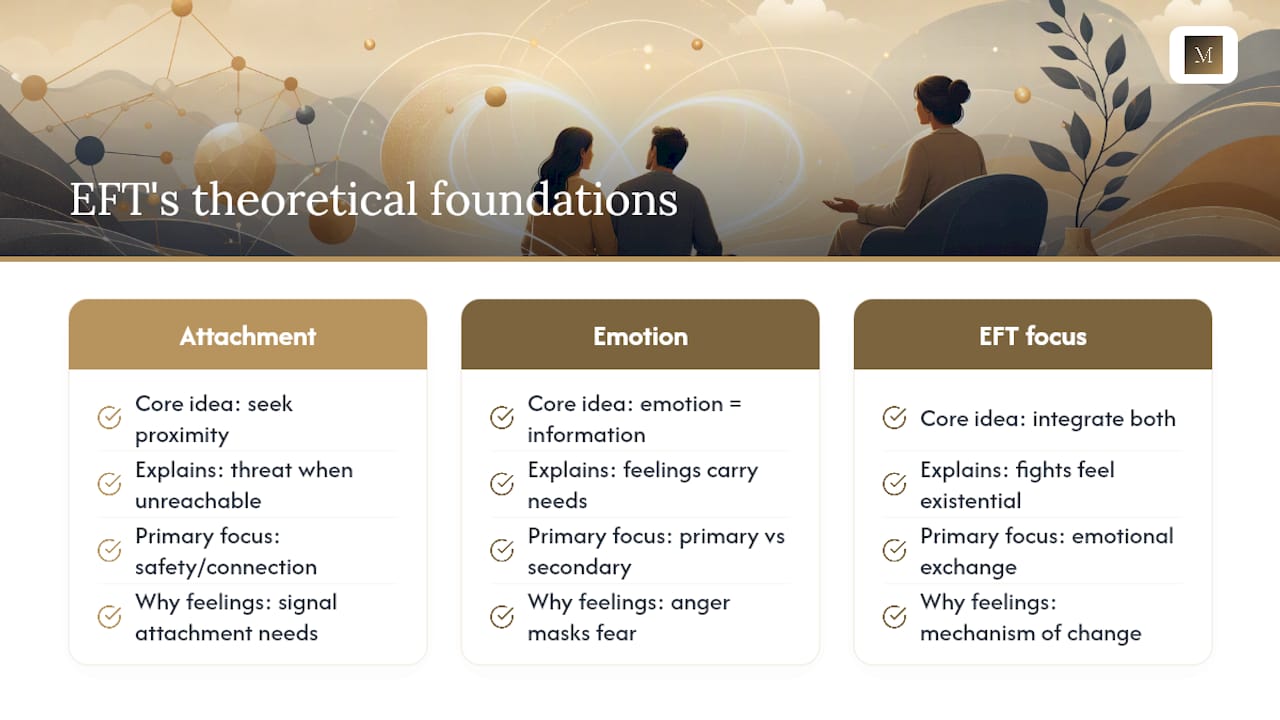
EFT combines two bodies of science that, on the surface, seem to belong to different fields entirely: attachment theory and emotion theory.
Attachment theory, originally developed to explain the bond between infants and caregivers, argues that humans are wired to seek proximity and comfort from significant others throughout life, not just in childhood. When a partner feels emotionally unreachable, the nervous system reacts as though a genuine survival threat is present. That's why arguments about dishes or diaries so often escalate into something that feels existential. The fight was never really about the dishes.
Emotion theory contributes the second half. EFT treats emotion not as noise to manage but as an internal compass carrying information about needs. Anger frequently masks fear. Withdrawal often masks a fear of failing or of being blamed. The therapist's job is to slow the conversation down enough that partners notice the primary emotion (the vulnerable one) rather than reacting only to the secondary emotion (the defensive one) that gets expressed first.
Put together, these two frameworks explain why EFT spends so much time on feelings rather than jumping straight to communication skills or compromise negotiation. A couple can learn every active-listening technique available and still fail to reconnect if the underlying attachment fear never gets voiced and answered. EFT treats that emotional exchange, not the technique, as the actual mechanism of change.
What do people get wrong about EFT?
The biggest misconception is that EFT is simply "talking about feelings" in a softer, less structured way than other couples therapy. In practice, it follows a defined nine-step sequence with specific therapist tasks at each stage, closer in rigour to a manualised treatment than to unstructured venting.
A second misconception is that EFT avoids practical problems like finances, parenting disagreements, or division of labour. It doesn't ignore these. It treats the emotional cycle underneath the argument as the thing to resolve first, on the reasoning that couples who feel securely connected tend to solve logistical disagreements far more easily than couples still locked in a fight for reassurance.
Some couples also expect rapid results because EFT has a strong evidence base. Reviews show meaningful improvement in a majority of cases, but stage two, restructuring the bond, is often the slowest and most emotionally demanding part of treatment. Couples who expect steady, comfortable progress from week one are sometimes caught off guard when things feel harder before they feel easier.
Finally, EFT isn't only for couples in crisis. It's used for general disconnection, low-grade dissatisfaction, and couples who describe their relationship as "fine" but distant, not exclusively for those on the edge of separation.
What can you actually expect to gain from EFT?
Symptom relief, meaning fewer arguments and less daily tension, is usually the most visible early outcome, but it's rarely the most significant one. Couples who complete treatment typically report a shift in how safe it feels to be emotionally honest with a partner, which tends to outlast the specific conflicts that brought them to therapy in the first place.
Improved communication is a common by-product rather than the direct target. Because EFT works on the emotional cycle underneath conflict, couples often find that ordinary disagreements resolve faster once the underlying fear of disconnection has been addressed directly. Partners also frequently describe feeling more curious about each other again, which sounds modest until you consider how much of long-term disconnection is really quiet indifference rather than active conflict.
Longer-term, the goal is what EFT researchers call an "accessible, responsive, and engaged" bond: each partner believes their significant other will be there when it matters, and can say so out loud without it triggering defensiveness. That belief, once established, tends to make the relationship more resilient to future stress, whether that's a house move, a new baby, or a health scare, because the couple has a proven track record of reconnecting after rupture rather than a hope that they might.
How does EFT differ from other couples therapy approaches?
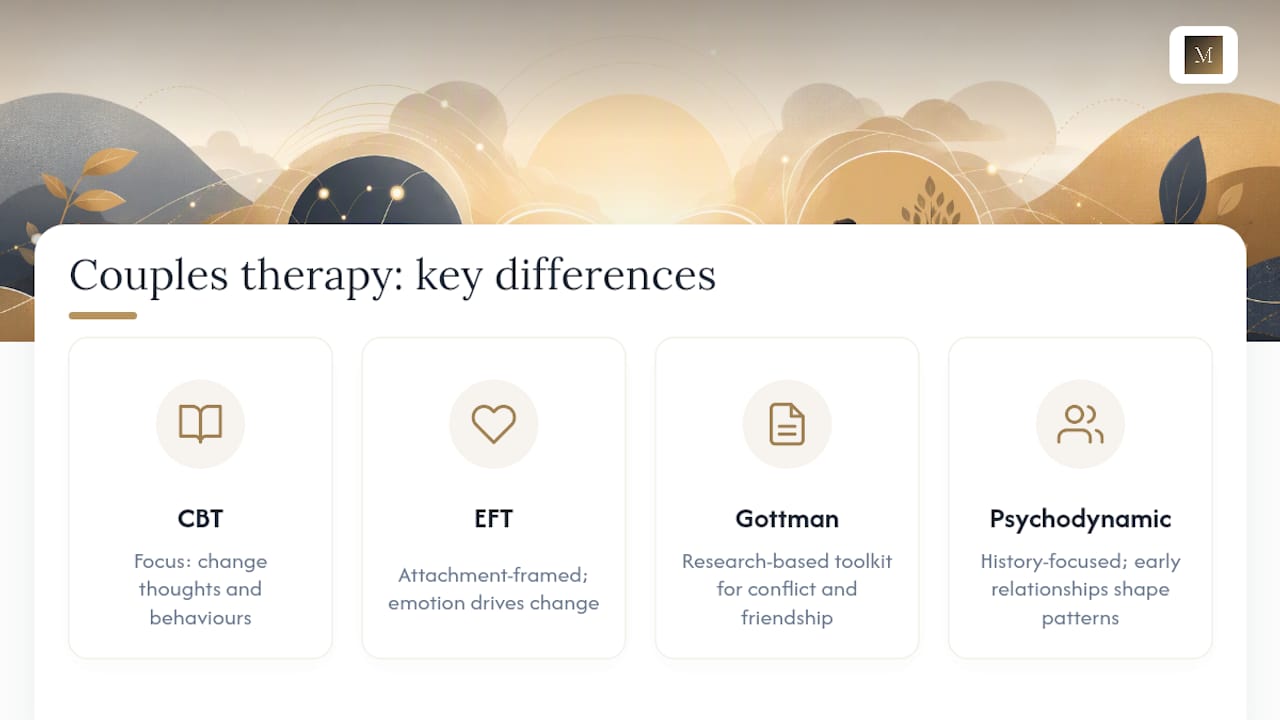
Cognitive-behavioural couples therapy focuses primarily on changing thoughts and observable behaviours, teaching communication scripts and problem-solving skills that couples practise between sessions. EFT instead treats emotion as the primary lever for change, working on the belief that new behaviour flows naturally once the underlying attachment fear has been addressed, rather than needing to be drilled separately.
The Gottman Method draws heavily on decades of observational research into what distinguishes stable couples from those heading towards separation, and it offers a broad toolkit covering conflict management, shared meaning, and friendship-building. EFT is narrower and more sequential by design, following its nine-step structure toward one specific outcome: a secure emotional bond, with other improvements expected to follow from that foundation.
Psychodynamic couples therapy tends to look further back, exploring how each partner's family history and early relationships shape their current patterns. EFT acknowledges that history matters but keeps the therapeutic focus on the present-moment interaction cycle rather than extensive historical exploration, which generally makes it a shorter course of treatment.
What sets EFT apart across all these comparisons is its explicit attachment framing. Every technique, from tracking the cycle to staging a new bonding conversation, exists to answer one underlying attachment question: can I count on you when I need you? Couples who want a structured, time-limited approach built around that specific question tend to find EFT a natural fit; couples wanting broad skills training or deep historical work may find another modality better suited to their goals.
Where does EFT fall short, and who might need a different approach?
EFT isn't the right starting point for every couple. Where there's ongoing physical violence in the relationship, individual safety planning takes priority over couples work of any kind, since joint sessions can inadvertently increase risk for the person being harmed.
Untreated substance dependency is another significant limitation. EFT can address the relational damage addiction causes, but it isn't a substitute for addiction treatment, and most experienced clinicians will recommend parallel or prior individual treatment before couples work begins in earnest.
Couples where one partner has decided, privately or openly, that the relationship is over sometimes struggle to get value from EFT, since the model depends on both partners being willing to risk emotional vulnerability toward a shared future. Untreated severe mental illness in one partner, particularly conditions that significantly impair emotional regulation or reality testing, may also require individual stabilisation before couples therapy can be productive.
None of this means EFT is fragile as a method. It means, like any structured therapy, it depends on certain preconditions being roughly in place, principally basic physical safety and a genuine, if uncertain, willingness from both partners to try.
Why the "just communicate better" advice misses the point
Most relationship advice treats communication as a skills problem: learn to listen, use "I" statements, take turns speaking. EFT's research base suggests that framing gets things backwards for a lot of distressed couples. Communication rarely fails because people lack vocabulary. It fails because the underlying attachment fear, of being unwanted, unimportant, or eventually abandoned, never gets named, so every conversation becomes a coded negotiation over whether the relationship is safe.
What the evidence supports isn't a leap of faith. It's a specific, sequenced process with a genuinely strong track record, not a vague promise that "talking helps." Where conventional advice falls short is treating disconnection as a communication deficit rather than an attachment signal. Couples who go into therapy expecting scripts and homework sheets sometimes find EFT's emotional focus uncomfortable at first, precisely because it asks them to feel something rather than simply say something differently.
My honest read: the couples who get the most from EFT are the ones who stop trying to win the argument and start asking what the argument is actually protecting. That question, more than any technique, is where the real work begins.
Ready to book EFT-aware couples therapy?
Mind a Porter is the practical next step once you've decided EFT sounds right for your relationship, without the usual weeks-long wait to see someone qualified.

Because the platform matches by specialism, you can search specifically for therapists experienced in emotionally focused approaches rather than sifting through generic "couples counselling" listings and hoping for the best. Matching also accounts for language and cultural background across multiple languages, and covers both online and in-person sessions. Visit the Mind a Porter therapy platform to browse therapist profiles and check who currently lists EFT or attachment-based couples work as a specialism.
Where to check EFT credentials and research
Verify any therapist's training directly rather than relying on a directory listing alone.
- ICEEFT: global training, certification, and therapist directory
- BEFT Centre: UK-based membership directory and training routes
- NCBI Bookshelf: peer-reviewed summary of EFT's evidence base
This article is general information, not a substitute for advice from a qualified doctor. Consult a qualified healthcare professional about your own circumstances before acting on anything here.
You can read more about emotionally focused therapy for couples and how sessions are structured.
Sources
- Johnson, S. M. et al. (PubMed entry describing the EFT model)
- NCBI Bookshelf: chapter on Emotionally focused therapy
- Dr Sue Johnson / ICEEFT overview of EFT research
- Medical News Today — Emotionally focused therapy overview (2025)
FAQ
What are the nine steps of emotionally focused couples therapy?
The nine steps sit within three stages: de-escalation (steps 1 to 4) identifies the negative cycle, restructuring the bond (steps 5 to 7) accesses attachment emotions and builds new bonding interactions, and consolidation (steps 8 and 9) stabilises the new pattern.
What is emotionally focused couples therapy?
It's a structured, attachment-based approach that helps couples identify destructive interaction cycles, access the vulnerable emotions driving them, and build a more secure emotional bond, typically over 8 to 20 sessions.
What is the 5:5:5 rule in couples therapy?
This isn't a recognised part of the EFT model; definitions of the "5:5:5 rule" vary widely across general relationship advice sources, so it shouldn't be treated as an established EFT technique.
What are some criticisms of EFT?
Much of the strongest EFT research has been led or supervised by practitioners closely connected to the model's development, and sample sizes in individual studies tend to be modest, which means independent replication remains an ongoing area of research rather than fully settled.
How do I know if an EFT therapist is properly qualified?
Look for training and certification through recognised bodies such as ICEEFT or the BEFT Centre, and ask directly about their supervised experience working with couples before booking.
Next Step
Reading is a start. Talking is the next step.
Tell us what you are looking for and we will match you with a qualified therapist who fits. Online across the UK, or in person in London.
Professional Support
Find the Right Therapy
Explore specialist treatment options related to this article.
Keep Reading
Related Articles

Therapy and Medication Together: Why the Combination Often Works Better
Many people recovering from depression or anxiety find that therapy and medication work better as a pair than either does alone. Here's what the evidence says, and how to make the combination work for you.

How long does therapy take to work? A realistic timeline
The first change usually arrives in weeks three to six, but a full course runs longer. What the timeline really looks like, week by week.

Grief Counselling Options in the UK: How to Choose
Navigate the UK's bereavement support landscape by comparing costs, accessibility, and types of care to find the right therapeutic path for your specific needs.