
Get Matched This Week: Co-Parenting Counselling for Separated Parents
Learn how co-parenting counselling resolves conflict, improves communication, and helps you select the right specialist to prioritize your child's emotional health.

Clinically reviewed by
Dr Martina Paglia
Founder & CEO of Mind a Porter
HCPC-registered Clinical Psychologist
Special interests include anxiety, depression, trauma, OCD, burnout, workplace stress, relationship difficulties and high-performance mental wellbeing.
Last reviewed: 7 November 2026
All health information on Mind a Porter is clinically reviewed by our clinical lead. These resources are educational and do not replace professional advice.
Co-parenting counselling helps separated parents reduce conflict and protect their children's emotional wellbeing by improving communication and decision-making. It works best for parents who keep clashing over handovers, routines, or parenting decisions and want a structured way to stop. A mental health platform connects parents to qualified therapists who specialise in this kind of family transition.
TL;DR:
- Co-parenting counselling primarily improves communication and conflict reduction, with most programs lasting six to twelve sessions tailored to conflict levels.
- Therapists often employ cognitive behavioral therapy, EMDR, or systemic approaches, and initial assessments are key to setting realistic goals.
- Between sessions, using scripted exchanges, shared digital calendars, and short, logistics-focused messages can prevent conflicts from escalating.
- Finding a specialist with experience in separation, clear confidentiality policies, and cultural or language compatibility is crucial for effective support.
- If one parent refuses help, options include individual coaching, parallel parenting, or court-led interventions, with online platforms offering quick matches to qualified therapists.
Table of Contents
- What is co-parenting counselling, and how does it differ from mediation?
- Who benefits from co-parenting counselling, and when should you seek it?
- What happens in sessions: format, length and typical course
- Practical strategies you can use between sessions
- How to choose a co-parenting counsellor
- How Mind a Porter helps you find the right co-parenting therapist
- A short note on getting started
- Book a matched co-parenting therapist through Mind a Porter
- Sources
- FAQ
What is co-parenting counselling, and how does it differ from mediation?
Co-parenting counselling is therapeutic support aimed at reducing conflict and improving communication between separated parents, with the child's wellbeing as the central focus. It is not the same as family mediation services, which exist to negotiate legally binding agreements about custody, finances, or property. Counselling addresses how you talk to each other; mediation addresses what you agree to.
It also differs from couples therapy, which tries to repair or process a romantic relationship. Co-parenting counselling assumes the relationship is over and works only on the parenting partnership that remains.
- Mediation: legal agreements, formal outcomes, often required before court applications.
- Couples therapy: relationship repair, shared history, emotional reconciliation.
- Co-parenting counselling: communication skills, conflict reduction, child-focused planning.
Courts sometimes order attendance at counselling or a related programme. When that happens, sessions may involve some reporting back on engagement, though the content of what you discuss usually stays confidential unless safeguarding concerns arise.
Who benefits from co-parenting counselling, and when should you seek it?
You don't need a court order to justify getting help. Many parents seek co-parenting support the moment handovers start feeling hostile or a child begins reacting badly to the arrangement.
Common triggers include:
- Handovers that regularly end in raised voices or silent standoffs.
- A child showing new anxiety, withdrawal, or acting out around visitation days.
- Repeated disagreements over school, medical decisions, or holiday schedules.
- One parent feeling permanently sidelined or dismissed in decisions.
Court-ordered counselling tends to follow a more defined structure, sometimes tied to a parenting plan review, and may involve brief updates to a court or Cafcass officer on whether parents are engaging constructively. That's a different arrangement from voluntary counselling, which stays entirely private between you and the therapist.
If conflict is extremely high and one parent poses a genuine risk or refuses any cooperation, parenting coordination or parallel parenting, where each parent manages their own household with minimal direct contact, may serve the children better than joint counselling.
What happens in sessions: format, length and typical course
Most programmes start with an individual assessment for each parent before any joint work begins. This lets the therapist understand each person's concerns privately and set realistic goals.
From there, expect this rough sequence:
- Initial assessment – separate sessions to establish history, concerns, and safety.
- Ground rules – the therapist sets clear limits, particularly that sessions won't relitigate the failed relationship.
- Skill building – parents learn techniques such as 'I' statements, neutral scripts for handovers, and shared calendar habits.
- Joint sessions – parents practise these tools together, with the therapist mediating in real time.
- Planning work – sessions shift towards drafting or refining a written parenting plan.
Many co-parenting programmes run for around six to twelve sessions, according to guidance from Custody X Change, though low-conflict families sometimes stabilise faster and high-conflict cases often need longer support. Therapists commonly draw on cognitive behavioural therapy (CBT), EMDR for unresolved trauma linked to the separation, or systemic family approaches that treat the co-parenting unit as one system to work with rather than two opposing sides.
Practical strategies you can use between sessions
Waiting for your next appointment doesn't mean waiting to improve things. A handful of tools, borrowed directly from what counsellors teach, work immediately.
Try scripting difficult exchanges before they happen. A handover script might sound like: "I'll drop the children at 6pm Friday. If anything changes, I'll text by 4pm." Keep it factual, brief, and free of blame. This mirrors the communication techniques counsellors use to stop handovers turning into arguments.
Shared digital calendars remove a huge source of friction because neither parent has to ask the other for information. Pair that with short, businesslike text templates for logistics, no more than a sentence or two, kept entirely about the children.
- Use 'I' statements: "I need Friday's pickup confirmed by Thursday," not "You never tell me anything."
- Keep handover talk to logistics only. Save feelings for your own session.
- Draft a short parenting plan covering routines, holidays, medical decisions, and school contact, following headings similar to those Cafcass recommends.
Pro Tip: Keep a shared notes document just for logistics. Anything emotional goes to your own support network, never into that shared space.
How to choose a co-parenting counsellor
Not every family therapist is the right fit for this specific work. Look for someone with genuine experience in separation and co-parenting dynamics, not general relationship counselling repurposed for your situation.
- Check specialism. Ask directly how much of their caseload involves separated or divorcing parents.
- Confirm modality. CBT suits practical communication rebuilding; EMDR helps where trauma from the breakup lingers; systemic approaches suit ongoing high-conflict dynamics.
- Ask about confidentiality. Clarify exactly what, if anything, gets reported back to a court or third party.
- Discuss fees upfront. Many practitioners offer sliding scales; private practices often list joint, individual, and child sessions separately, so ask how costs break down.
- Ask about language and cultural fit. A counsellor who shares your language or cultural context can make sensitive conversations easier.
If the other parent refuses to attend, you still have options: individual coaching to manage your side of the dynamic, parallel parenting structures, or, in persistent cases, a court-facing pathway.
How Mind a Porter helps you find the right co-parenting therapist
Finding a counsellor who genuinely specialises in separation and co-parenting shouldn't take weeks of phone calls. The platform matches you to qualified therapists, filtered by specialism, language, and therapy modality, so you're not stuck choosing blindly from a generic directory.
The service covers CBT, EMDR, and systemic family approaches, with therapists working in multiple languages. That matters when cultural context shapes how you and your co-parent communicate, and because there is typically no waiting list, you can often speak to someone suited to your situation within days.
Author: Martina

A short note on getting started
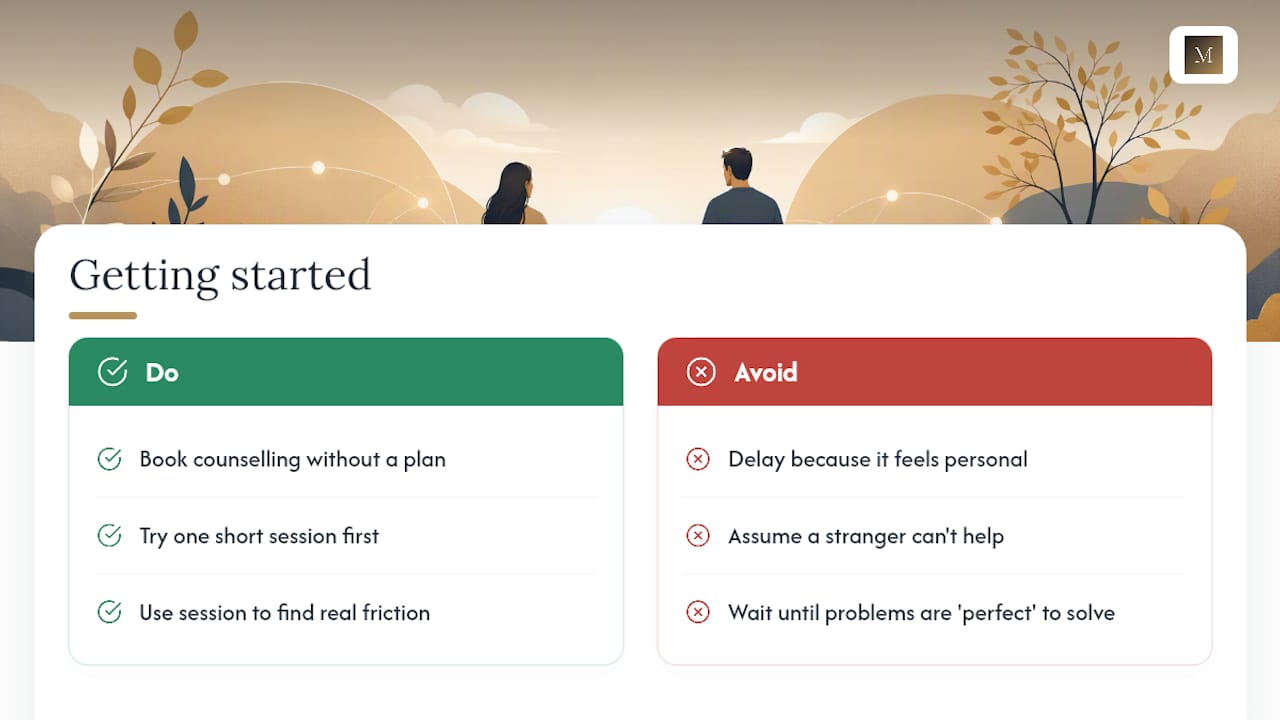
Most parents delay counselling far longer than they need to, usually because the conflict feels too personal to hand over to a stranger. It rarely is. One short session is often enough to see where the real friction sits and what a workable next step looks like.
You don't need to have a plan before you book. That's what the first session is for.
Book a matched co-parenting therapist through Mind a Porter
This platform provides access to therapists who specialise in co-parenting, rather than general counsellors. You can choose based on modality, language, and availability, with sessions available online or in person depending on your needs.

Getting started typically involves a discovery call rather than a lengthy intake process. From there, clients can move into sessions with a therapist matched to their situation, for example using CBT or systemic approaches. Fees vary by therapist, so discussing costs during the initial call is recommended. If you're ready to stop managing handovers on your own, book a consultation with Mind a Porter and get matched with a co-parenting specialist this week.
You can read more about family therapy in London and how sessions are structured.
Sources
For written guidance alongside counselling, Cafcass's parenting plan resource offers a practical template parents can adapt themselves. The Parenting Apart Programme is worth reading if your case involves any court contact, since it explains how structured conflict-reduction interventions interface with legal processes.
- Cafcass — parenting plan guidance
- Co-Parenting Counselors: What They Do, Cost & How to Find One — Co-Parenting Guide
- Co‑Parenting Counseling: Deciding To Go & Preparing — Custody X Change
- Effective communication guidelines for co‑parenting after separation — Kiddra Pinet
FAQ
What are the signs of a toxic co-parent, and how do I deal with them?
Warning signs include constant blame, refusal to compromise on routines, or using the child to pass hostile messages. Co-parenting counselling helps by teaching neutral scripts and boundaries, but if one parent won't engage at all, parallel parenting or individual coaching may protect you and your child better.
What does the 7-7-7 rule of parenting mean?
The 7-7-7 rule generally refers to a custody schedule alternating equal blocks of time between parents, though definitions vary by family and jurisdiction. It's a scheduling pattern, not a therapeutic framework, so check with a family law professional for how it applies to your arrangement.
Is there therapy specifically for co-parenting?
Yes. Co-parenting counselling is a distinct form of therapy focused on communication and conflict reduction between separated parents, separate from mediation or couples therapy. Mind a Porter matches parents to therapists experienced in this exact area, working across CBT, EMDR, and systemic approaches.
What are some tips for co-parenting effectively?
Keep handover communication brief and logistical, use shared calendars, and avoid discussing anything unrelated to the children during exchanges. A short written parenting plan covering routines, holidays, and decision-making rules, similar to what Cafcass recommends, reduces day-to-day friction significantly.
Next Step
Reading is a start. Talking is the next step.
Tell us what you are looking for and we will match you with a qualified therapist who fits. Online across the UK, or in person in London.
Professional Support
Find the Right Therapy
Explore specialist treatment options related to this article.
Keep Reading
Related Articles

Therapy and Medication Together: Why the Combination Often Works Better
Many people recovering from depression or anxiety find that therapy and medication work better as a pair than either does alone. Here's what the evidence says, and how to make the combination work for you.

How long does therapy take to work? A realistic timeline
The first change usually arrives in weeks three to six, but a full course runs longer. What the timeline really looks like, week by week.

Grief Counselling Options in the UK: How to Choose
Navigate the UK's bereavement support landscape by comparing costs, accessibility, and types of care to find the right therapeutic path for your specific needs.