
CBT for depression: does it work, and how do you start?
Discover how CBT effectively combats depression through evidence-based techniques and learn practical steps to access the right treatment for your specific needs.

Clinically reviewed by
Dr Martina Paglia
Founder & CEO of Mind a Porter
HCPC-registered Clinical Psychologist
Special interests include anxiety, depression, trauma, OCD, burnout, workplace stress, relationship difficulties and high-performance mental wellbeing.
Last reviewed: 7 November 2026
All health information on Mind a Porter is clinically reviewed by our clinical lead. These resources are educational and do not replace professional advice.
Yes. Cognitive behavioural therapy is an evidence-based treatment that reduces depressive symptoms and, for many people, keeps them from coming back. The largest meta-analysis on record, covering 409 trials and 52,702 patients, found a moderate-to-large effect against control conditions, with benefits still measurable at 6 to 12 months after treatment ends. That durability matters more than the initial improvement. A treatment that works for six weeks and fades is very different from one that changes how you respond to setbacks long after therapy finishes.
Statistic callout: The 409-trial meta-analysis found CBT's effect size against control was g = 0.79, a moderate-to-large result that held steady at 6 to 12 month follow-up.
If you're dealing with depression right now, here's where to start:
- In crisis: contact emergency services or a crisis line immediately; CBT is not a substitute for urgent care.
- Mild to moderate symptoms: NHS self-referral to talking therapies is usually the fastest route.
- Moderate to severe symptoms: ask your GP about combined CBT and medication.
- Want more control over therapist choice, language or specialism: private or platform-based routes, including Mind a Porter, remove the waiting list altogether.
Key takeaways
CBT is a well-evidenced, structured treatment for depression that works through changing thought patterns and behaviour, and its benefits typically persist well beyond the end of therapy.
| Point | Details |
|---|---|
| Strong evidence base | A 409-trial meta-analysis found a moderate-to-large effect (g = 0.79) that held at 6 to 12 months. |
| Severity guides format | Group CBT suits less severe depression; combined CBT plus medication suits more severe cases. |
| Homework drives results | Practising thought records and activity scheduling between sessions predicts stronger outcomes. |
| Access routes vary | NHS self-referral is free but can involve waiting; private and platform routes offer faster, tailored matching. |
| Mind a Porter offers immediate access | Its no-waiting-list model matches clients to CBT-trained therapists by language, culture and specialism. |
Table of Contents
- What does the evidence say about cognitive behavioural therapy for depression?
- How does CBT actually change depressive thinking?
- Is CBT enough on its own, or do you need medication too?
- What formats does CBT come in, and how do you access it?
- What actually happens in a CBT session?
- What CBT exercises can you try before your first session?
- When is CBT not enough, and where do you get urgent help?
- How can Mind a Porter help you start CBT without delay?
- The gap between the research and the therapy room
- Ready to start CBT without the wait?
- Frequently asked questions
- Sources
What does the evidence say about cognitive behavioural therapy for depression?
The scale of research behind CBT for depression is unusual for a talking therapy. Most psychological treatments have a handful of decent trials behind them. CBT has hundreds.
The 409-trial meta-analysis is the single most cited piece of evidence, and it's worth understanding why it carries weight. Pooling 52,702 patients smooths out the noise you'd get from any one small study, whether that's an unusually motivated sample or a therapist having a good year. The result, an effect size of g = 0.79 against control conditions, sits in the moderate-to-large range by conventional standards. What stands out more is persistence: the improvement was still detectable at the 6 to 12 month mark, long after sessions had stopped.
A separate, even larger network meta-analysis of 676 randomised controlled trials, spanning 105,477 participants, adds a layer of nuance the single-treatment studies can't offer. It compared psychological, pharmacological, physical and combined treatments head-to-head rather than each against a placebo in isolation. Two findings stand out:
- Group CBT performed strongly against treatment as usual for people with less severe depression.
- For more severe depression, combining individual CBT with an antidepressant outperformed most single treatments on their own.
Statistic callout: The network meta-analysis of 676 trials found combined individual CBT plus an antidepressant was among the most effective treatment classes for more severe depression.
None of this means CBT works identically for everyone. Evidence at population scale tells you what happens on average across thousands of people, not what will happen to you specifically. Your response depends on symptom severity, how consistently you attend sessions, whether you practise the skills between them, and whether other conditions, such as anxiety or a physical health problem, are also in play. The component-level analysis of CBT delivery formats found that even the format you receive it in, individual, group, or computerised, shifts the odds somewhat. Treat the headline numbers as strong grounds for trying CBT, not a guarantee of a specific outcome.
How does CBT actually change depressive thinking?

CBT rests on a simple but powerful idea developed by Aaron Beck: your thoughts, feelings and behaviours constantly feed into one another, and depression often takes hold through cognitive distortions, patterns of thinking that distort reality in a consistently negative direction. Catastrophising a minor setback, assuming the worst about how others see you, or discounting anything positive that happens to you are all common examples. Left unchallenged, these thoughts lower mood, mood lowers activity, and reduced activity generates more negative thoughts. The cycle feeds itself.
A CBT therapist works with you to interrupt that loop using a defined set of techniques:
- Cognitive restructuring — identifying automatic negative thoughts and testing them against actual evidence, rather than accepting them as fact.
- Behavioural activation — deliberately scheduling activities that used to bring meaning or pleasure, even before motivation returns.
- Activity scheduling — planning the day or week in advance to counter the inertia depression creates.
- Structured problem solving — breaking overwhelming problems into smaller, actionable steps.
- Behavioural experiments — testing a feared prediction in real life to see whether it actually holds up.
This isn't a passive process. The clinical overview from StatPearls describes CBT as fundamentally collaborative: the therapist doesn't tell you what to think, they help you examine your own thinking and design experiments to test it. Homework between sessions, whether that's a thought record or a scheduled walk, is where the real work happens, and consistent practice between sessions is one of the strongest predictors of good outcomes.
Pro Tip: Treat CBT homework the way you'd treat physiotherapy exercises. Skipping them doesn't just slow progress, it often stalls it entirely, because the skills only take hold with repetition outside the therapy room.
Is CBT enough on its own, or do you need medication too?
The honest answer depends on severity, and the evidence is reasonably clear about where the line sits.
For mild to moderate depression, CBT alone, particularly group CBT, has shown strong results against treatment as usual in the 676-trial network meta-analysis. Many people in this category do not need medication to see meaningful improvement.
For more severe depression, the picture shifts. Combined treatment analyses show that pairing individual CBT with an antidepressant tends to produce a stronger effect than either approach alone. This isn't a failure of CBT, it reflects that more severe depression often benefits from tackling the biological and cognitive sides of the illness at once.
A few situations tend to call for specialist or combined input rather than CBT alone:
- Marked functional impairment, such as being unable to work, care for yourself, or maintain basic routines.
- Perinatal depression, where timing, safety and medication considerations need specialist oversight.
- Chronic or treatment-resistant depression that hasn't responded to a first course of therapy.
- Any presence of suicidal thoughts, which always warrants an urgent conversation with a GP or psychiatrist, regardless of how mild the depression otherwise seems.
If you're unsure which category you fall into, that uncertainty is itself a reason to speak with a GP before choosing a route. Severity assessment isn't something to guess at from a symptom checklist.
What formats does CBT come in, and how do you access it?
CBT isn't a single fixed format. That flexibility is part of why it's so widely available.
Delivery formats:
- Individual face-to-face — the traditional model, one therapist, one client, weekly sessions.
- Group CBT — several patients working through similar material together, often effective for less severe depression.
- Guided self-help — structured workbooks or programmes with light-touch therapist support.
- Computerised CBT — software-delivered modules, with or without a supporting practitioner.
- Hybrid/online delivery — live video sessions replacing in-person appointments, often with identical structure and content.
The component-level meta-analysis found that delivery mode genuinely affects outcomes, though well-supported digital and hybrid formats can approach face-to-face effectiveness when a therapist remains involved. A practical guide to online depression treatment covers what to expect from a fully digital course if you're weighing that option.
Access routes, roughly in order of speed:
- NHS self-referral to talking therapies — no GP appointment required in most areas, though waiting lists vary regionally.
- GP referral — necessary for more complex cases or referral to secondary mental health services.
- Private practice or therapy-matching platforms — faster access, more control over therapist specialism, language and cultural fit, usually at a cost.
Waiting time is the main trade-off with NHS routes. Cost and accreditation checks are the main trade-off with private ones.
What actually happens in a CBT session?
The structure is more predictable than most people expect, and that predictability is deliberate.
- Initial assessment. The first session, or sessions, focus on understanding your symptoms, history and goals. This builds a shared formulation, essentially a working theory of what's maintaining your depression.
- Session structure. Most sessions follow a consistent shape: reviewing the week, setting an agenda, working through a specific technique or problem, and agreeing homework for the following week.
- Skills practice. Expect active work within sessions, not passive listening, testing a thought, planning an activity, rehearsing a response to a difficult situation.
- Homework review. Nearly every session opens by checking how the previous week's homework went, since consistent practice between sessions predicts stronger outcomes.
- Course length. Low-intensity guided self-help often runs a shorter planned course with regular check-ins, while high-intensity individual CBT commonly runs 12 to 20 sessions, occasionally more for complex presentations.
- Booster sessions. Some patients return for occasional top-up sessions months after finishing, specifically to reinforce relapse-prevention skills.
Knowing this structure in advance helps. A lot of early dropout in therapy comes from people expecting something looser and unstructured, then feeling wrong-footed by how active and homework-driven CBT actually is.
What CBT exercises can you try before your first session?
You don't need a therapist in the room to start practising the basics, and doing so often makes your first proper session more productive.
- Thought record. When you notice a strong negative emotion, write down the situation, the automatic thought, the emotion it triggered, and one piece of evidence that contradicts the thought.
- Activity scheduling. Plan one small, achievable activity each day, ideally something that used to bring some enjoyment or sense of accomplishment, even if motivation is low beforehand.
- Simple problem solving. Write the problem in one sentence, list three possible actions, pick the smallest workable one, and set a date to review how it went.
Aim for short, frequent practice rather than long, occasional sessions, five minutes daily beats an hour once a week for building these habits.
Pro Tip: Keep your thought record somewhere you'll actually see it again, a notes app you open daily works better than a notebook that stays in a drawer.
Safety note: if any exercise increases suicidal thoughts, self-harm urges, or significant distress, stop immediately and contact a GP, crisis line, or emergency services. These techniques are a supplement to professional care, not a substitute for it when risk is present.
When is CBT not enough, and where do you get urgent help?
CBT has real limits, and recognising them matters as much as knowing its strengths.
It is not designed to manage active suicidal intent, psychosis, or severe substance dependence on its own, these situations need urgent medical assessment first. Some short-term discomfort is a normal part of confronting entrenched negative thoughts; feeling worse before you feel better happens to many patients and doesn't mean the therapy has failed.
Statistic callout: The 409-trial meta-analysis found CBT's effects held at 6 to 12 months, but that data reflects average trial populations, not cases involving acute crisis, which always need immediate care rather than a course of therapy.
Watch for these warning signs and act on them straight away:
- Thoughts of suicide or self-harm, however fleeting.
- A sudden worsening of mood or hopelessness rather than gradual improvement.
- Inability to function in daily life, work, or relationships.
- Any sign of psychosis, such as hearing voices or losing touch with reality.
If any of these apply, contact your GP urgently, call emergency services, or reach a crisis line immediately. Don't wait for a scheduled therapy appointment.
How can Mind a Porter help you start CBT without delay?
Waiting lists are the single biggest barrier between deciding to try CBT and actually starting it. Mind a Porter removes that barrier with a no-waiting-list approach, matching you directly with a qualified therapist rather than adding your name to a queue.
The platform gives you more than speed. Matching considers specialism, language, and cultural background, factors that materially affect how comfortable and understood you feel in therapy, alongside straightforward booking and insurance options.
- No waiting list, therapist matching begins as soon as you register.
- Access to CBT, EMDR and other modalities depending on your needs.
- Matching by specialism, language and cultural fit across 22+ languages.
- Options for insurance-based payment alongside private booking.
Clients report a 98% satisfaction rate across more than 13,717 sessions delivered through the platform, a reflection of how closely therapist matching aligns with what clients actually need.
Booking starts with a short intake covering your goals and preferences, followed by a first session structured much like the assessment described earlier in this guide.
The gap between the research and the therapy room
The strongest evidence for CBT is also the least talked about, its durability. Most public conversation about depression treatment fixates on whether something works right now, not whether it still works a year later. The 409-trial meta-analysis answers that second question, and it's the more important one.
Where conventional advice falls short is in treating CBT as a single, uniform product. It isn't. Group CBT, individual CBT, computerised CBT and combined medication routes behave differently depending on severity, and pretending one size fits all does readers a disservice. The evidence supports matching the format to the person, not defaulting to whichever option is easiest to find.
If there's one thing readers should prioritise first, it's this: start the low-effort techniques, thought records, activity scheduling, immediately, without waiting for a first appointment. The research is consistent that consistent practice, not the format of delivery, does much of the heavy lifting.
Ready to start CBT without the wait?
Mind a Porter is the direct alternative to sitting on an NHS waiting list or scrolling through generic directories hoping a therapist's specialism matches yours. Every therapist on the platform is matched to you by specialism, language and cultural background, and there's no queue standing between you and a first session.
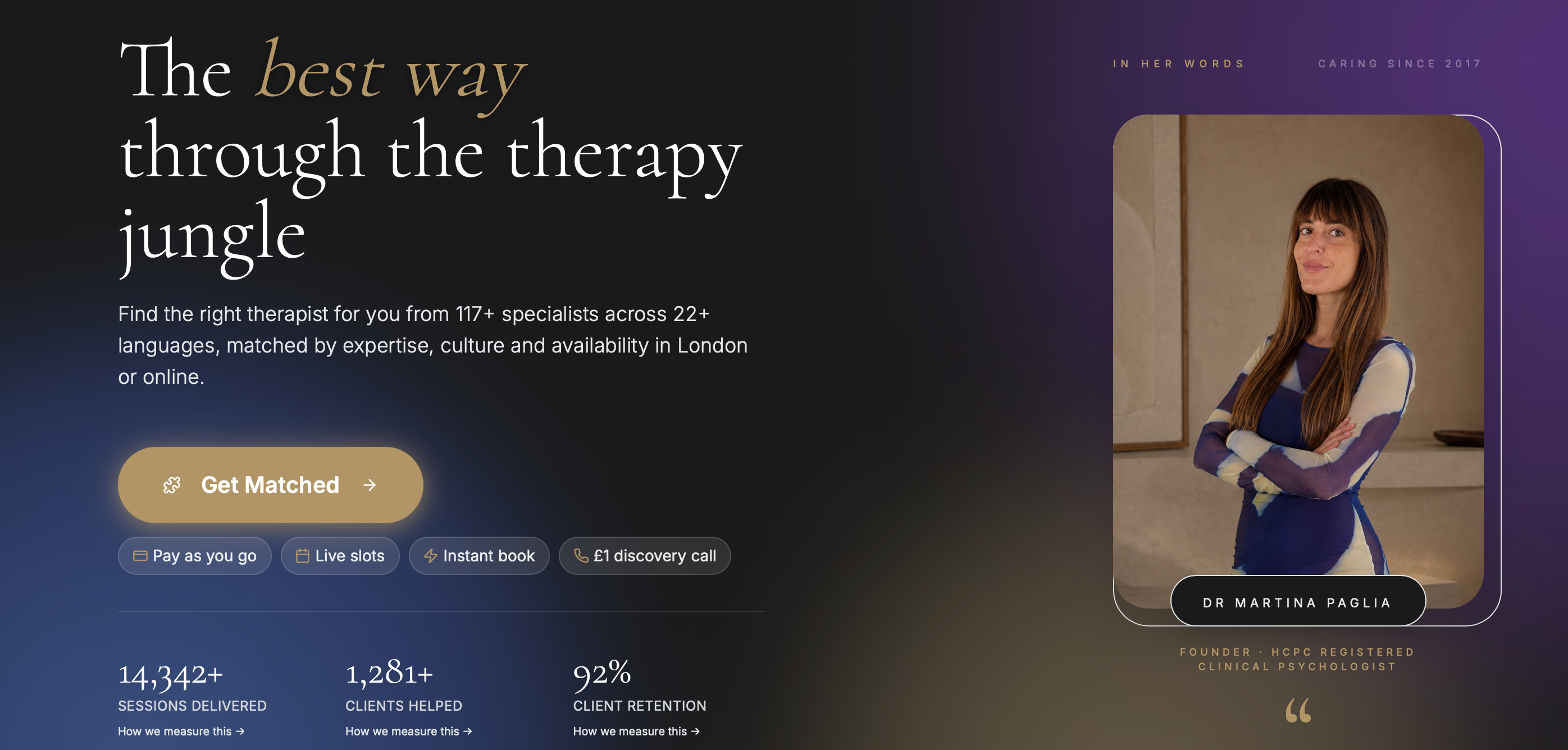
Rather than choosing between speed and fit, you get both: CBT-trained therapists available now, with insurance and private payment options built in. If severity or comorbidities mean combined care with a GP or psychiatrist makes more sense, the matching process accounts for that too, connecting you with a therapist suited to working alongside your wider care.
Visit Mind a Porter to complete a short intake and get matched with a CBT therapist without joining a waiting list.
Frequently asked questions
Is CBT good for depression, or is medication more effective? For mild to moderate depression, CBT alone performs strongly. For more severe depression, combining CBT with an antidepressant tends to outperform either treatment on its own.
How many sessions of CBT does depression usually need? High-intensity individual CBT commonly runs 12 to 20 sessions, while low-intensity guided self-help often follows a shorter course with regular reviews.
Can CBT help with social anxiety or anger alongside depression? Yes. CBT for social anxiety and CBT for anger share the same core techniques, cognitive restructuring and behavioural experiments, adapted to the specific triggers involved, and these conditions frequently co-occur with depression.
What is trauma focused CBT? Trauma focused CBT (often shortened to TF CBT) adapts standard cognitive behavioural techniques specifically for processing traumatic memories, and it's typically delivered by therapists with additional trauma-specific training.
Does CBT work for OCD and perfectionism as well as depression? CBT for OCD usually incorporates exposure-based techniques alongside standard cognitive work, while CBT for perfectionism focuses on challenging rigid, all-or-nothing thinking patterns, both drawing on the same underlying model used for depression.
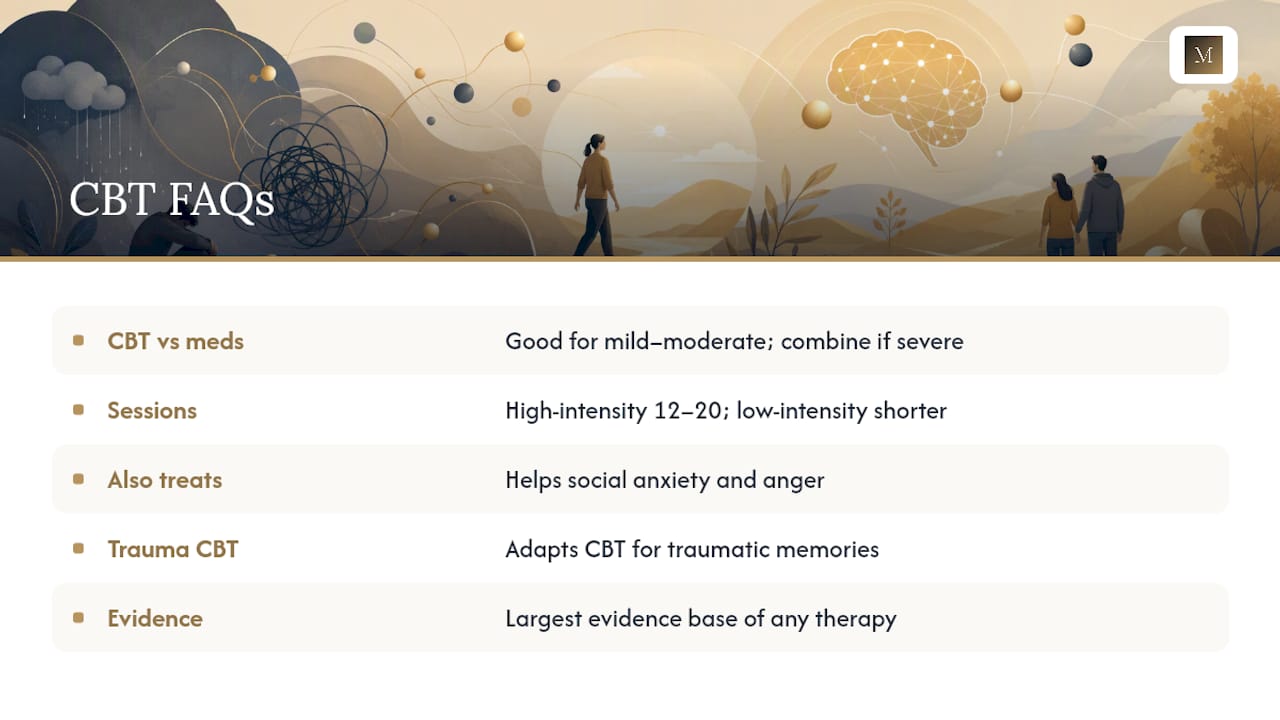
What's the difference between CBT and general depression therapy? Cognitive behavioural therapy is one specific, structured approach within the broader field of depression therapy; other approaches exist, but CBT has the largest evidence base of any single method for this condition.
Sources
- Cognitive behavior therapy vs. control conditions, other psychotherapies, pharmacotherapies and combined treatment for depression: a comprehensive meta-analysis including 409 trials with 52,702 patients
- A systematic review and network meta-analysis of psychological, psychosocial, pharmacological, physical and combined treatments for adults with a new episode of depression
- Cognitive behavioural therapy (CBT) - NHS
- Cognitive Behavior Therapy - StatPearls - NCBI Bookshelf
- A systematic review and component-level network meta-analysis of CBT interventions for depression (PMC)
Next Step
Reading is a start. Talking is the next step.
Tell us what you are looking for and we will match you with a qualified therapist who fits. Online across the UK, or in person in London.
Professional Support
Find the Right Therapy
Explore specialist treatment options related to this article.
Keep Reading
Related Articles

Therapy and Medication Together: Why the Combination Often Works Better
Many people recovering from depression or anxiety find that therapy and medication work better as a pair than either does alone. Here's what the evidence says, and how to make the combination work for you.

How long does therapy take to work? A realistic timeline
The first change usually arrives in weeks three to six, but a full course runs longer. What the timeline really looks like, week by week.

Grief Counselling Options in the UK: How to Choose
Navigate the UK's bereavement support landscape by comparing costs, accessibility, and types of care to find the right therapeutic path for your specific needs.